A dump bin display is an open, bin-shaped unit that holds product loose or in bulk. Shoppers reach in and take one, with nothing to unpack and no shelf to keep tidy. Brands use dump bins for impulse lines, promotions, launches and end-of-season clearance, placed at the entrance, along the main aisle or next to the till.
At Euromon PLV we design and manufacture custom dump bin displays in Barcelona and ship them worldwide. The pieces in the photos are ours: cardboard bins for DIY brands like Sika, Tangit and Pattex, and clear bowls for pharmacy brands like Neutrogena and Sante Verte. If you already have a campaign in mind, request a quote and tell us about the product.
What is a dump bin display
A dump bin is the simplest way to put a lot of one product in front of shoppers. It has no shelves and no hooks. The product goes in loose, or in its own small boxes, and the pile does the selling: a full bin reads as an offer and gives people a reason to stop and pick one up. You will also see them called bulk bins, or written as dumpbins.
What sets it apart from a floor display with shelves is that nobody faces the product. A shelved unit shows a range, each reference in its place, and someone in the store has to keep it in order. A dump bin usually carries one or two references and only needs refilling. That is why it works best with:
- Small, sturdy products that come to no harm in a pile, like sweets, snacks, lip balm, sachets, adhesive tubs or cartridges.
- Packaging that explains itself, because the shopper sees it from above and at an angle.
- One price or one offer, with the message on the header or on the front of the bin.
- Short campaigns where the goal is to move volume in a few weeks.
Types of dump bin display
The shape changes a lot from one project to the next. These are the formats we make most often.
Floor and pallet bins
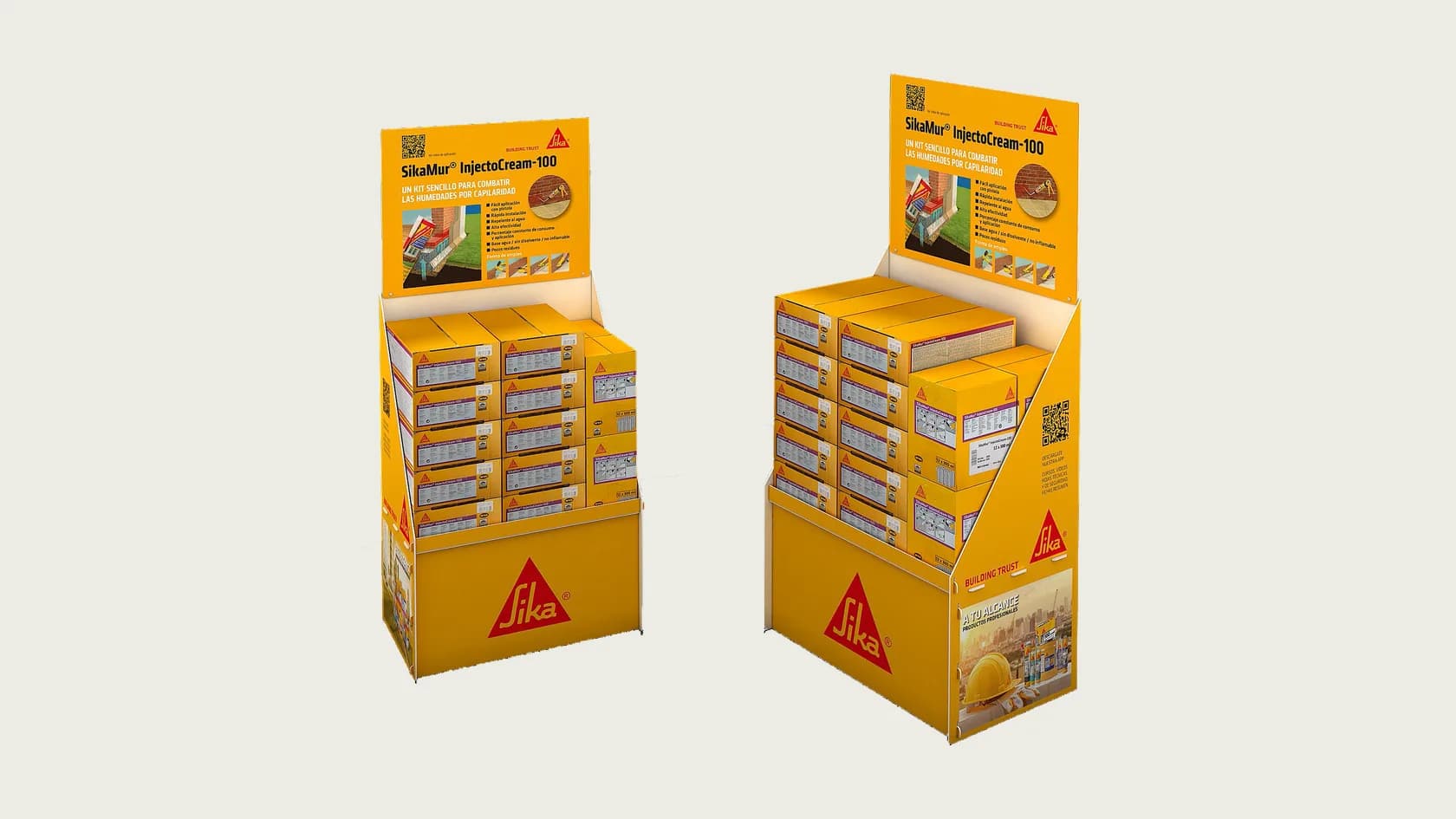
The classic dump bin stands on the floor, with a deep open bin at the base and a header above it with the brand and the message. The Sika SikaMur InjectoCream-100 unit in the cover photo works that way. The boxed kits sit in the bin, the tall front carries the Sika triangle and the header explains the product step by step, with a QR code that opens the application video. On a pallet base the same idea grows into a full promotional unit for a hypermarket or a DIY aisle, which we cover in our post on cardboard displays for tool manufacturers.
Die-cut bins
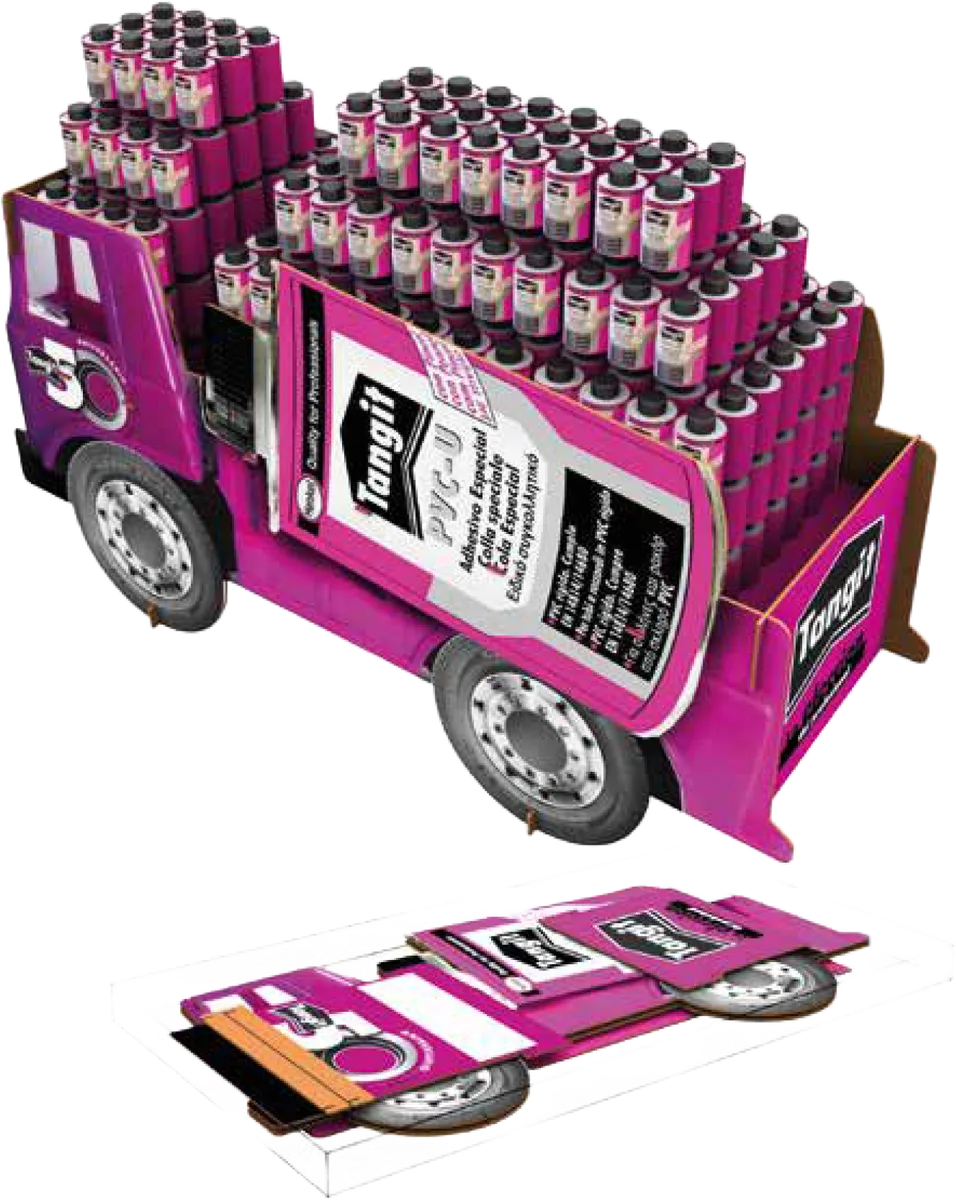
A bin does not have to look like a box. The Tangit PVC-U unit is cut and printed as a pink delivery truck, with the cab, the wheels and the logo on the side, and its load is the product itself, rows of adhesive tubs standing in the back. It ships folded flat in its own box and is assembled on site.
Tiered and divided bins
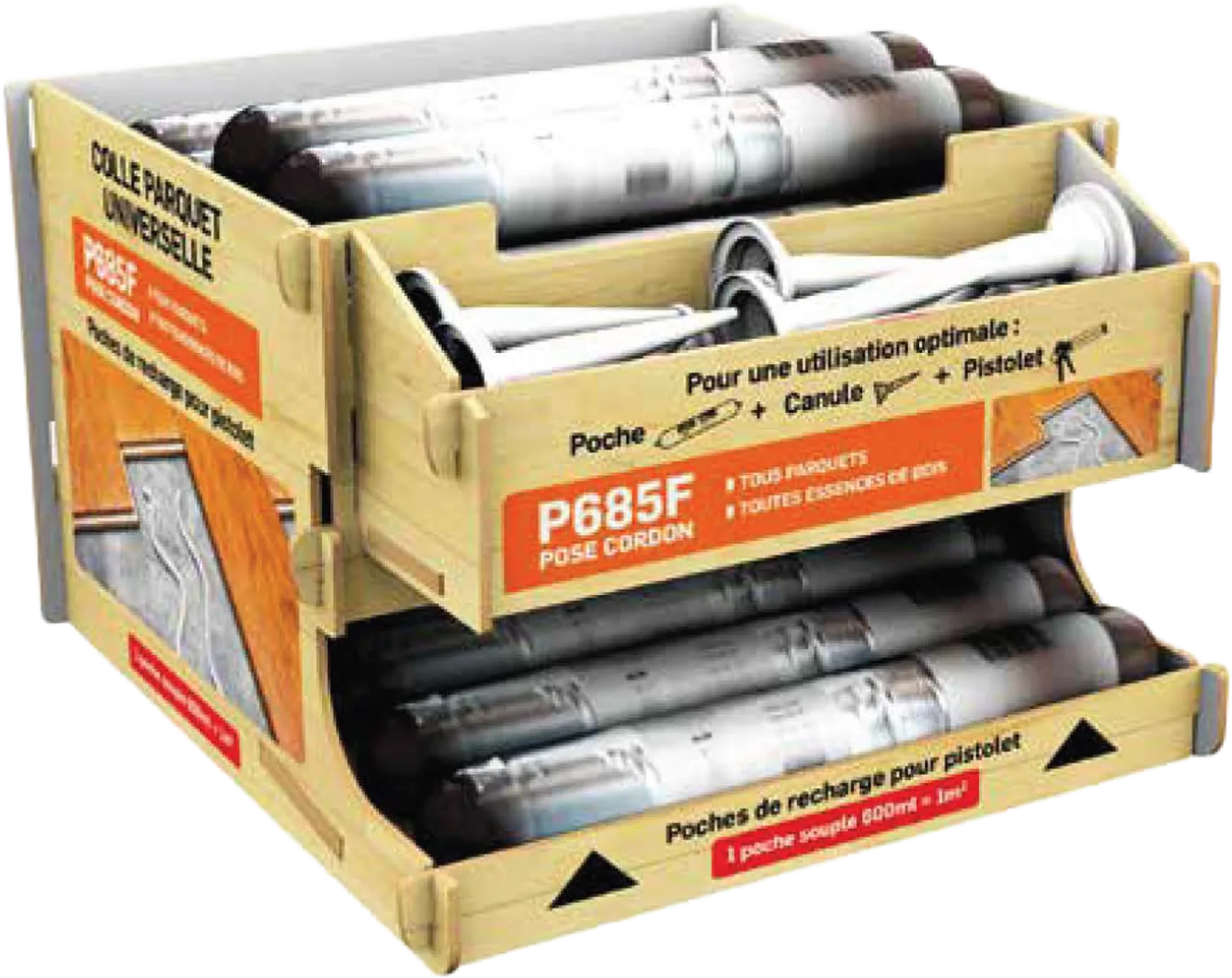
When a brand wants to sell two or three versions of a product from the same unit, the bin is split into levels. The Pattex P685F parquet adhesive unit has two tiers of bins with the refill pouches lying down, so the shopper sees the whole length of each one, and it is printed to look like a wooden crate. The graphics are in French, for that market. The same approach works with dividers inside one bin, to keep flavours, colours or sizes apart.
Counter bowls
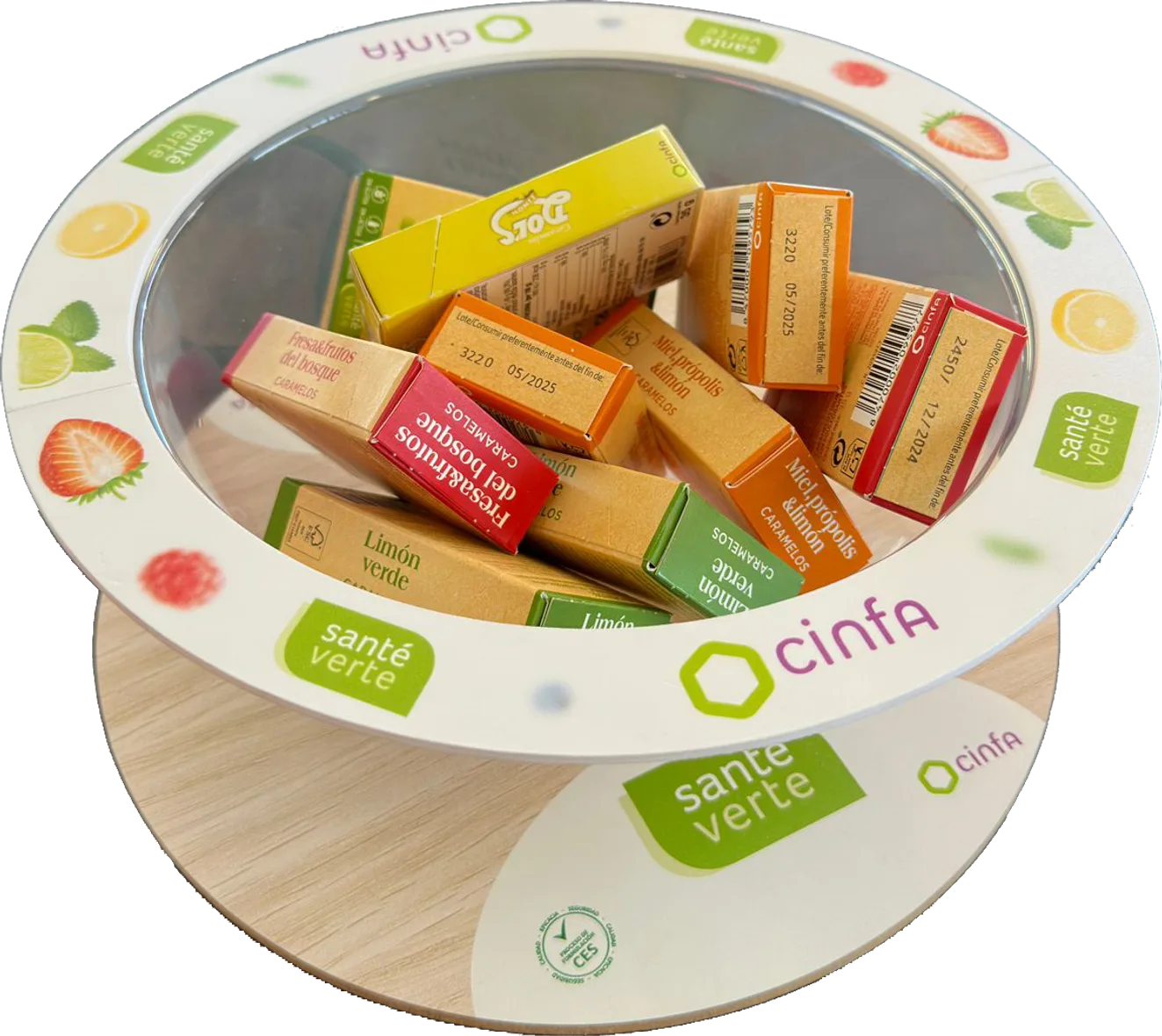
On a pharmacy or perfumery counter there is room for one small piece, and a clear bowl is often the answer. The bowl we made for Sante Verte and Cinfa holds boxes of sweets thrown in loose, with a printed ring on the rim that carries the fruit flavours and both logos. The product is in plain sight and within the pharmacist's reach, which matters for small items that are easy to pocket.
There is more on this format, with the Carmex bowl as an example, in our post on pharmacy counter displays.
Floor-standing bowls
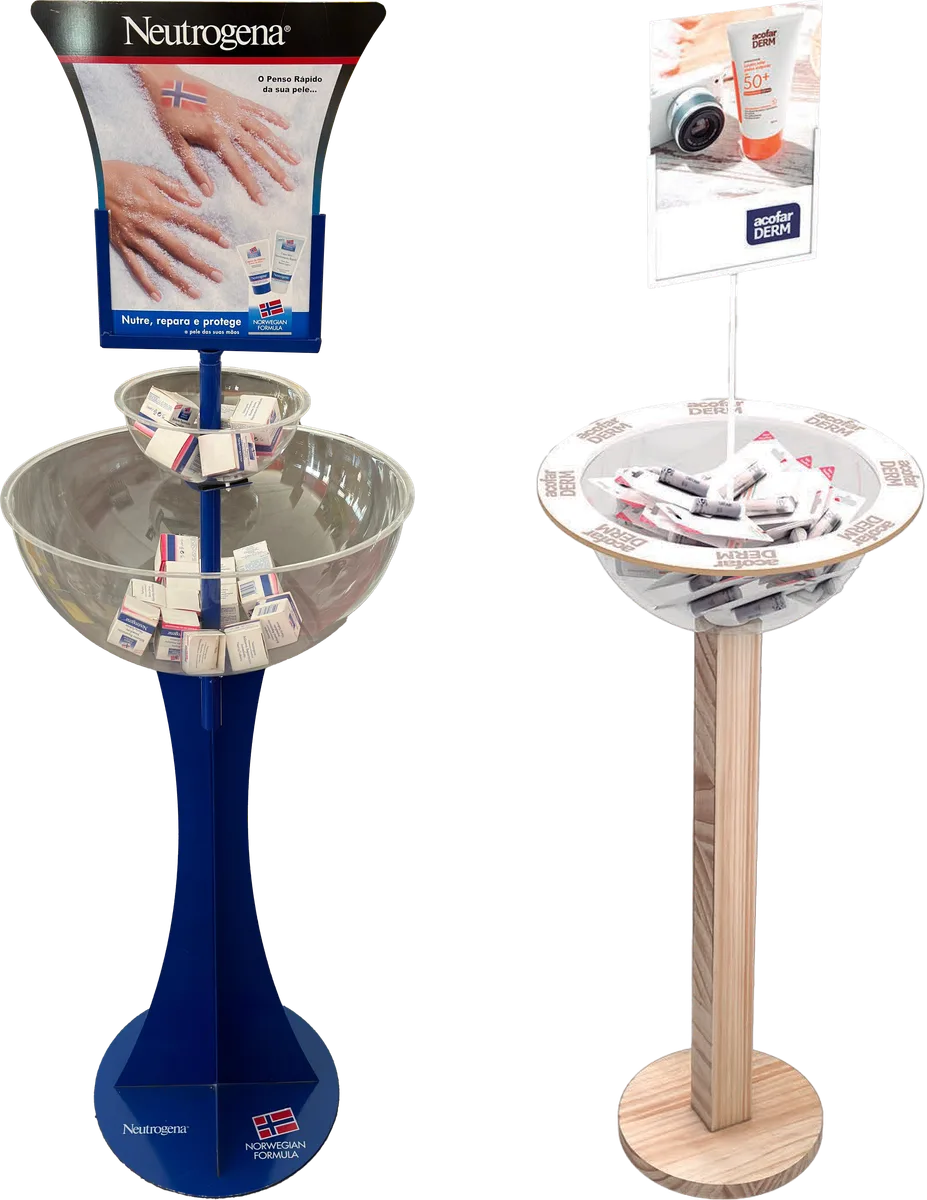
Put the bowl on a post and it becomes a floor unit that fits in a narrow aisle. The Neutrogena Norwegian Formula stand has two clear bowls stacked on one column, loaded with boxes of hand cream, under a header with the campaign photo and a Portuguese claim. The acofar DERM one has a single bowl of sun cream sachets and a sign holder on a rod, so the poster can change with the season while the stand stays.
Dump bin materials
The material decides how long the bin lasts, how it travels and what it costs. Most dump bins are made in one of three.
| Material | Best for | Life in store |
|---|---|---|
| Cardboard | Launches, promotions and seasonal campaigns, with graphics on every face | Weeks or a few months |
| Wire | Heavy product and permanent spots that are refilled again and again | Years |
| Clear acrylic or PET | Small, colourful items on a counter or on a floor stand | Years |
Cardboard is the usual choice for a campaign. The whole bin is a print surface, it can be die-cut into almost any shape and it travels flat, which keeps freight down when the same bin goes to hundreds of stores. Our page on cardboard displays has the details. On sustainability, display board is usually laminated to survive in store, so it is harder to recycle than an MDF, wood or metal unit. Its real environmental advantage is its weight and flat-pack shipping.
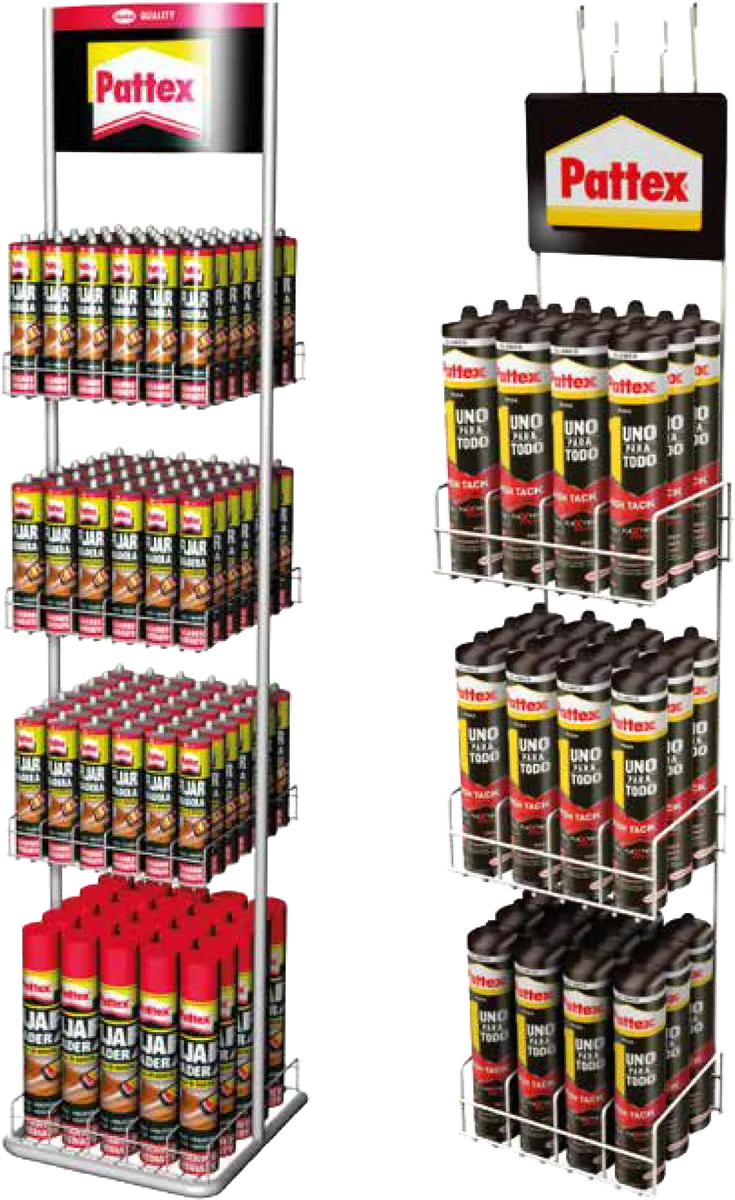
Wire is for bins that stay. A wire basket takes the weight of cartridges, cans or bottles and keeps the product visible from every side. The two Pattex units below are both wire, a floor tower on two posts with four baskets and three baskets that hang from an upright. Our metal displays page shows more permanent formats.
Clear acrylic or PET lets the product be the display, which is why bowls work so well for small, colourful items. The bowl usually carries a printed ring on the rim and stands on a base or a post, as in the Sante Verte and acofar DERM pieces above. There are more options on our plastic and acrylic displays page.
If the bin has to stay in the store for years, go for wire or acrylic. If it has to reach many stores for a few weeks, go for cardboard.
Custom options
Almost everything on a dump bin is designed around your product and your campaign.
- Print on every face. In cardboard the bin, the front and the header are all graphics, printed edge to edge.
- A header with the brand, the offer or the instructions, like the step-by-step panel on the Sika unit. On a permanent bin the header or the poster can be swapped for each campaign while the structure stays.
- A die-cut shape, from a curved front to a whole truck like the Tangit one.
- Tiers and compartments to separate versions, flavours or sizes in the same unit.
- Sized to the product. The depth, the opening and the height of the walls come from the size and weight of what goes inside, and we check them on a prototype loaded with real stock.
- Flat-packed or assembled and loaded. A cardboard bin can travel flat and be assembled in the store without tools, or arrive assembled and loaded with product, ready to place. We compare both options in our post on self-assembling or pre-assembled displays.
Where a dump bin works in store
A dump bin sells because it is in the shopper's way. The usual spots are the store entrance, the main aisle, the end of an aisle and the checkout area, where people slow down and have a hand free. A few things decide whether it keeps selling after the first day.
- Keep it full. A bin that looks half empty looks picked over. Plan the initial load and who refills it, and size the bin for the stock you will really put in it.
- Think about the value of the product. Small, expensive items in an open bin are easy to take. In a pharmacy or a perfumery they work better in a bowl on the counter, in view of the staff.
- Leave room around it. A bin in a narrow aisle gets pushed by the first trolley. A floor-standing bowl takes up much less floor than a box bin.
- Follow the retailer's rules. Chains set the size, the height and sometimes the material of promotional units, and we start the design from those specifications.
In supermarkets a dump bin is often one piece of a bigger plan, as we explain in our post on POS displays for supermarkets.
Dump bin or another display
A dump bin is the right choice for one product and a quick sale. When the brand needs to show a full range, or the shopper has to read each pack, another format does the job better.
| Format | How the product sits | Use it for | Read more |
|---|---|---|---|
| Dump bin | Loose or in small boxes, picked by hand | One or two references, impulse buys, a short promotion | This post |
| Floor display with shelves | Faced, each reference in its place | A range with a planogram | Floor displays |
| Pallet display | Boxes stacked on a pallet base | High volume in hypermarkets and DIY chains | Pallet displays |
| Counter display | Small items in trays or a bowl | The till of a pharmacy, perfumery or hardware store | Counter displays |
You can see every format we make on our page of POP display types.
How we make a dump bin display
- Briefing. The product, its size and weight, how many units go in each bin, where the bin will stand and the date it has to be in store.
- Structure and design. We draw the structure around the product and the graphics around the brand, and send 3D renders for approval.
- Prototype. A sample of the bin, loaded with real product, to check its strength, its depth and how it looks when full.
- Production. Printing, cutting and assembly in Barcelona, under ISO 9001 and ISO 14001 certified management systems. We also hold an EcoVadis Gold rating.
- Delivery. Flat-packed or assembled and loaded, to your warehouse or straight to the stores, anywhere in the world.
How each phase works is in our post on working with a POS display manufacturer in Barcelona, and how long it takes is in our guide to lead times for custom POS display manufacturing. There are more finished projects in our portfolio.
Frequently asked questions
What are dump bins typically used for in retail environments?
Dump bins hold one product loose or in bulk so shoppers can pick it up on impulse. Brands and retailers use them for promotions, new launches, seasonal lines and clearance, and place them at the entrance, along the main aisle, at the end of an aisle or near the checkout. They suit small, sturdy items such as sweets, snacks, lip balm, sachets or adhesive tubs.
What is the difference between a dump bin and a floor display?
A floor display with shelves shows a range, with each reference faced in its own place and someone in the store keeping it tidy. A dump bin has no shelves. It carries one or two references piled loose and only needs refilling. Many dump bins stand on the floor too, so what changes is how the product sits inside.
What materials can a dump bin display be made of?
The most common are cardboard, wire and clear acrylic or PET. Cardboard is for campaigns of weeks or a few months and takes graphics on every face. Wire carries heavy product and lasts for years. Acrylic or PET bowls let the product itself be the display, usually on a base or a post. Some units combine materials, such as a metal frame with printed cardboard panels.
Can I order a custom dump bin display with my branding?
Yes. Every dump bin we make is designed for one brand and one product, with your graphics on the bin, the front and the header, and a die-cut shape if the idea calls for one. To start, tell us the product with its size and weight, how many units go in each bin, where it will stand and the date it has to be in store.
Does a dump bin display arrive assembled or flat-packed?
Either, depending on the design. A cardboard bin usually travels flat and is assembled in the store without tools in a few minutes, which keeps freight and storage down. It can also arrive assembled and loaded with product, ready to place. For wire and acrylic units, which are permanent, the delivery is agreed for each project.
How long does it take to make a custom dump bin display?
It depends on the material, the volume and how quickly the artwork and the prototype are approved. A cardboard bin for a campaign is usually faster to make than a permanent unit in wire or acrylic. For a fixed campaign date we plan backwards from the day it has to be in store. Every phase is broken down in our guide to lead times for custom POS display manufacturing.
Are dump bin displays recyclable?
Not always. Display cardboard is usually laminated to survive in store, which makes it harder to recycle than an MDF, wood or metal unit. Its real advantage is weight and flat-pack shipping, with less volume on every truck. If the bin has to stay in store for years, a wire or acrylic unit that is reused across campaigns is usually the better choice. Our approach is on the eco page.
Planning a dump bin display?
Every dump bin starts with the product. Send us what you want to sell, how much it weighs, where the bin will stand and when the campaign starts, and we will come back with a format, a material and a plan to get it into your stores.