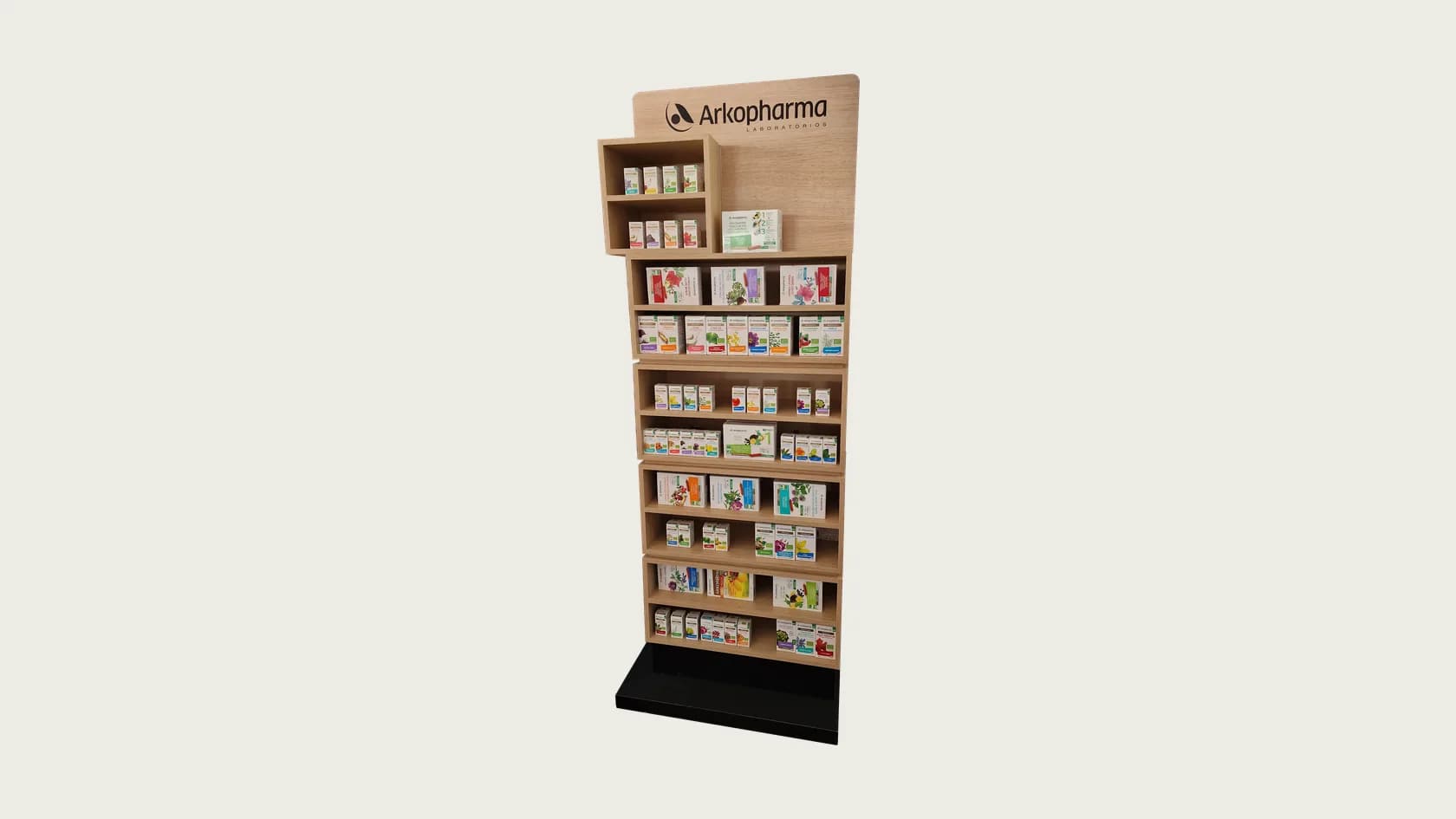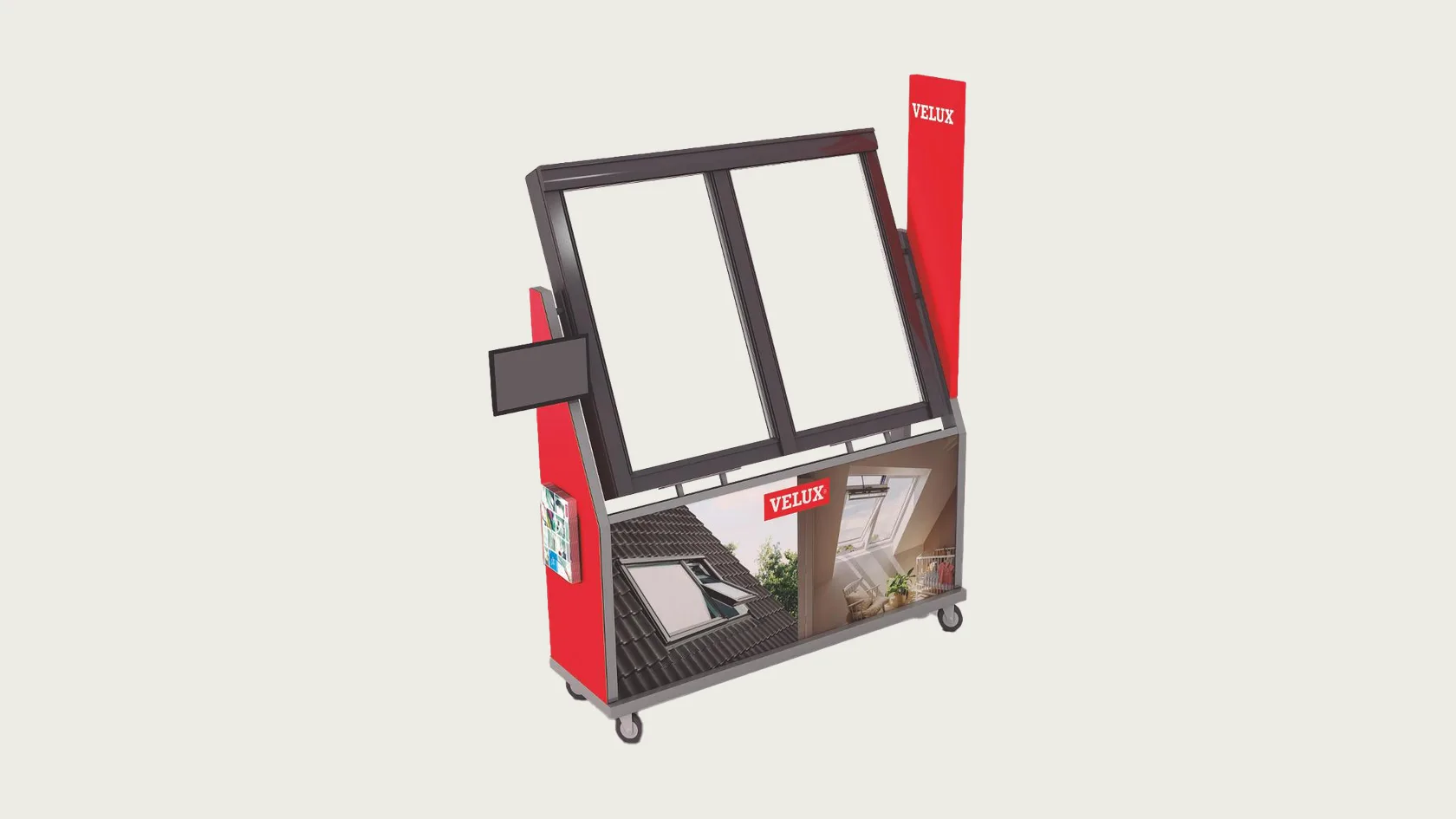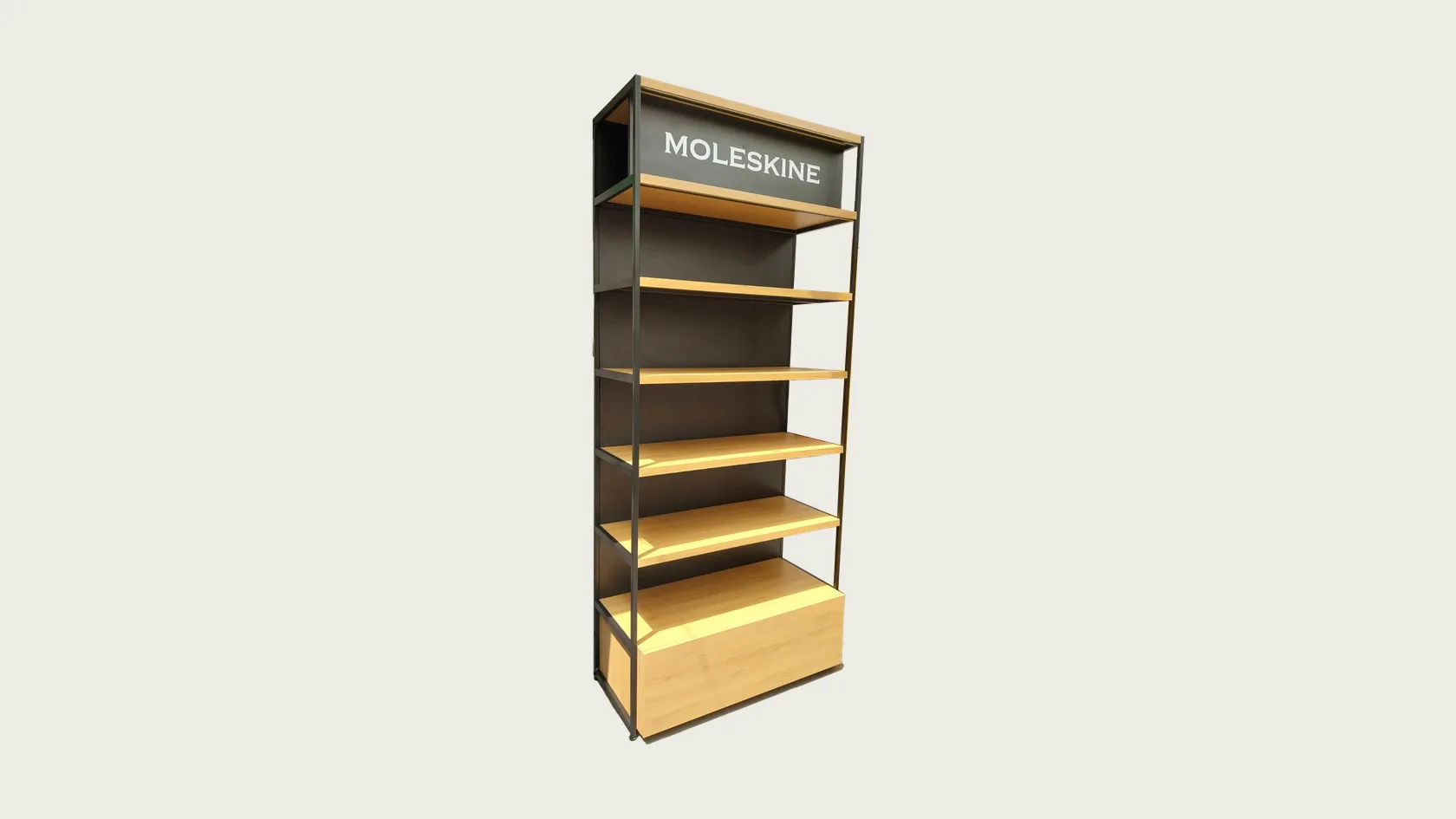
A floor display is the piece of furniture your brand wins outside its shelf space: by the entrance, in the main aisle, on a gondola end or next to the till. It stands straight on the shop floor, holds more stock than a countertop display and can be seen from the far end of the aisle.
It is also the POS display that most often goes wrong when it is ordered on looks alone, because what makes it work rarely shows up in a render.
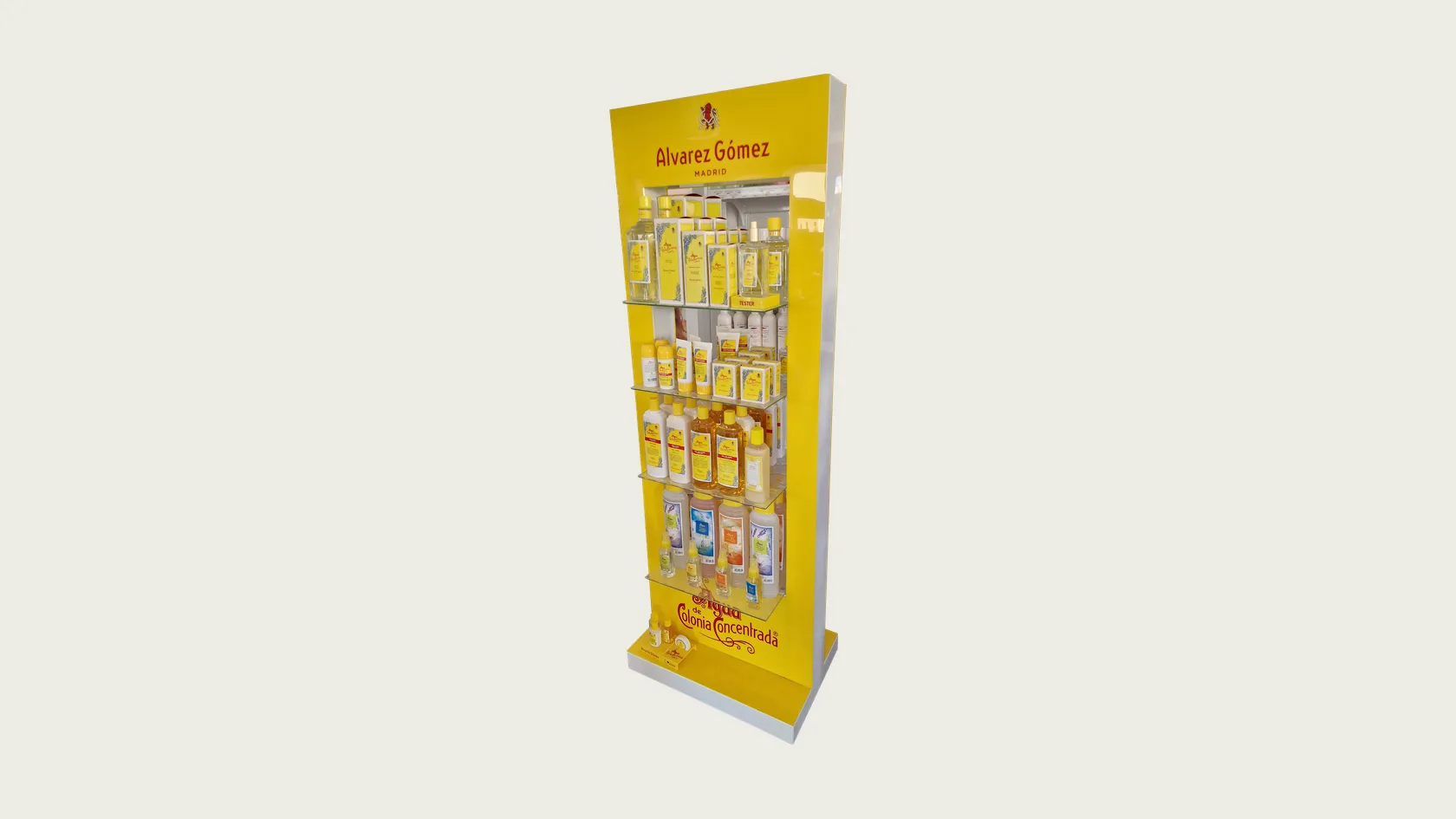
At Euromon PLV we design and manufacture floor displays in every material, for stores all over the world from Barcelona. The Álvarez Gómez unit on the cover, lacquered in yellow with clear shelves for the Agua de Colonia Concentrada range, is one of them. Before we suggest a material we always ask the same things: what it will carry, how long it will stay in the store, which space it goes into and how it gets there. This post takes those questions one at a time, with our own projects.
When a floor display is worth it
It usually pays off in four cases.
- The range does not fit on the shelf. A brand with colognes, shower gels, creams and travel sizes needs several levels to show everything together, and the store gives it a few inches of shelf.
- The product is big or heavy. Tyres, bottles or gift boxes will not fit on a countertop unit.
- You want a spot that is not your shelf. The entrance, the seasonal zone or the end of an aisle, where shoppers have not yet decided what to buy.
- You are launching something. A new product stands out far more in its own unit than among the usual range.
If the product is small and bought on impulse at the till, a countertop display usually works better. We cover it, with sizes, in our post on the pharmacy counter display. And if the store will not give you floor space, what is left is standing out on the shelf itself with shelf-edge displays.
The load decides the structure
The first thing we ask is what goes on the display and how much it weighs fully loaded. A shelf that holds paperboard boxes will not hold glass bottles, and you cannot see that difference in a render.
The trolley we built for Continental makes the point. It carries two decks of car tyres stood on edge, on a steel tube frame with castors so it can be moved while full. With that weight, and with the unit being moved every time the floor is cleaned or the stock topped up, the structure has to be metal.
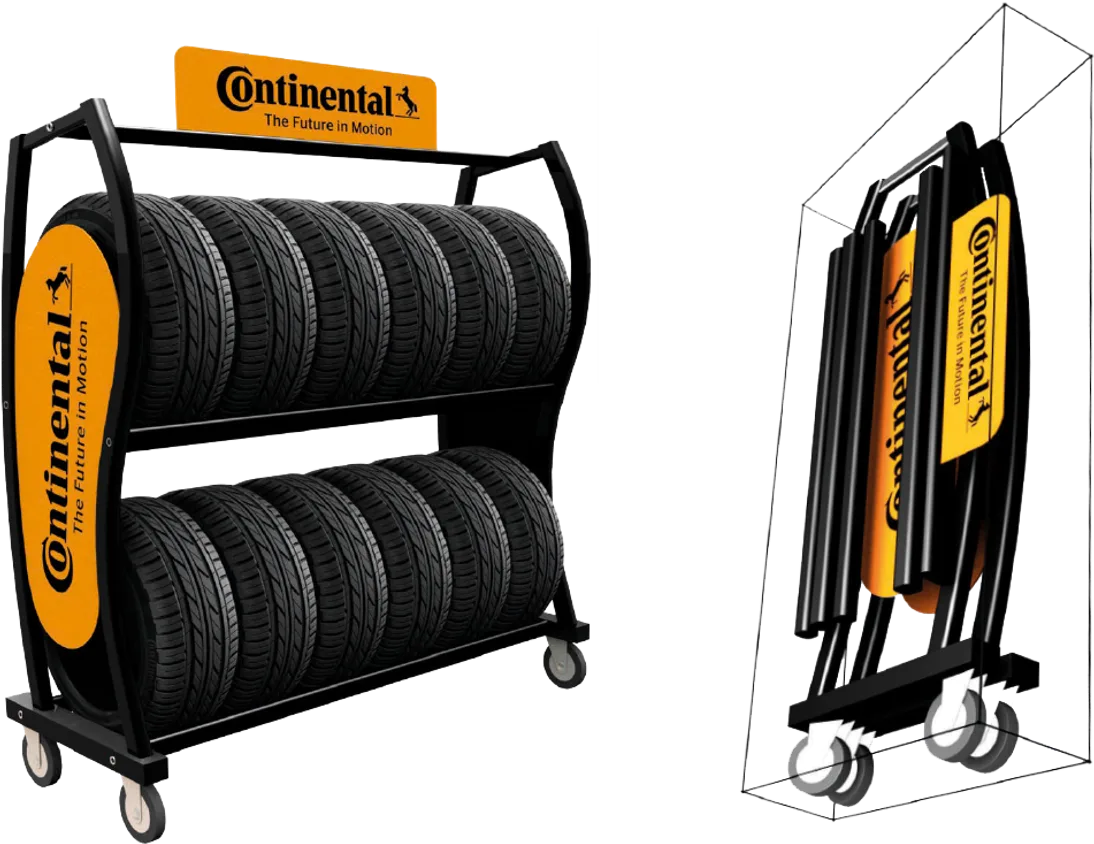
With heavy products we ask for the weight of each SKU and how many units go on each shelf at the first fill, which is when the unit is under most strain. It also matters whether shoppers lift the product from above or pull it out from the front, because that sets the depth and angle of every shelf. And if the unit is going to be moved, castors and brakes go into the design from the first sketch.
How long it will stay in the store
This question separates cardboard from everything else. A cardboard display is the cheapest option for a campaign of a few weeks or a few months, ships flat and can be cleared without leaving a structure behind. A permanent unit in MDF, wood or metal costs more per piece, but lasts for years and pays for itself campaign after campaign.
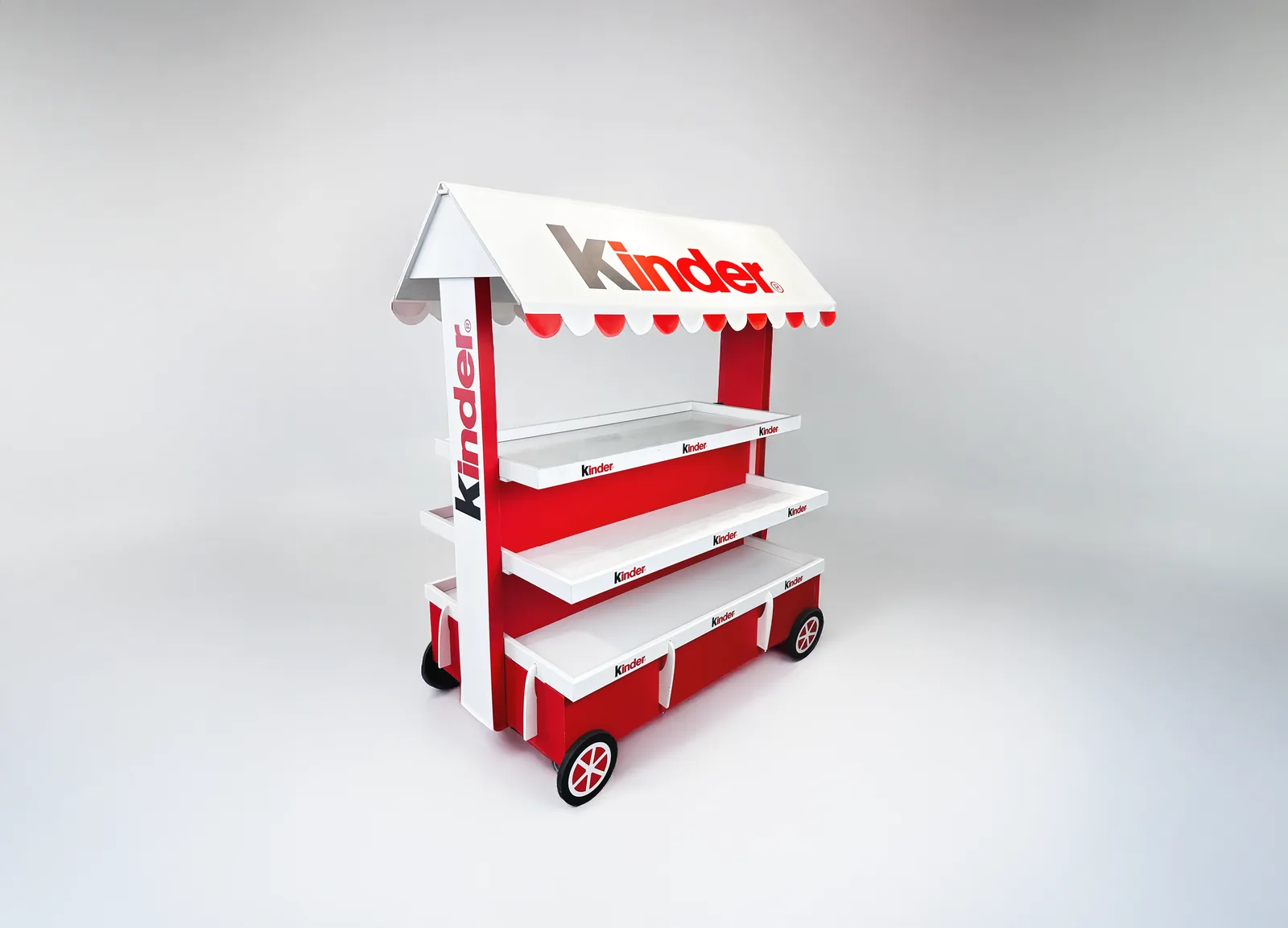
The Kinder market cart shows that the answer is not always obvious at the start. The first version was made in cardboard, with its awning, three shelves and decorative wheels. In store it wore out fast, because children touch it, so the following runs of the same cart were made in wood. The design stayed and the material changed. That is why, on top of how long a display will stay, we ask how hard it will be used.
Between the two ends there is a middle ground: premium cardboard with internal reinforcement and careful finishes, which outlasts a short campaign. The semi-permanent floor display we manufacture for Lancaster is of this kind.
| Material | When it suits a floor display |
|---|---|
| Cardboard | Campaigns, launches and rollouts to many stores at once |
| MDF and wood | Permanent, delivered flat and assembled without tools |
| Metal | Permanent, with heavy loads, heavy use or graphics that change every campaign |
| Mixed | When each part of the unit calls for a different material |
When the display is permanent
A permanent unit spends years in the same store, and the brand's team sees it on every visit. That is why finishes matter more than in a campaign.
The Fever-Tree unit combines a black steel frame, with perforated mesh sides at the top, and an oak-finish header, shelf fronts and plinth. The metal carries the bottle packs and the oak finish dresses what shoppers see up close.
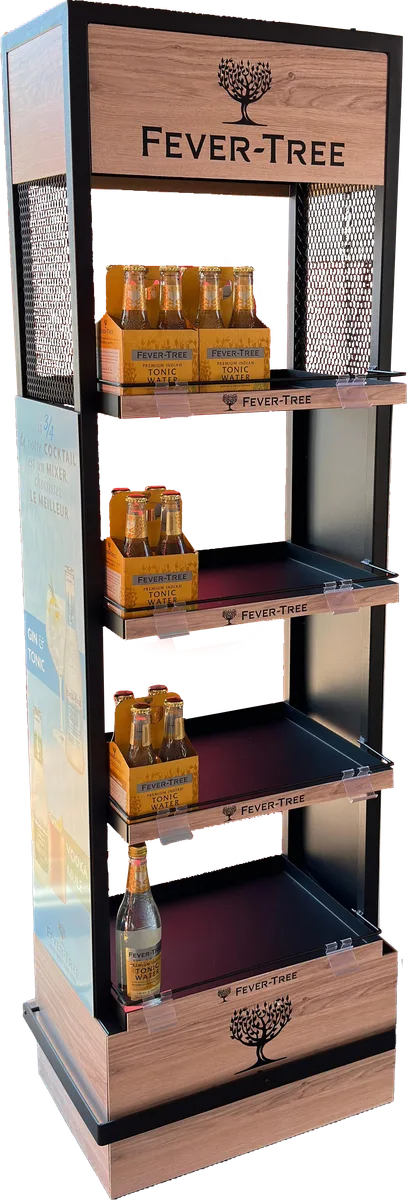
On a metal unit, magnetic vinyl graphics can be swapped every campaign without touching the structure. It is worth screen-printing the logo underneath the magnet, because now and then another brand takes over the unit and puts its own vinyl on top.
Lighting is another common feature on permanent units, with an LED strip along the shelves or a backlit header, as on the make-up unit we built for Dermacol. It always runs on mains power: nobody in a store is going to keep batteries charged. And in perfumery and cosmetics the tester needs a fixed spot at hand height. The Álvarez Gómez unit has it on the top shelf.
The store decides the footprint
The same floor display does not perform the same on an island in the main aisle as it does against a wall. So we ask where it goes and how much floor there really is, measured in the store.
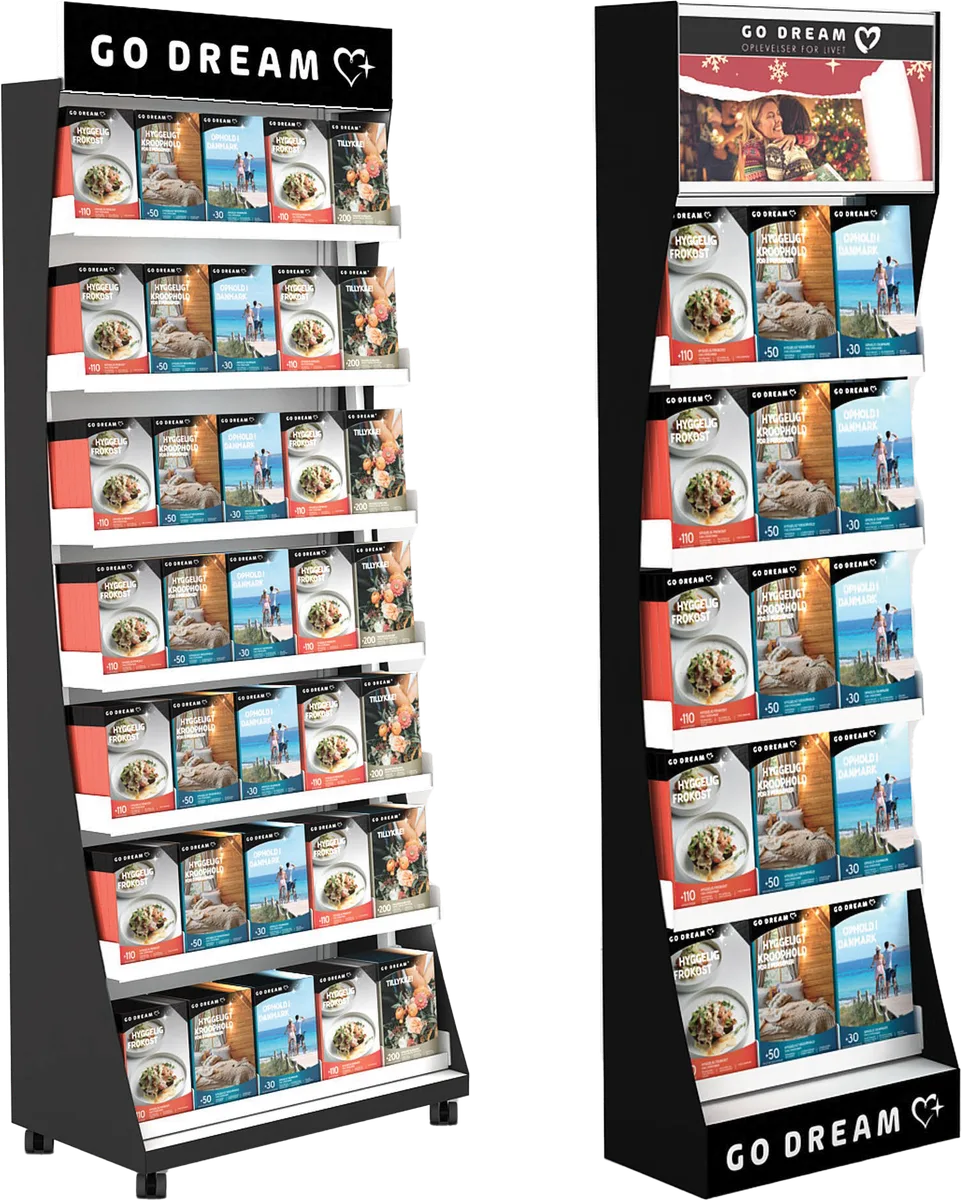
For Go Dream we made the same unit in two widths. The standard one has seven shelves with five facings of gift boxes each. The narrow version has five shelves with three facings, fits spaces where the other will not, and carries a seasonal header graphic that can be changed without touching the unit.
An island unit is seen from every side and needs product and graphics on more than one face. The Wonderbox Connect tower, all in metal, has four faces with five shelves on each. Against a wall one face is enough and you can gain height. Tall, narrow formats have a post of their own, the one on the tower display, and if the space is tiny, see our post on displays for small spaces.
How it reaches the store and who assembles it
A floor display shipped assembled travels almost empty, so you pay for a lot of freight and very little furniture. That is why we nearly always design it to travel folded or as flat panels, and decide in the briefing who will put it together.
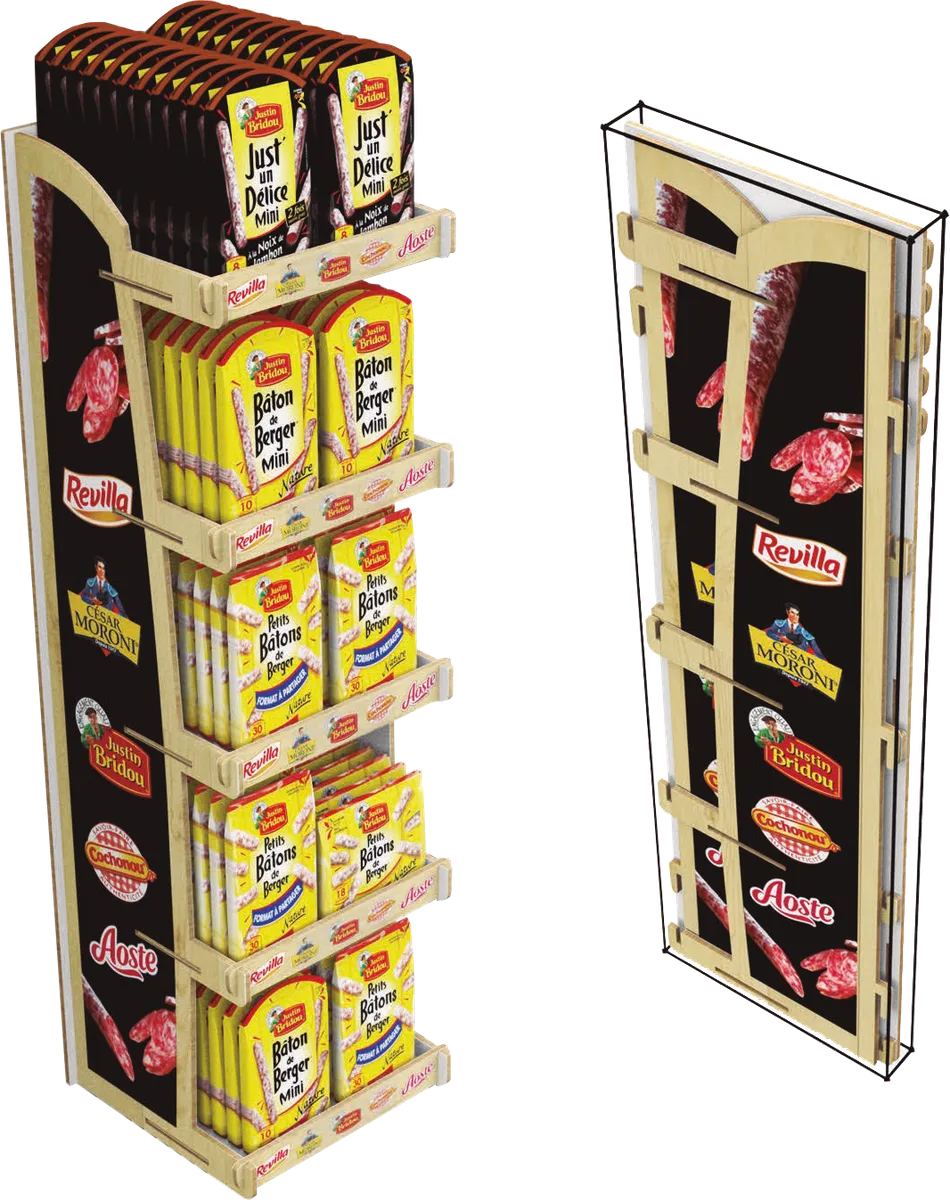
The Aoste unit, for Justin Bridou charcuterie snacks, is made of thin wood board and slots together without tools. Folded, it becomes a flat pack, as the right-hand side of the image shows. The Continental trolley above does the same in metal. On a two-metre unit we designed for Arcos, compacting the base and trays meant about eight units fit on a pallet flat-packed, against about two if they travelled assembled.
There are three ways for the display to reach its spot:
- Flat, assembled by the store. The cheapest to ship, and it means assembly has to be simple and explained on the unit itself. We go into it in our post on the self-assembling cardboard display.
- Assembled and loaded. Cardboard can be shipped ready to place, with the product already inside.
- Installed by our team. Useful when the unit is large or goes into many stores at the same time.
We ship from Barcelona to any country. The permanent metal displays for Goodyear, for instance, are delivered to Belgium, Germany and Slovenia, among other markets.
Lead times and minimum runs for a floor display
The minimum is counted per SKU: 200 units for a cardboard floor display and 100 units for a permanent one. Each version counts as a separate SKU, even if only the graphics change.
Sending you a quote takes about two weeks from receiving the brief, and the prototype another two weeks from design approval. Cardboard production takes 30 to 45 days from artwork approval, and a permanent unit 45 to 60 days from approval of the artwork and sign-off of the prototype. We break down each stage in our guide to lead time for custom POS display manufacturing.
What we need to quote it
- Units per SKU, or the volume range you are working with.
- Product samples. If you cannot send them, exact dimensions, although with a sample we design the housing around the real product.
- The maximum pallet height.
- Where it goes in the store and how much floor there is.
- How long it will stay.
- Who assembles it and whether it ships loaded.
Frequently asked questions
How much does a floor display cost? We have no catalogue prices, because every project is made to order. The price depends on the material, the complexity and the number of units, and it drops as volume goes up. With the brief in hand we send you a quote in about two weeks.
What is the minimum order? 200 units per SKU in cardboard and 100 for a permanent floor display.
What size is a floor display? There is no standard size. It is set by the space the store gives you and the maximum pallet height, which is why those are two of the first things we ask.
Can the graphics change without replacing the unit? Yes. On metal, with magnetic vinyl; in any material, with headers and panels designed to be swapped, like the seasonal one on the narrow Go Dream unit.
Do you deliver it assembled? Whichever you prefer: flat for in-store assembly, assembled and loaded, or installed by our team. We ship from Barcelona to any country.
Planning a floor display?
Tell us what product goes on it, in how many stores, for how long and by when, and we will tell you which format and material fit that budget and that timeline.