A tool manufacturer rarely sells straight to the end user. Its products reach DIY chains, builders' merchants and neighbourhood hardware stores, and in many of those stores the brand only gets real visibility when it rents promotional space: an aisle end, a pallet spot near the entrance, a few weeks in the seasonal zone. For those placements the usual answer is a cardboard display, and the practical question is who designs it, who makes it and how it gets from the supplier to the factory, and from the factory to the store.
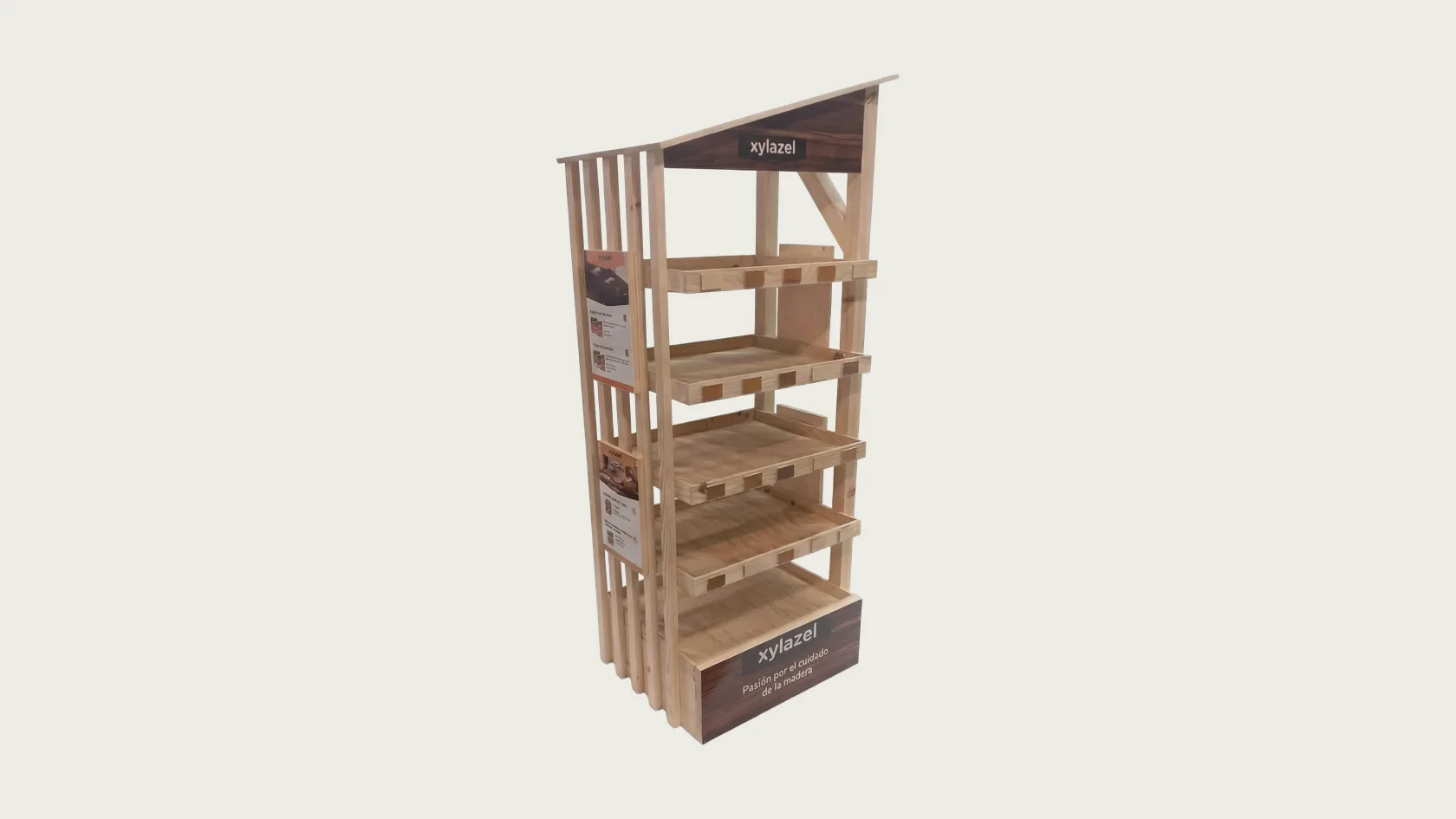
At Euromon PLV we design and manufacture displays in every material, cardboard included. In the DIY and hardware aisle, where tools sit next to adhesives, sealants and paint, we have built cardboard units for Sika, Tangit, Hammerite, Pattex and Rubson. The constraints are the same ones a tool brand faces, so this guide uses those projects to explain what works.
Why tool brands use cardboard displays
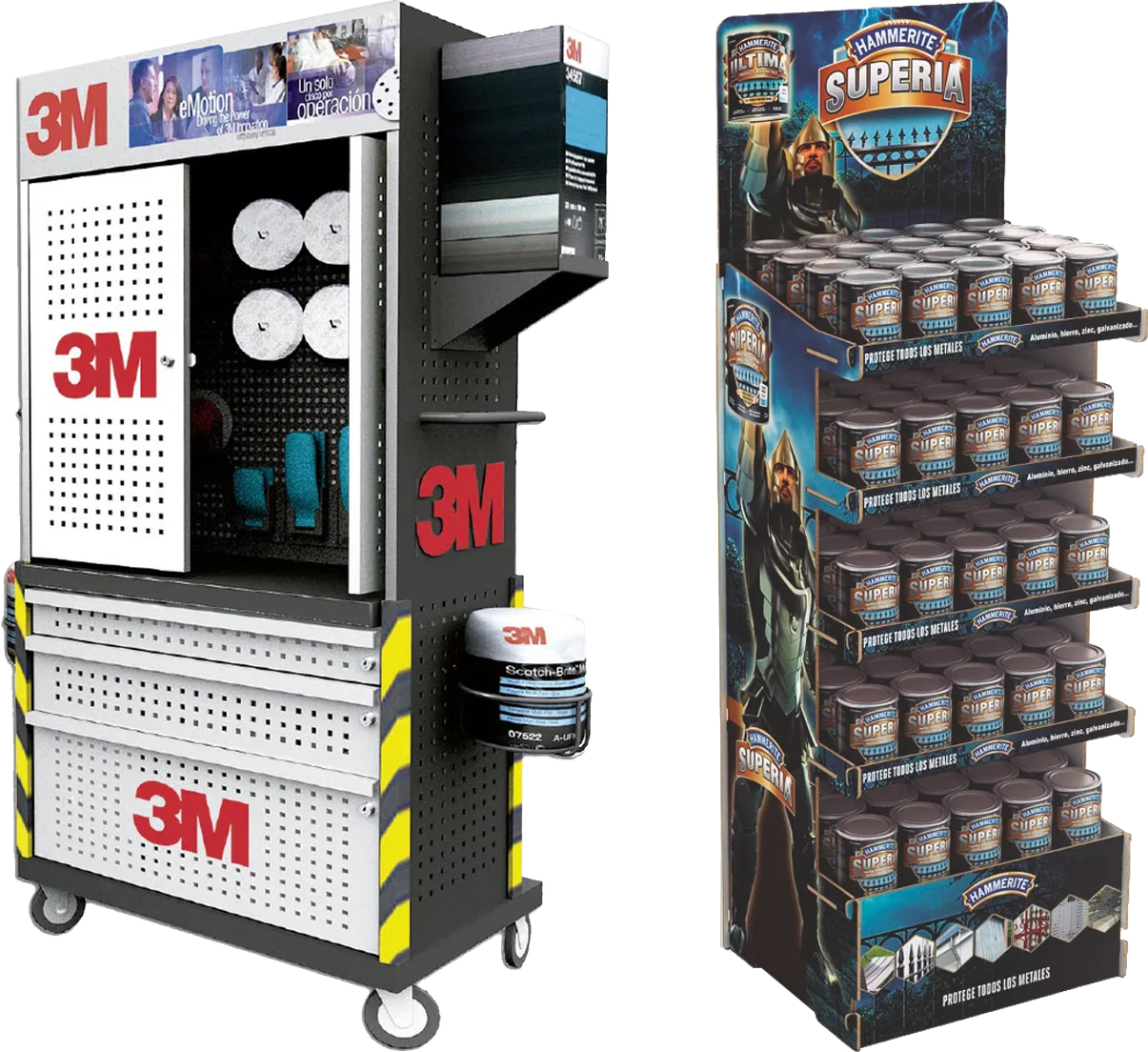
Cardboard is not the default material for every display in this channel. A brand with a stable, permanent space usually goes for metal or wood. The 3M workshop cart we built for abrasive discs, for example, is a metal unit on wheels with drawers and a perforated door, made to last well beyond any campaign. Cardboard earns its place in other situations:
- Launches and promotions. A new range, a seasonal push or a gift set needs presence for weeks, not years. Cardboard costs much less than a permanent unit and can be removed without leaving a structure behind.
- Rented promotional space. DIY chains sell aisle ends and pallet spots for a fixed period. The display has to arrive, sell through and be cleared quickly.
- Large rollouts. When the same campaign goes into hundreds of stores at once, a flat-packed display keeps freight and storage costs under control.
- It travels with the product. A cardboard display can leave the tool factory already loaded, so the store receives a single unit ready to place.
If you are weighing cardboard against metal or wood for a permanent placement, our guide to displays for building materials stores covers that side of the channel.
What makes tools difficult in cardboard
Tools are not an easy product for a paper-based structure. Four things need solving before a single sheet is cut.
Weight packed into small formats
A box of drill bits, a set of chisels or a pack of screwdriver blades weighs much more than its size suggests. What breaks a cardboard shelf is not the total weight of the display but the point load of each level with the real product on it. The Hammerite Superia display we made carries five shelves of metal enamel tins in cardboard, and that only works when each shelf is sized for its own load rather than for an average.
Products that hang
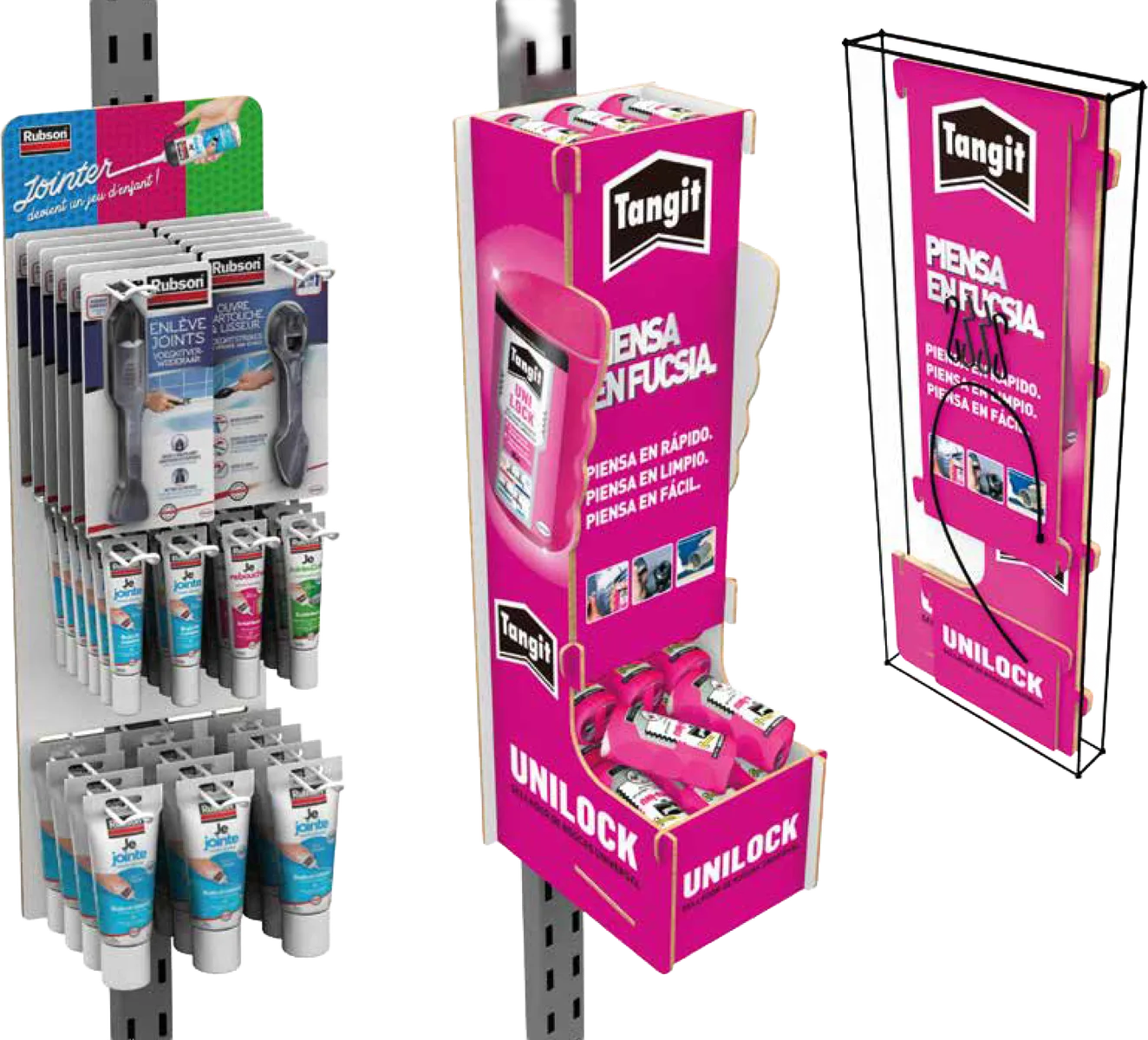
Much of a tool range sells in blister packs on hooks. A hook pushed straight into corrugated board tears out after a few days of customers pulling packs. The hooks need a reinforced back panel, a compact board insert or a metal hook bar fixed to the structure. On the Rubson Jointer panel, which holds blistered joint removal and smoothing tools, the panel is compact board with wire hooks and it hangs from the store's own shelving uprights.
Edges and points
Blades, saw teeth and bits are packed to protect the edge. The display should not undo that work: trays deep enough that blisters do not hang over the front lip, dividers that stop packs from rubbing against each other, and no sharp corner left at hand height.
Mixed formats in one unit
A typical tool promotion combines a boxed product, its blistered accessories and some consumables. The display needs flat shelves for boxes in the lower levels and hooks or trays for small items higher up, all in a footprint the store will accept.
Formats that work for tools
Pallet and half-pallet displays
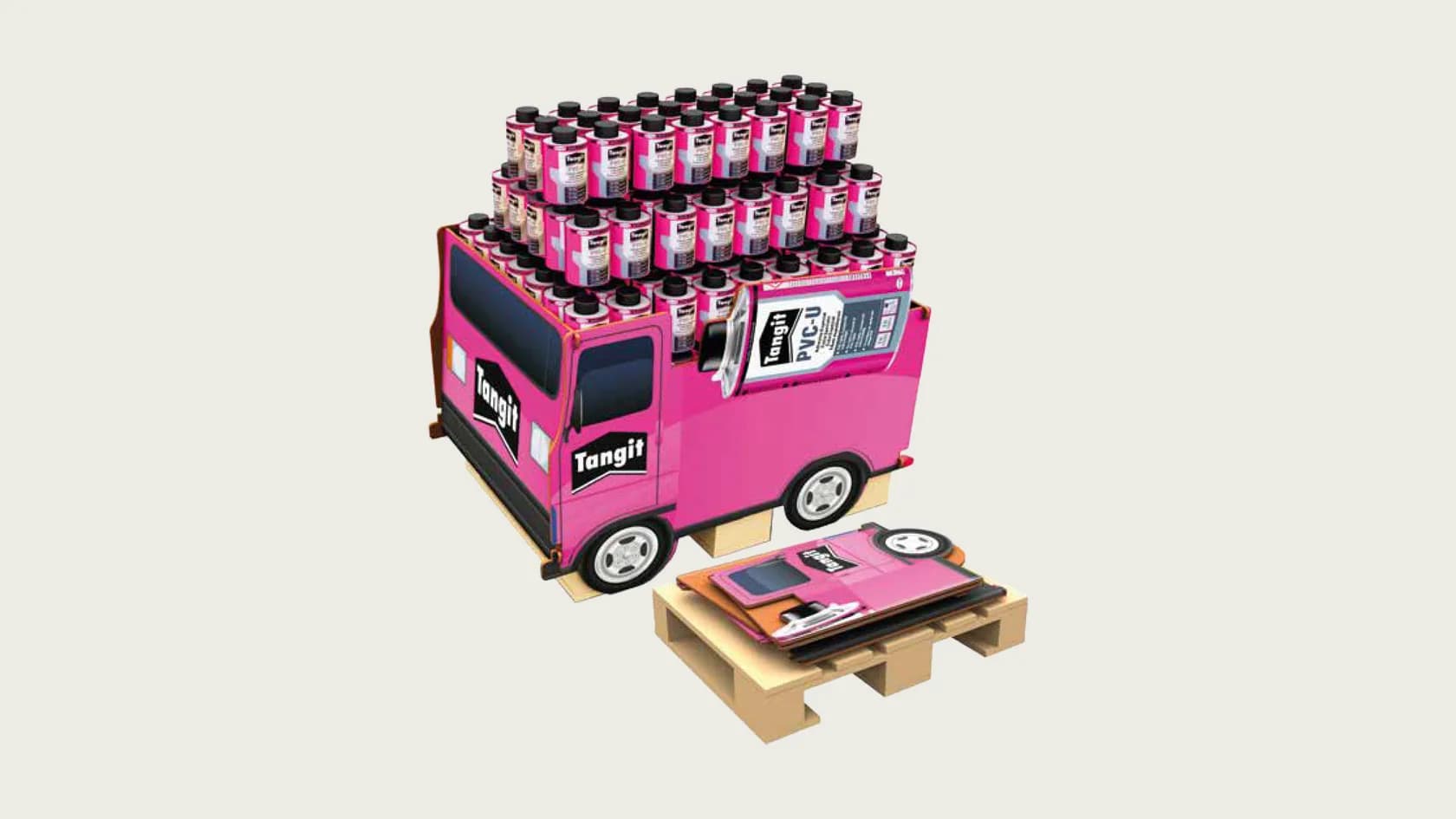
These are the backbone of the big DIY promotions. The Tangit pallet display we made, the one in the cover photo, is printed as a delivery truck in the brand's fuchsia, stands on wooden blocks and carries three stepped levels of adhesive. It ships folded on a real pallet and is assembled on site. The same approach works for a power tool range or a garden tool campaign: maximum volume of product, visible from the end of the aisle.
Floor displays with shelves and hooks
For aisle ends and secondary placements. The Sika Boom-562 display has three deep shelves for polyurethane foam cans and is made of microflute board, which takes print much better than standard corrugated. For tools, the usual layout is boxes below and blistered accessories on hooks above.
Hook panels and clip strips
The lightest option and often the most profitable for accessories. A panel or strip hung from the shelf uprights lets you place drill bits next to the drills, blades next to the saws or masking tape next to the paint without taking floor space. The Tangit Unilock module, a narrow cardboard unit hung from the store's uprights with a bulk bin at the bottom, is an example of this format.
Counter displays
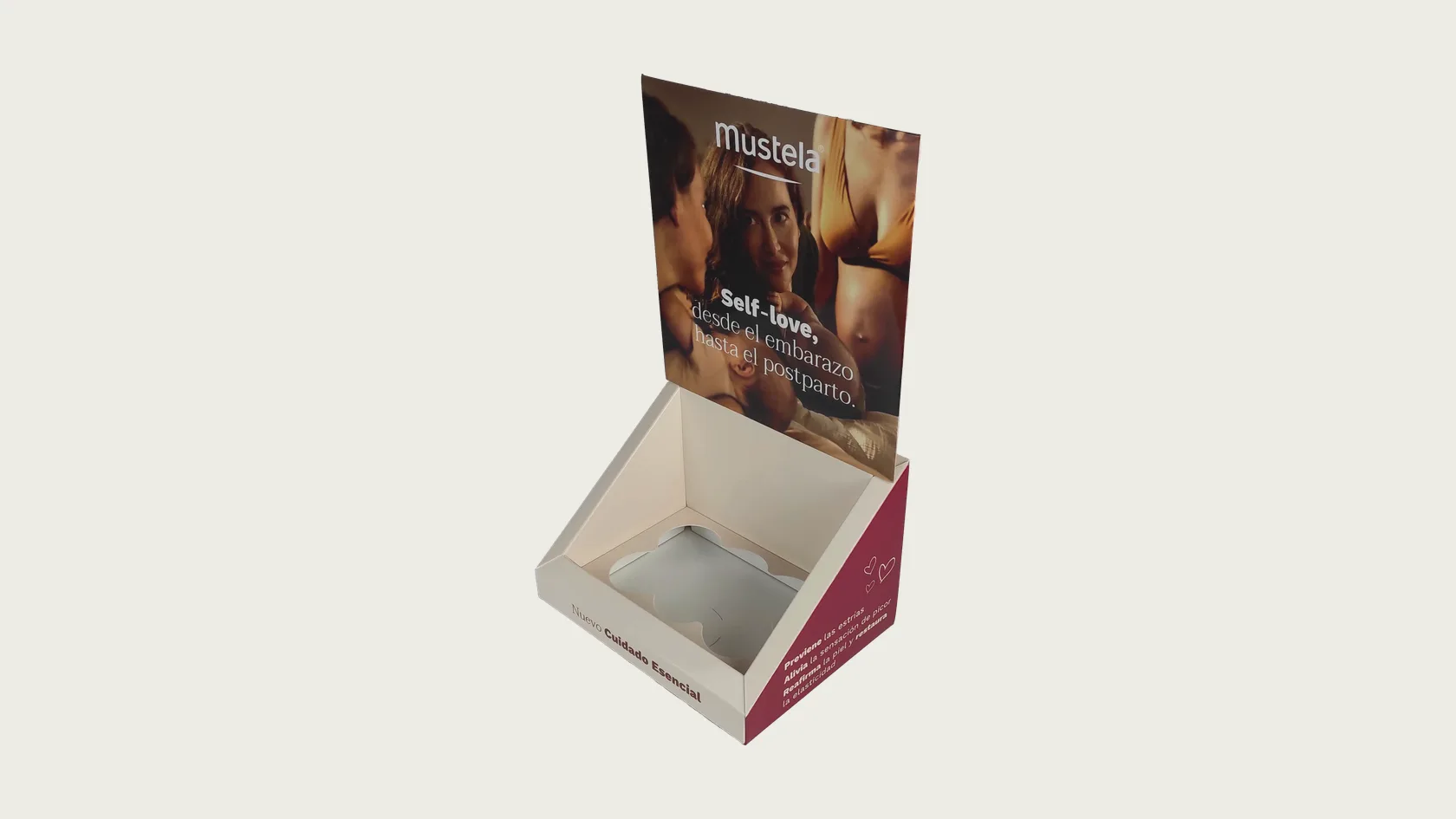
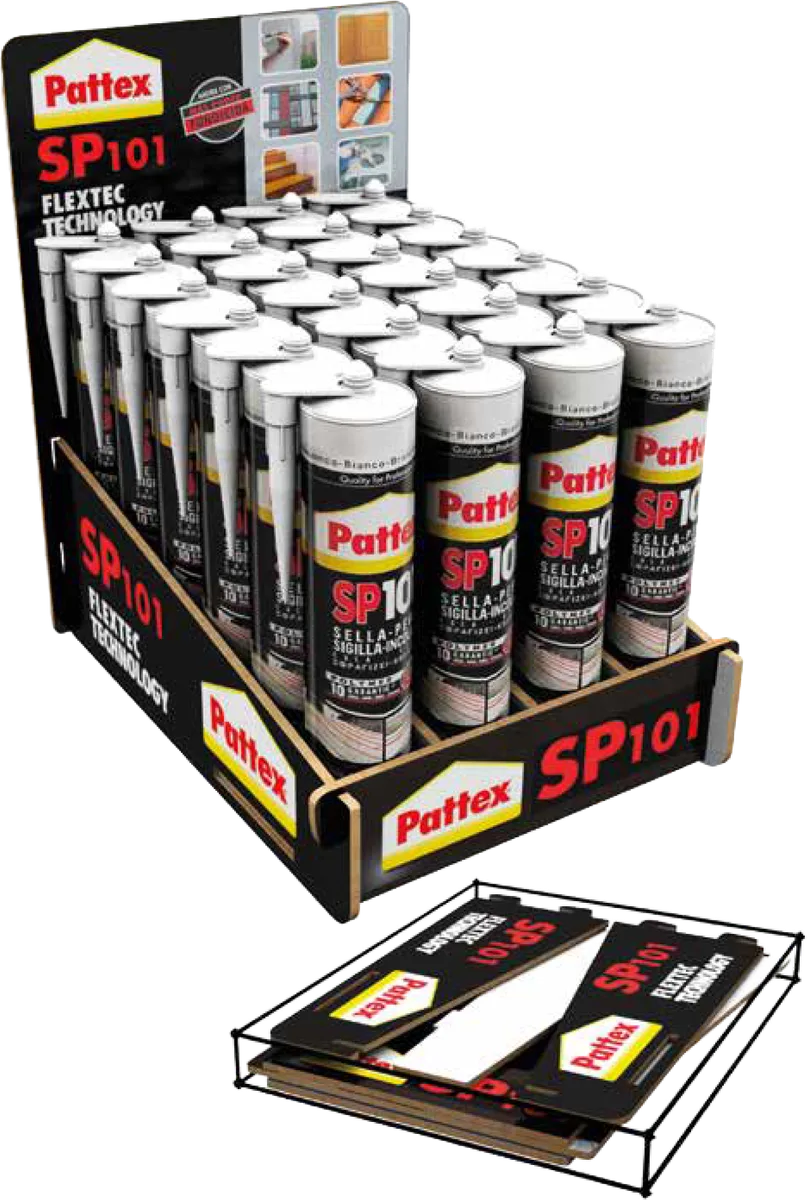
For small, frequently bought items near the till: tape measures, utility knives, bits, spare blades. The Pattex SP101 counter tray, made of black cardboard, holds several rows of cartridges in a compact footprint made for a hardware store counter, and ships folded in a flat box.
Supplying the display to your factory
At this point a project for a tool manufacturer looks very different from other sectors. There are two ways to get the display into the store, and the decision shapes the whole design.
Pre-packed at the factory
We deliver the displays flat-packed to your factory or logistics warehouse. Your team assembles them at the end of the packing line, loads the product according to the planogram, wraps the unit and sends it to the retailer on a pallet. The store only has to remove the wrap and place it.
- Advantage. The assortment and the planogram arrive exactly as designed, and store staff do almost nothing.
- What it requires. Space and time on your line to assemble and load, and a display that survives transport fully loaded. That means a top cap, corner protection, product locked in its trays and a base that takes stacking pressure.
Flat-packed to the store
The display and the product travel separately, and store staff assemble and fill it. Freight is cheaper and your line is not involved, but the result depends on someone in the store having ten minutes and the right stock. If you go this way, the display has to assemble without tools. We explain how it is done in our post on the self-assembling cardboard display.
What we need from your logistics team
- Pallet standard used by the factory and accepted by each retailer: full, half or quarter pallet.
- Maximum height allowed by the retailer and by your transport.
- Units per pallet of flat-packed displays, so inbound deliveries to your warehouse can be planned.
- Who assembles on the line, so the instructions printed on the unit are written for them.
- A pilot assembly with your team before production, using the prototype.
We ship from Barcelona to factories and warehouses anywhere in the world, and the delivery schedule is agreed with your production plan so the displays arrive before the packing run starts.
Structure and print
Three decisions settle the cost and the life of a cardboard display for tools:
- Board grade. Double wall or reinforced structures for the load-bearing parts, microflute for faces that carry photography, compact board for hook panels.
- Load per shelf. Calculated with the real product at the initial load, which is the worst case, and checked on a prototype loaded with real stock. An empty prototype proves nothing.
- Printing method. Offset for long runs and photographic quality, digital for short runs or when each retailer or country needs its own version.
Versions are common in this channel. The Rubson Jointer panel pictured above was produced with French graphics for that market. When one structure serves every version the tooling cost is shared. It is also worth protecting the base, because store floors are mopped regularly and a bare cardboard foot soaks up the water.
Lead times and minimum runs
Cardboard is an industrial-run material. Our minimum is 200 units for floor displays and 500 units for counter displays. Below those figures the cost of tooling and print preparation weighs too heavily on each piece.
Production takes 30 to 45 days from artwork approval, after a prototype that takes about two weeks. If the displays are going to be pre-packed at your factory, add the days your line needs to assemble and load them before the trucks leave. We break down each phase in our guide to lead times for custom POS display manufacturing.
What to settle in the briefing
Before we start designing, these are the points we ask a tool manufacturer to define:
- References in the display, with packaging format (box, blister, loose), dimensions and weight of each one.
- Units per reference at the initial load.
- Target retailers and store formats, and their rules for promotional space: pallet sizes, maximum height, whether they accept hooks.
- Pre-packed at the factory or assembled in store.
- Pallet standard and logistics flow from your warehouse to the stores.
- Time in store, which separates a four week promotion from a full season.
- Number of units and versions by retailer, language or country.
Frequently asked questions (FAQ)
Can cardboard really hold tools? Yes, when the structure is designed shelf by shelf for the real load and validated with a loaded prototype. For heavy power tools in a permanent placement, a mixed display with a metal base or hook bar and cardboard graphics is often the better choice. We have built several of those for Loctite, with a metal base and printed cardboard panels.
Can you deliver to our factory if it is outside Spain? Yes. We ship from Barcelona to any country, flat-packed on pallets, and coordinate the delivery date with your packing schedule.
Who assembles the display? Whoever you decide: your packing team if the display is pre-packed, or store staff if it travels flat. We design the assembly sequence and the printed instructions for that person.
What is the minimum order? 200 units for cardboard floor displays and 500 for counter displays.
Can we work to the retailer's technical specifications? Yes. If the DIY chain has its own requirements for promotional displays, such as dimensions, materials or labelling, we take them as the starting point of the design.
Planning a cardboard display for your tool range?
Every range and every distribution network has its own constraints, so we do not work from a standard catalogue. If you need cardboard displays for a launch or a promotion in DIY chains or hardware stores, we can help you define the briefing, prototype the unit with your product and deliver it to your factory ready for the packing line.
Written by the marketing and production team at Euromon PLV. For questions about a specific project for a tool brand, contact our sales department at euromonplv.com.