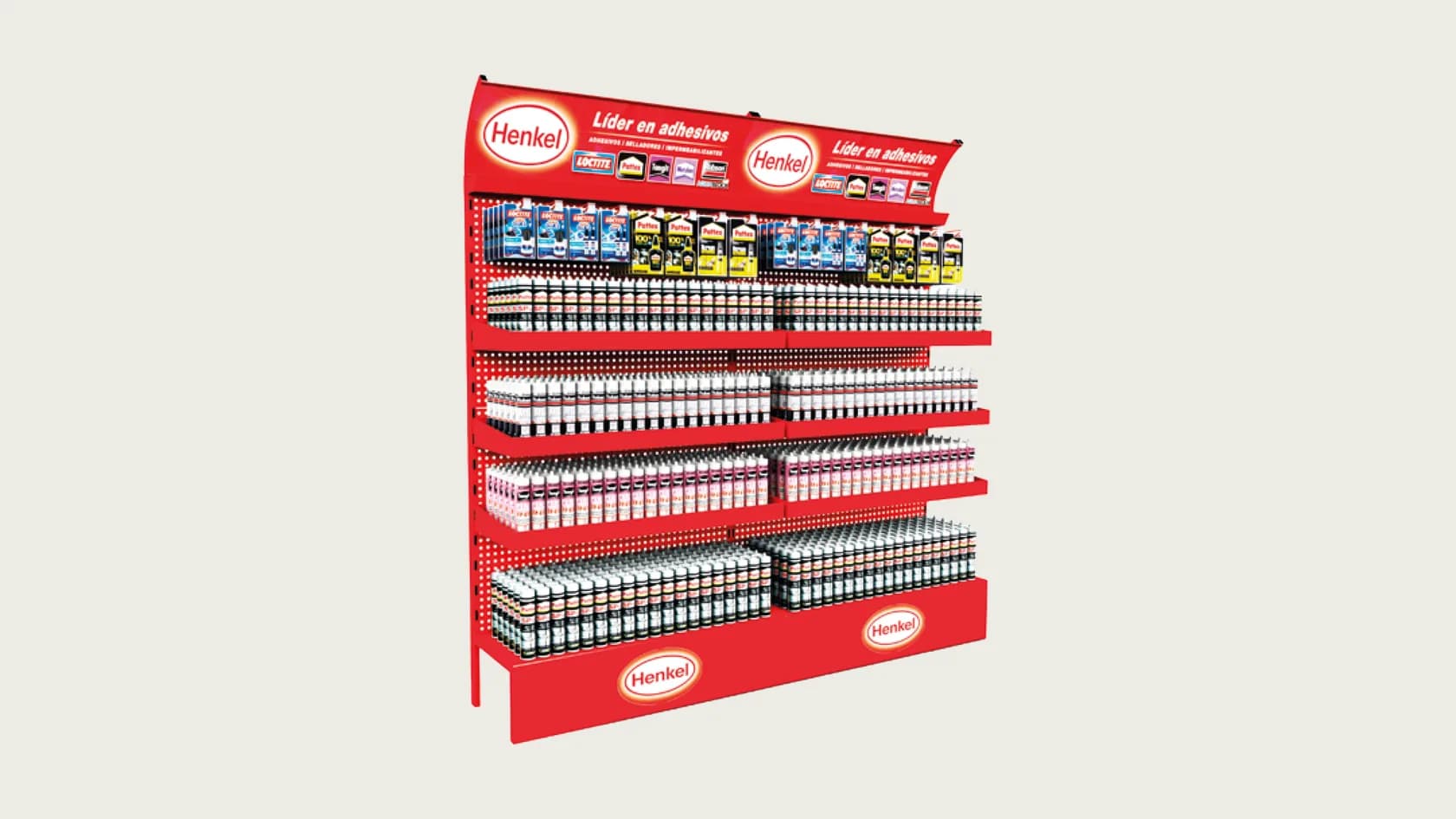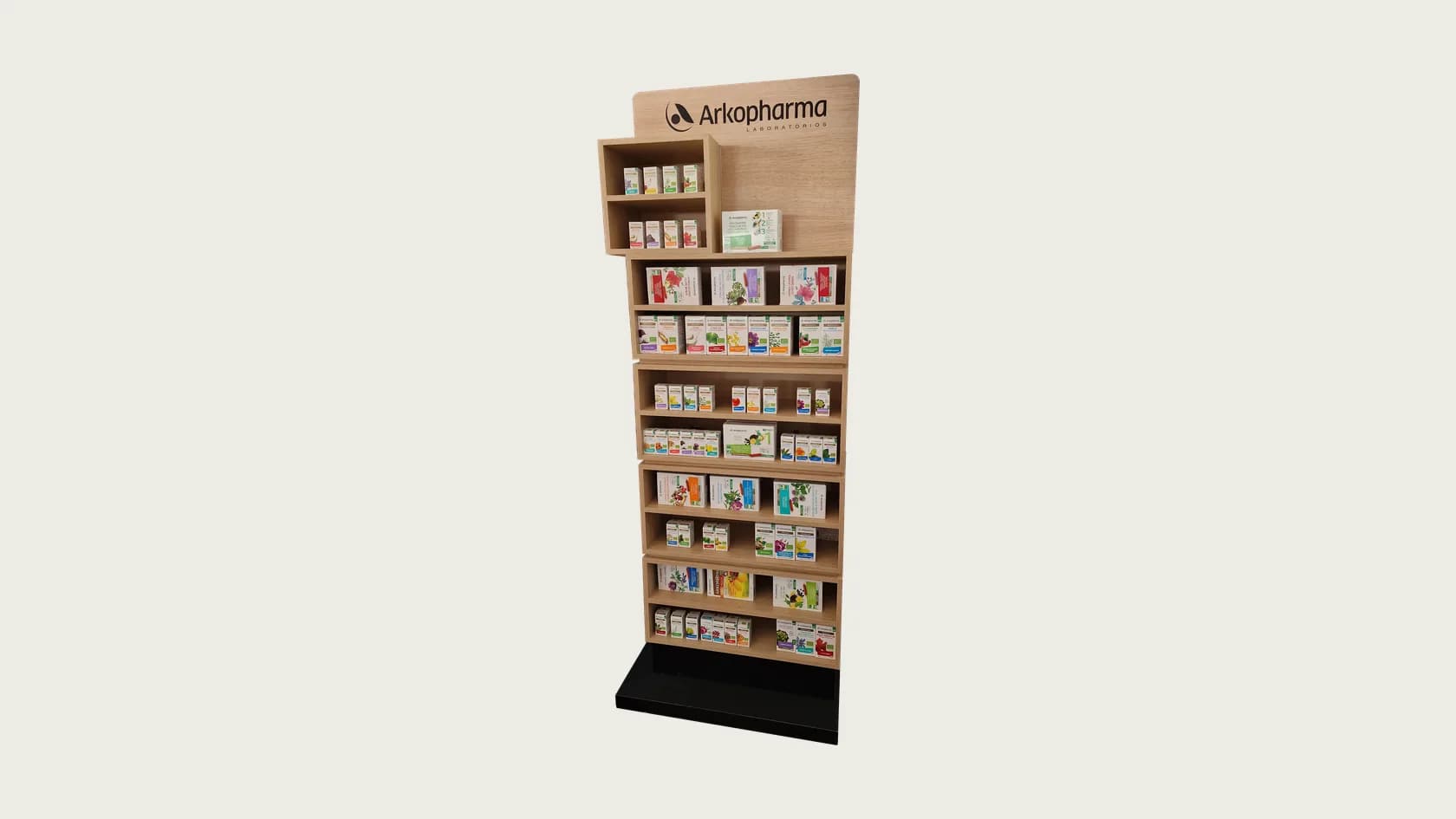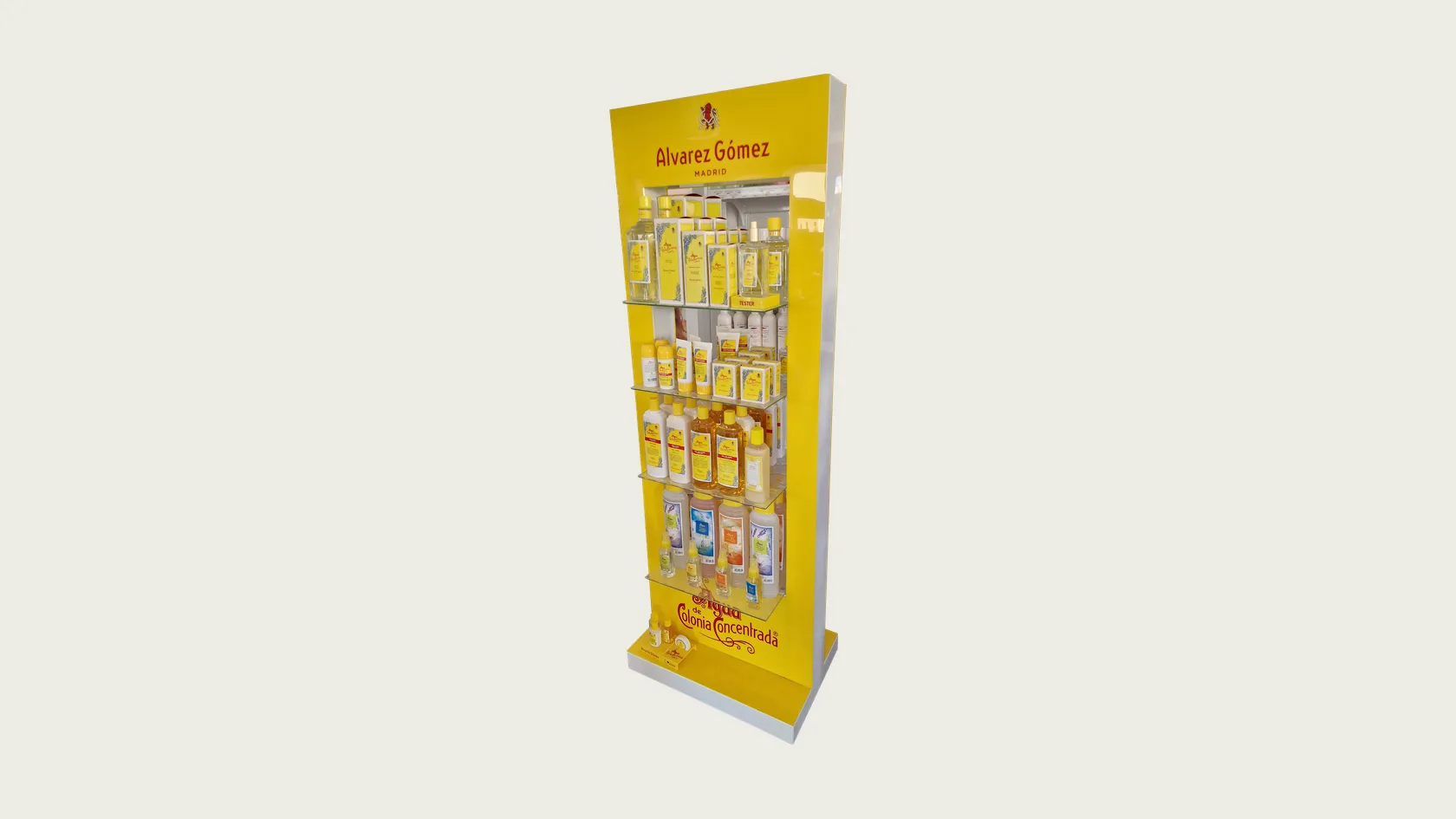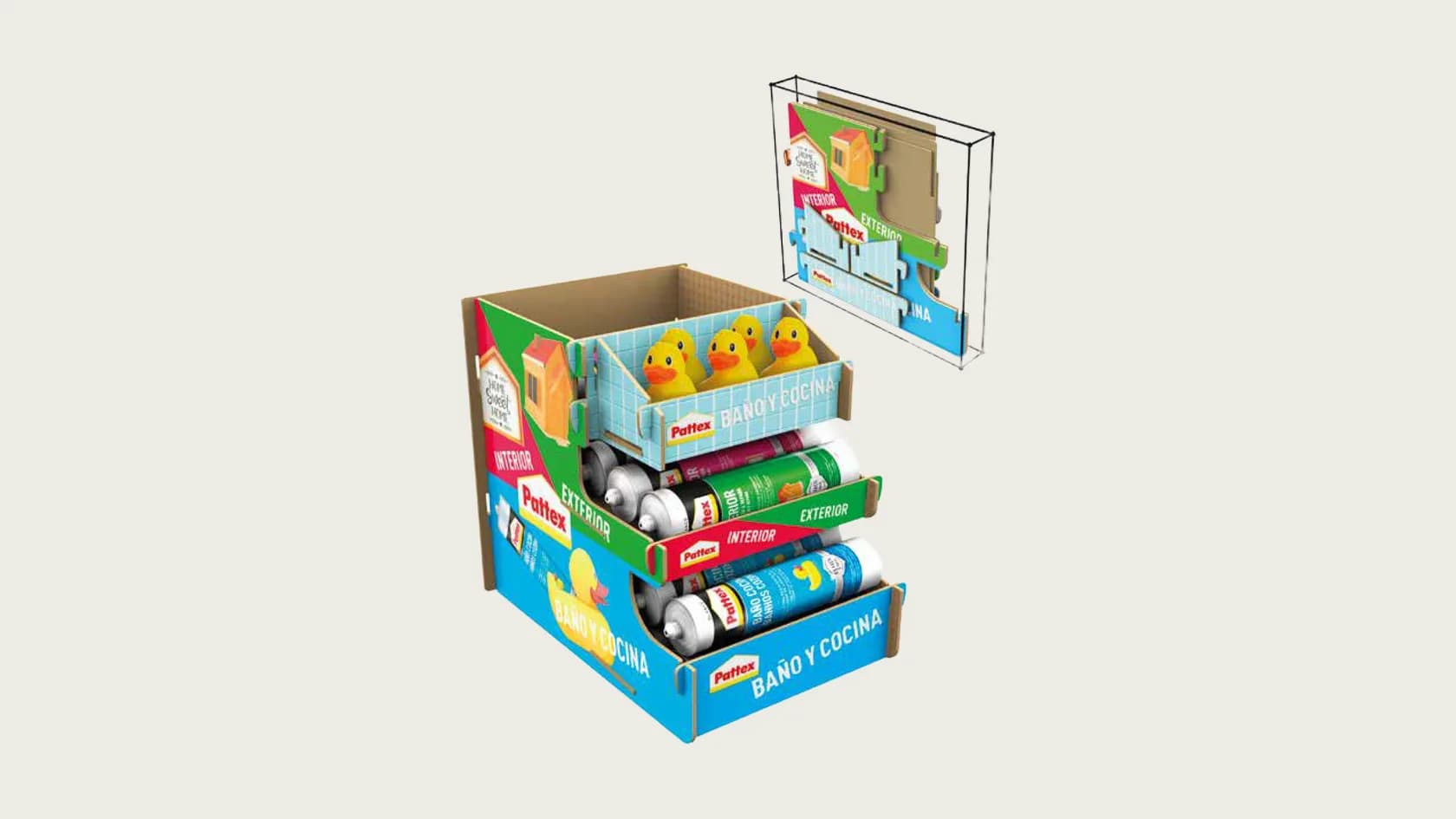
A cardboard display can reach the store in one of two ways. Flat, inside a box, so that someone builds it on the spot: that is a self-assembling cardboard display. Or already built, sometimes loaded with product as well, so that all the store has to do is put it in place: a pre-assembled display.
It looks like a logistics question, and to a large extent it is. It also decides who does the work at the point of sale, how much the brand pays to move air around in a truck, and what can and cannot be built in cardboard. We go through it with displays we have made, and at the end you will find the questions worth asking before you choose.
How a self-assembling cardboard display arrives
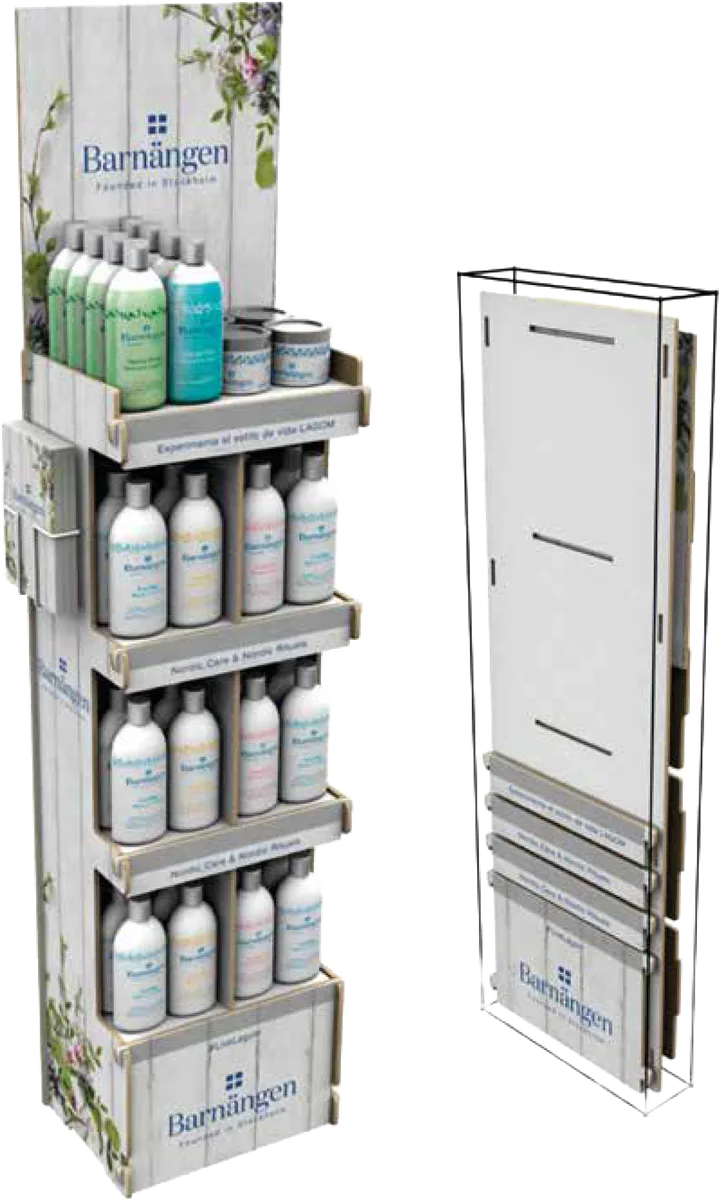
The Barnängen column shows the idea well. Built, it has four shelves, a header and a leaflet holder. Taken apart, all of it fits in a box only slightly bigger than one of its side panels, with the shelves flat and stacked against the back.
The die cut does the assembly work. Parts lock together with tabs and slots, with no screws, glue or staples, and they are drawn so that each one can only go in its own place. That is why a self-assembling display is designed around the person who will put it together as much as around the product it will carry.
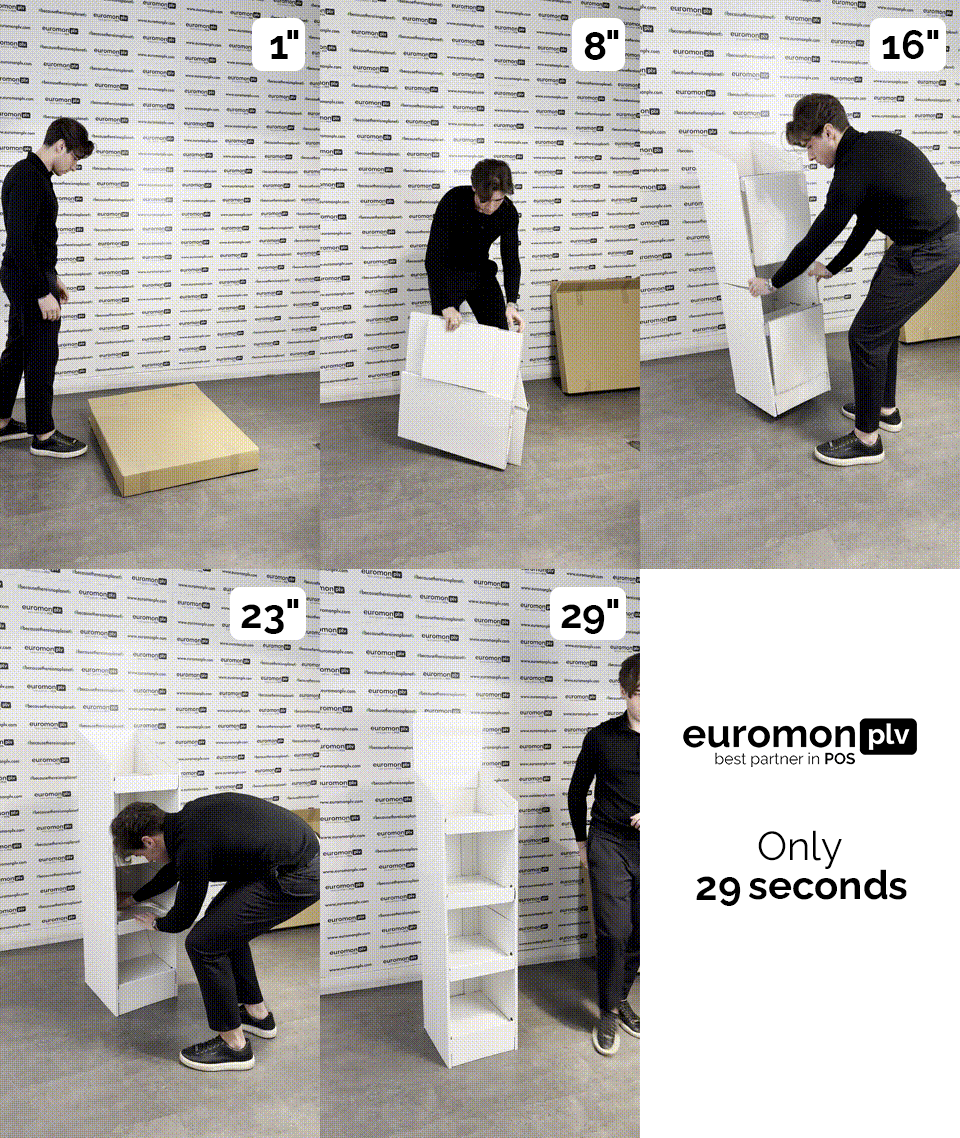
The video shows one of our self-assembling floor displays, white and unprinted. It comes out of the box flat, and in under half a minute it is standing with its shelves in place. That is what a good self-assembling display should achieve: assembly should never be a job store staff keep putting off.
What shipping flat saves
The first saving is volume. A built display is mostly air, and the space between shelves takes up as much room in the truck as if it were product. There is no fixed reduction figure, since it depends on each design, but one real case gives a sense of scale. On a two-metre floor unit we made for Arcos, with trays and a back panel, a pallet holds about eight units flat and about two built. That unit is not made of cardboard, but the arithmetic works the same way for a cardboard display.
You pay for that volume on every pallet and every shipment, and more the further it travels. We ship from Barcelona to any country, and on an international shipment going from two to eight units per pallet changes the budget. You pay again in the warehouse, because the displays for a campaign usually arrive weeks before the campaign does, and sometimes in the store itself, which does not always have room to keep a built display until installation day.
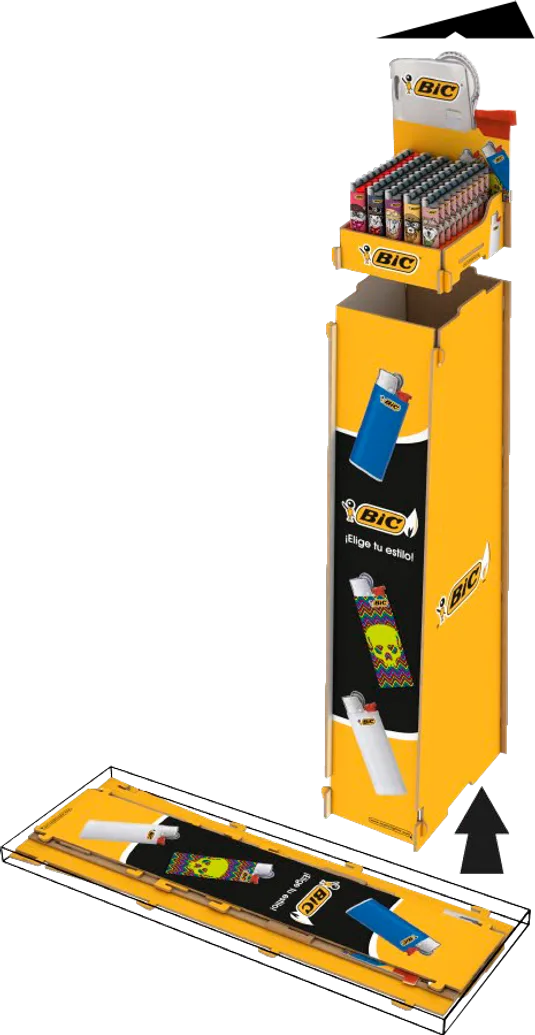
The BIC lighter column is the simplest case. It travels as one printed sheet, in store it is raised and closed into a column, and the tray of lighters goes on top. Two parts and one movement.
What a self-assembling display asks of the store
All of that saving only counts if someone builds it properly. A badly assembled display stays crooked, or with a loose shelf, for the whole campaign, and that is the brand's image in the store. So we design self-assembling displays with few steps, with parts that only fit in their own position and with the assembly sequence printed on the box or on the piece itself.
When the store network has no time to build displays, or the brand would rather not leave it to them, there is another option besides pre-assembly: in-store installation. We have done it on other projects, and it means the display can still ship flat.
Self-assembly works on the counter too. The INDOLA countertop unit, with its black marble finish, comes down to two flat boards: the folded base and the back panel, which slides underneath for shipping. On the counter it goes up in a moment.

When a pre-assembled display makes sense
Pre-assembly gains ground in three situations.
When few units go to few places. If the display is for a flagship store, an event or a trial in five stores, the extra cost of shipping it built is small, and any assembly risk disappears.
When the piece carries more than cardboard. Cardboard can go premium, with matte or metallic textures, weighted inner reinforcement so the structure never feels flimsy, and parts in other materials such as acrylic. The BOSS Bottled Beyond column is cardboard, and on its top it carries a stand for the bottle in front of the ambassadors' header. On the Lancaster Sun Perfect Air tray, four coloured acrylic cards are set into the orange cardboard. The more materials and delicate finishes a piece has, the more each assembly step becomes a chance to spoil the finish, and the more sense it makes to send it out built from the factory.

When the display travels with the product. The fullest form of pre-assembly is the display that leaves built and loaded: the product goes in before shipping, for example at the brand's own factory, and the store receives a single piece ready to stand on the floor. We cover it in more detail in our post on cardboard displays for tool manufacturers, where the display is delivered to the factory and loaded on the packing line.

There is room for solutions in between. The body can arrive built with only the header added in store, or the structure can arrive flat with the trays already assembled. It is decided piece by piece.
How to choose between self-assembling and pre-assembled
| Self-assembling | Pre-assembled | |
|---|---|---|
| Shipping and storage | Flat, takes a fraction of the space | Built, you pay for the volume |
| Assembly in store | Store staff or an installer | None, or one final step |
| What you can build | Anything solved with folds and slots | Also pieces with several materials or delicate finishes |
| Best for | Many stores, long distances, campaigns | Few units, premium ranges, displays loaded at the factory |
Before you close the brief, these questions usually make the answer clear:
- How many stores, and how far away? The more stores and the further away, the more shipping weighs, and the stronger the case for self-assembly.
- Who will build it? If it is store staff, the piece has to go up in minutes with no doubts. If nobody can, it is pre-assembly or installation.
- What does it carry besides cardboard? Acrylic, lighting or reinforcements push towards pre-assembly.
- Does it travel empty or with the product? If it is loaded before it leaves, it is designed to arrive built.
A cardboard display takes 30 to 45 days to manufacture from artwork approval, as we explain in our post on lead times. For floor displays, how to choose a floor display goes through the formats, and our cardboard displays page has more projects.
Frequently asked questions
Is a self-assembling display as strong as a pre-assembled one? If the structure is calculated for the real weight of the product, yes. We check it with a loaded prototype before producing the run, and the prototype takes about two weeks.
Who assembles a self-assembling cardboard display? Usually store staff, with the assembly sequence printed on the box or on the piece. We can also handle in-store installation, and if the display ships loaded, it is built before it leaves.
How much does a self-assembling display save on shipping? It depends on the design, so there is no fixed percentage. As a reference, a two-metre floor unit for Arcos fits about eight units per pallet flat against about two built.
Can a pre-assembled design be turned into a self-assembling one? Often, yes, although it usually means reworking the structure so it holds together with folds and slots. We see it at the prototype stage.
What is the minimum order? 200 units for cardboard floor displays and 500 for countertop units.
Deciding how your display gets to the store?
Tell us how many stores it is going to, who will build it and what product it carries, and we will suggest the delivery format that fits best: flat, built, loaded or a mix.
Written by the marketing and production team at Euromon PLV. For questions about a specific project, contact our sales department at euromonplv.com.