A supermarket has several places for POS material, and each one plays by its own rules. In the main aisle and on the gondola ends, a brand pays for a few weeks of visibility. On the shelf, it fights for space next to the rest of the category. The deli, the household cleaning aisle and the pet aisle each display product their own way, and the checkout is the last metre before the shopper pays. A display designed for one of those areas rarely works in another.
At Euromon PLV we make displays for brands that sell through supermarkets and hypermarkets: confectionery, cooked meats, household cleaning, home care and pet food. This guide walks through the store with pieces we have made for those categories, and ends with what to have settled before asking for a quote. Drinks have their own post, cardboard displays for beverages, so we leave them out here.
Types of POS displays for supermarkets by store area
Before talking about material or format, you need to know where the display will go, because each area sets the footprint, the height, how long it stays and who handles it.
- Main aisle, entrance and gondola ends. Fairly large floor displays, for a campaign or semi-permanent, seen from a distance and sometimes from several sides.
- Shelf. Shelf stoppers, shelf strips, trays and modules that fit the retailer's shelving without taking floor space.
- Departments with their own display logic. Deli, household cleaning and pet food, where product often hangs or is sold loose.
- Checkout. Narrow towers and countertop units for impulse buys.
Islands and gondola ends
The gondola end and the promotional area of the main aisle are the most visible spots in a supermarket, and also the ones the retailer rents out for a fixed period and with fixed dimensions. A display there has to read from several metres away and, if it sits in an island or at the end of a run, from more than one side.
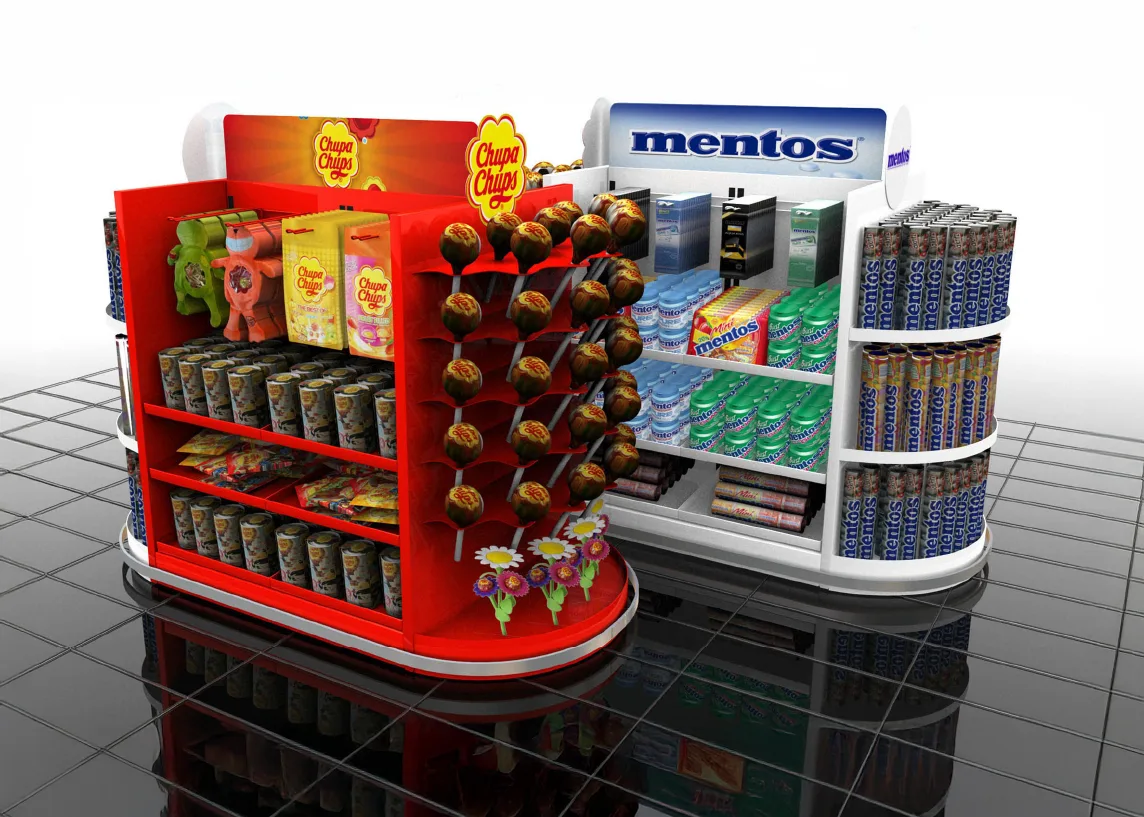
The Chupa Chups and Mentos displays in the image handle that with curved, loaded ends, so the unit sells from the front and from the side. They also mix formats in the same piece: lollipops on stems, tins on shelves and hanging bags on the Chupa Chups one; rolls, tubs and boxes on the Mentos one. That is normal on a gondola end, where the brand wants to show the whole range in the space it has been given.
If the display is going to stay in store for months, we cover structure and footprint decisions in how to choose a floor display.
Seasonal campaigns in cardboard
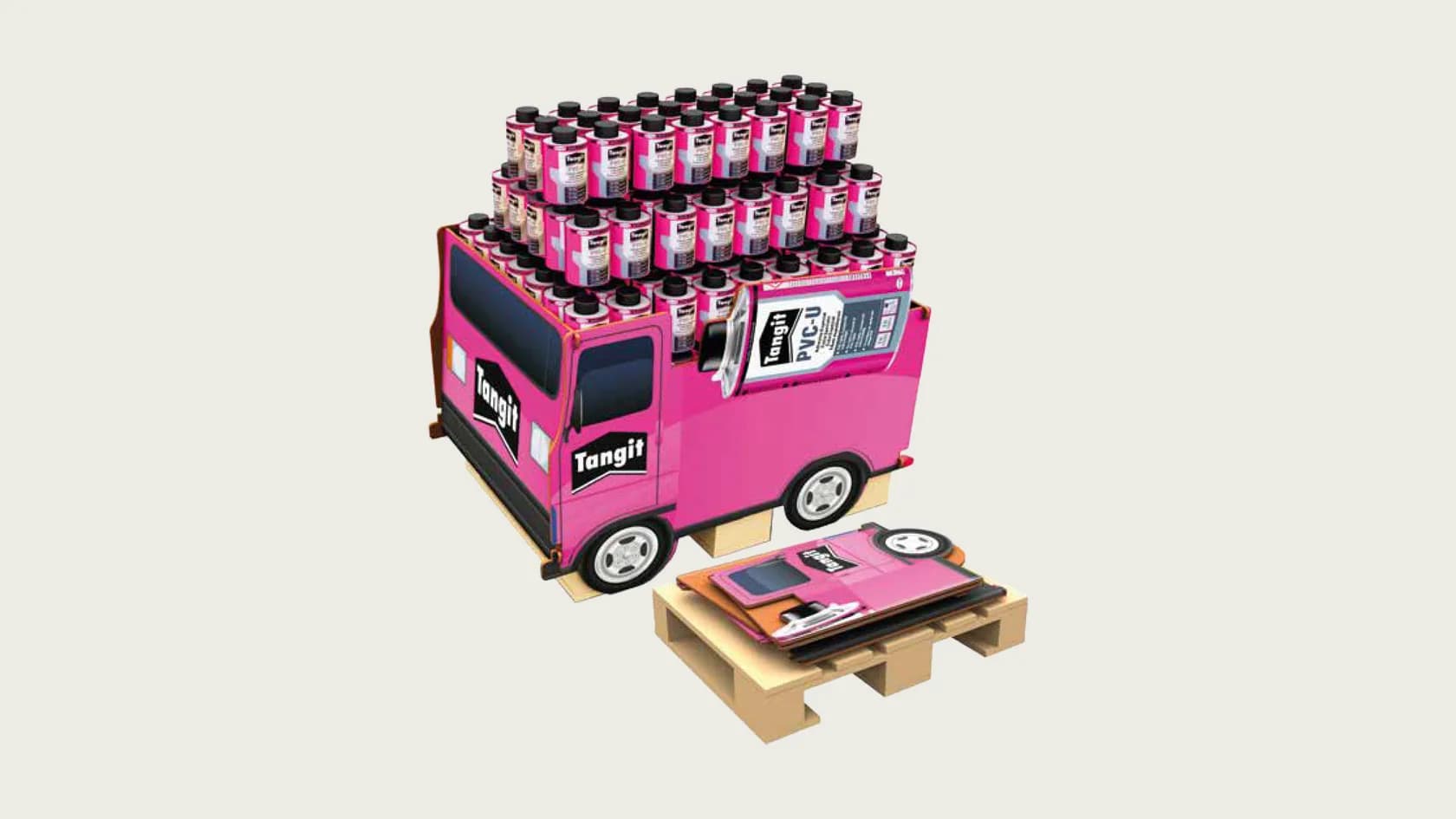
A good part of supermarket POS lasts a few weeks: a launch, Christmas, back to school, a promotion agreed with the retailer. Cardboard is the logical material for that. It is the cheapest, it carries the full campaign artwork, it can travel flat or assembled and loaded, and it leaves no structure behind when it goes.
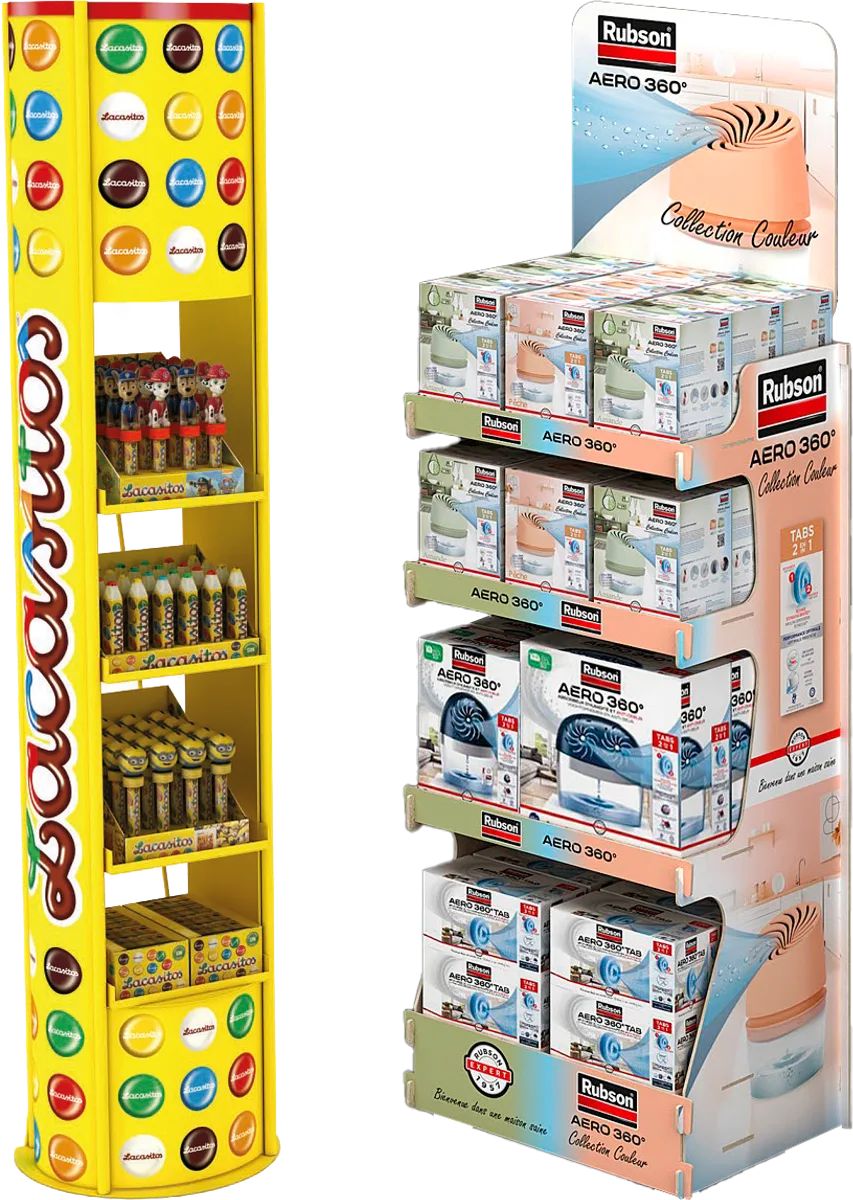
The Lacasitos column takes up very little floor space and carries the logo along its whole side, so it reads from the far end of the aisle. Its four trays split the campaign formats, from the tubes with character toppers to the boxes. The Rubson Aero 360 display brings the whole range into one piece, from the device to the refills, with the colours of the collection on the shelves, and it went out with French artwork.
In cardboard, the cutting die and print set-up are a fixed cost. When one structure goes out with several sets of artwork (per retailer, country or language), that cost is shared across all the versions. We compare cardboard with permanent materials on our cardboard displays page.
POS displays for supermarkets on the shelf
When there is no floor space, the brand works on the shelf. POS material there has to live with the retailer's fixtures and price labels without covering any of them, and still stand out among dozens of competing products.
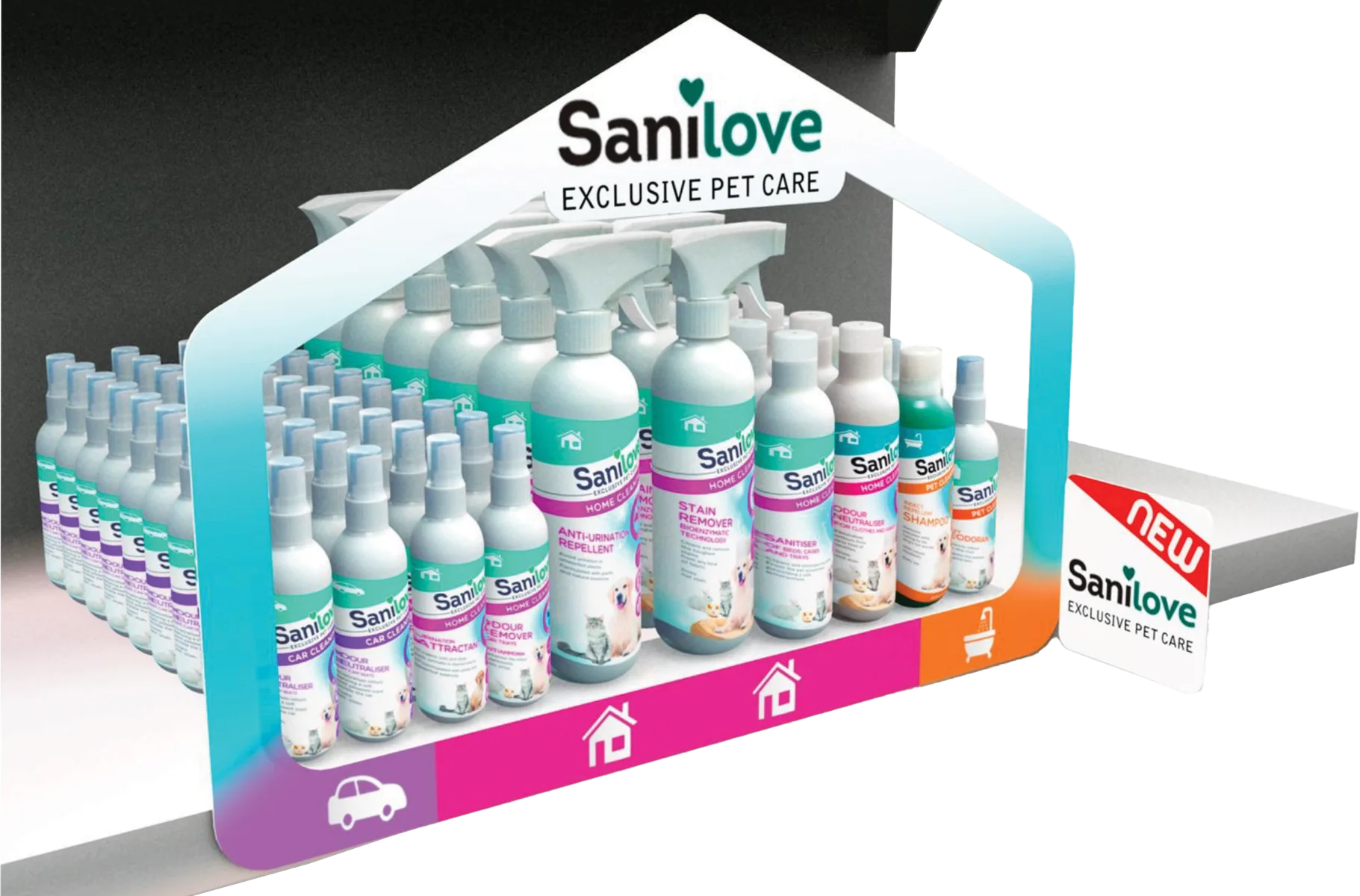
In the module we made for Sanilove, a range of cleaning products for pets, the house-shaped frame marks out the brand's space on the shelf. The strip along the base changes colour by use (car, home, bath), so shoppers find their product without reading labels. A shelf stopper with the word NEW sticks out from the shelf edge and catches people walking down the aisle.
Stoppers, shelf strips, frames and dividers are small pieces, but a roll-out across hundreds of stores multiplies the units. We cover them on our shelf-edge displays page.
Departments with hanging or loose product
Some departments have their own way of displaying product. In a self-service deli, whole salamis hang; in the pet aisle, snacks come in bags with a hang hole; in household cleaning, some products are sold loose. A shelf unit works for none of the three.
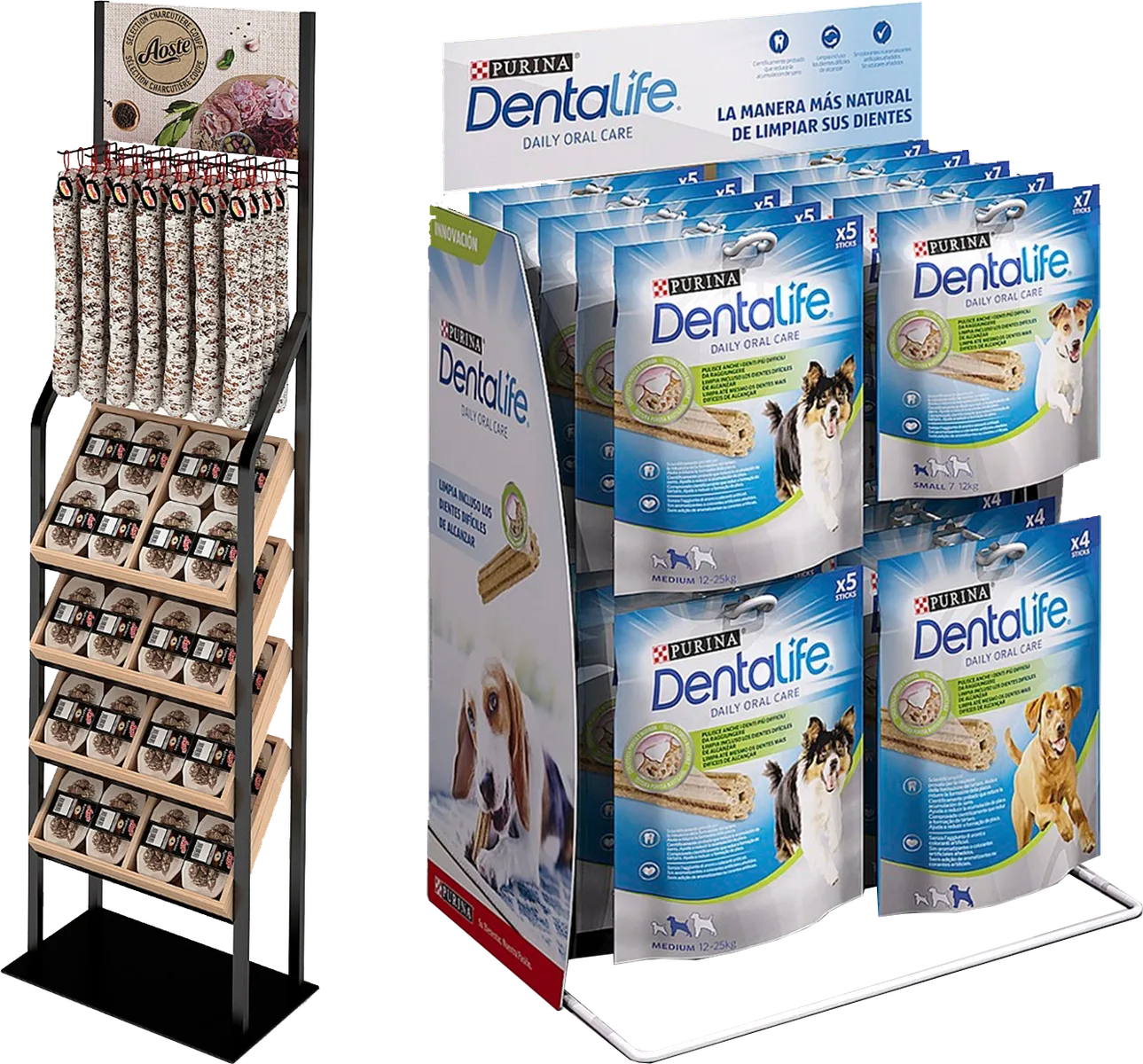
The Aoste display combines the two ways of selling cooked meats in one unit: a bar at the top for whole salamis and four angled trays below for sliced packs, all on a black metal frame. The Purina Dentalife one is a wire countertop display with hanging rods, where each bag size gets its own row and a printed side panel explains what the product does. Hanging product frees up the shelf and shows the whole pack.
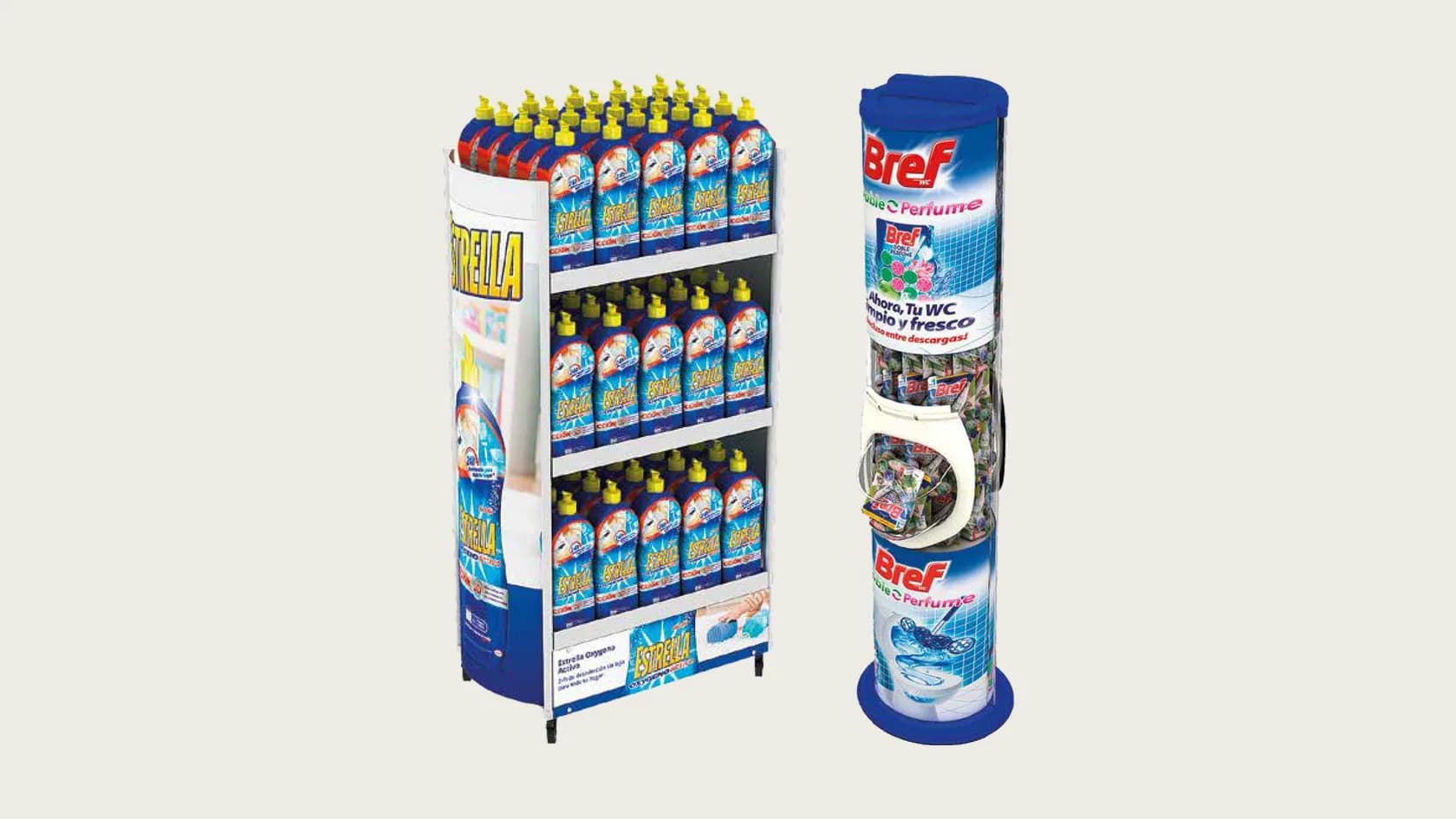
The two pieces in the cover image are for the household cleaning aisle. The Estrella Oxígeno Activo display sits on castors, with three shelves of bottles and a curved side that reproduces the bottle at large scale. The Bref WC one is a clear tube filled with loose product that comes out through an opening shaped like a toilet seat. For loose product there are more options in our post on dump bins.
The checkout
Space next to the checkout is tight and almost everything is an impulse buy: sweets, chewing gum, batteries, lighters. The display has to be narrow, show a lot of product on a small footprint and put up with hands all day.
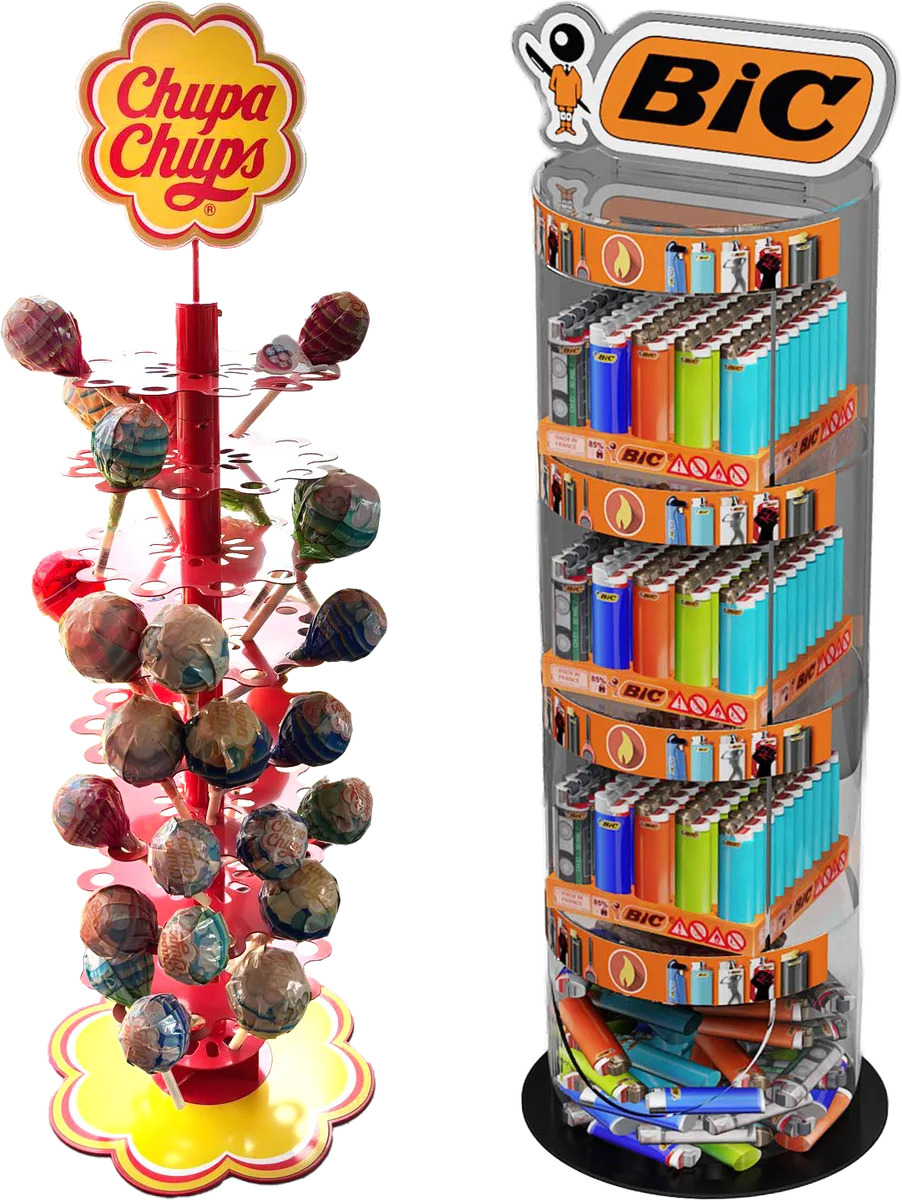
The Chupa Chups tower stacks die-cut, flower-shaped trays around a post, and every lollipop sits in its own hole, visible and easy to grab. The BIC one is a clear cylinder with trays of lighters sorted by colour and a bottom loaded with loose lighters, all visible through the tube.
What the retailer asks for
Before designing anything, it pays to know what each retailer accepts, because its rules override any idea.
- Footprint. Full, half or quarter pallet in the promotional areas, and the exact shelf depth on the shelf.
- Maximum height. The store's and the transport pallet's. It is the figure that shapes the design most.
- How it arrives. Assembled and loaded, ready to place, or flat for store staff to build. If it travels flat, it should go together without tools, as we explain in our post on the self-assembling cardboard display.
- Real load. Each shelf is sized for the product sitting on it and checked on a loaded prototype.
- Technical specifications. If the retailer has its own requirements for displays, we start from them.
Lead times and minimums
All lead times count from artwork approval.
- Quote. About two weeks.
- Prototype. Two weeks.
- Cardboard. 30 to 45 days of production.
- Permanent (metal, MDF, plastic). 45 to 60 days, also counted from prototype approval.
Minimums are per reference. In cardboard, 200 units for floor displays and 500 for countertop displays; in permanent materials, 100 for floor and 250 for countertop. Shelf pieces such as stoppers or shelf strips also have a minimum run, which depends on the piece.
What we need to quote it
- The products going on the display, with their packaging format and a sample of each. If that is not possible, exact dimensions and weight.
- Units per reference.
- Store area and retailers it is going to, with their dimensions and maximum pallet height.
- Assembled and loaded, or flat.
- Time in store, which separates a four-week promotion from a unit that stays.
- Versions per retailer, country or language.
Frequently asked questions
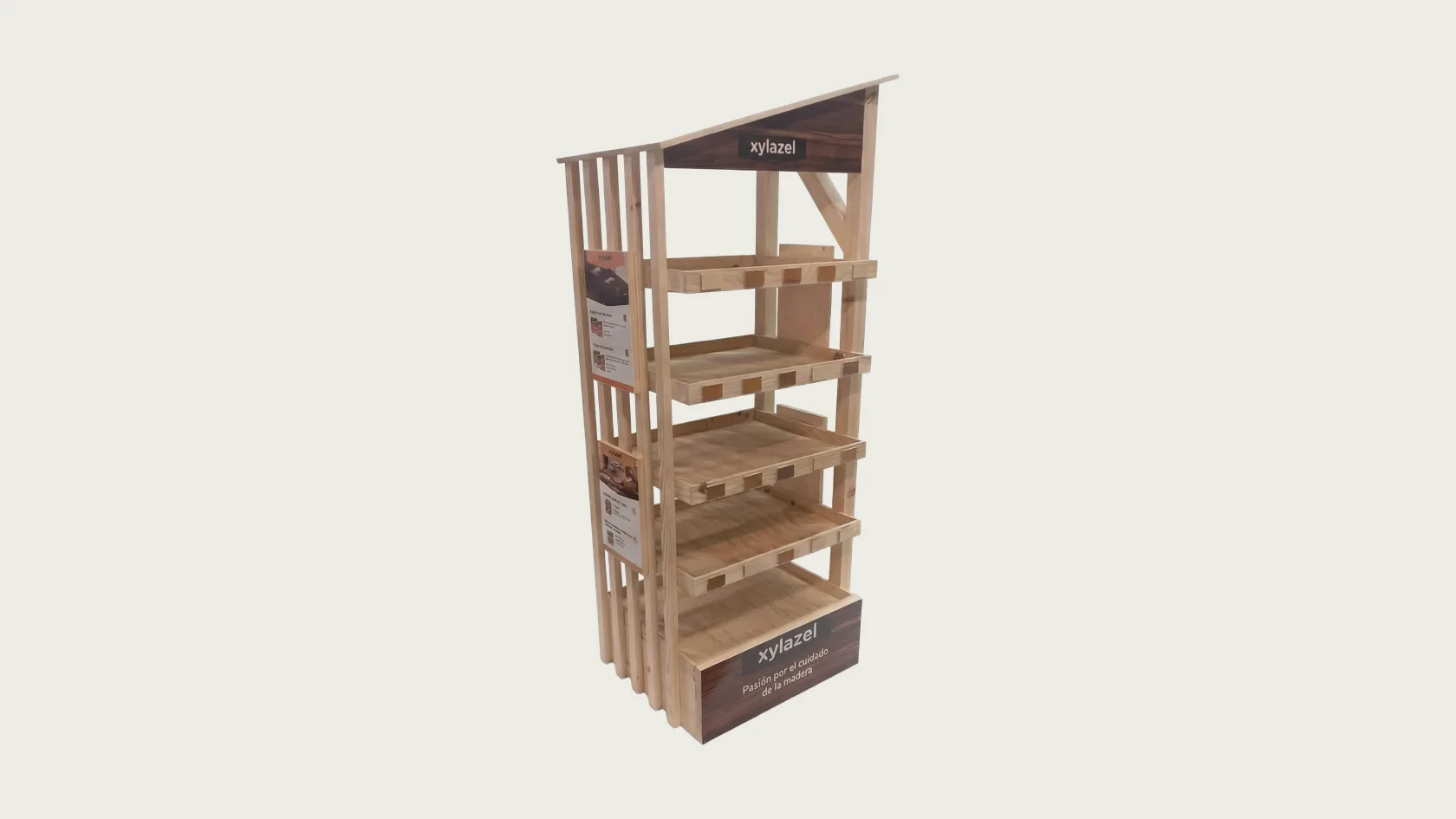
Which material works best for a supermarket? It depends on how long the display will stay. For campaigns lasting weeks, cardboard. For anything that stays months or years in the department, metal, MDF or plastic, and often a mix: a metal frame with interchangeable graphics.
Can you make displays that travel assembled and loaded? Yes. Cardboard can be designed to travel assembled and loaded with your product, ready to place in store, or flat to be built there.
Do you also make shelf POS, such as shelf stoppers or shelf strips? Yes. We design and make shelf stoppers, shelf strips, frames and shelf modules, fitted to each retailer's fixtures.
Do you work with the retailer's specifications? Yes. If the retailer has its own requirements on dimensions, materials or assembly, the design starts from them.
Do you ship to supermarkets outside Spain? Yes. We ship worldwide from Barcelona, and the same structure can go out with artwork in several languages, like the Rubson and Aoste displays in this post, which went out in French. We also handle in-store installation.
Planning a supermarket campaign?
Every retailer and every area of the store has its own constraints, so we do not work from standard catalogues. Tell us what the product is, where in the store it will go, in how many stores and by when, and we will tell you which piece makes sense and how long it takes.