In perfumery, the display competes with the product itself. The bottle is already a design object and the packaging already signals luxury on its own. The display has to add to that without stealing the spotlight.
That makes POP display design and manufacturing for perfumery a fairly different discipline from FMCG. The materials change, the level of finish you will be held to changes, and so do the lead times.
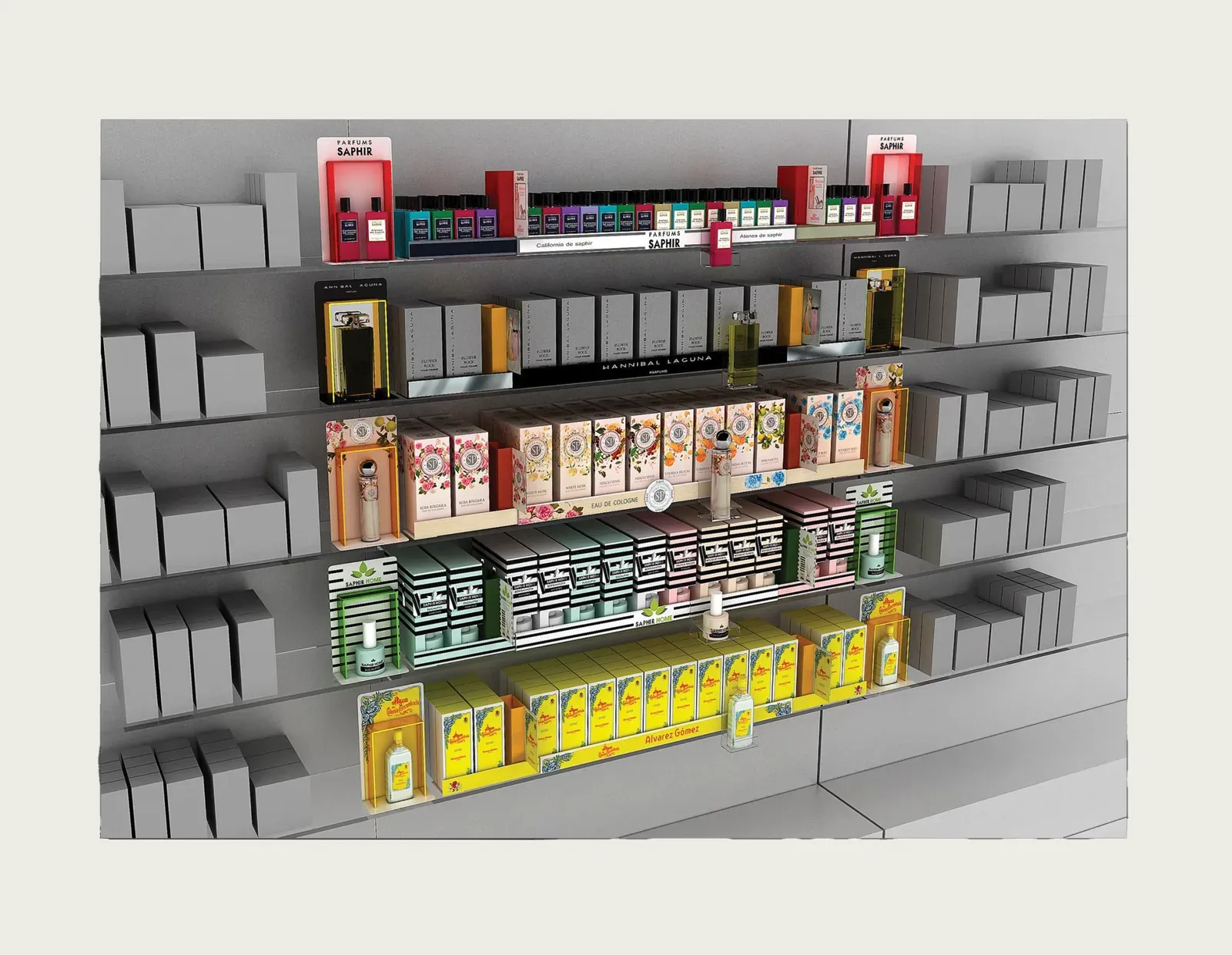
At Euromon PLV we have been building displays for this channel for 30 years, for houses like Gucci, BOSS, Calvin Klein, Lancaster, Chloé, Rabanne and Parfums Saphir. Here is what we have learned along the way.
Why perfumery is not designed like the rest of retail
Four constraints show up in almost every project in this channel, and they are worth putting on the table from day one.
The product is small, expensive and easy to steal. A 100 ml bottle costs about as much as a week's groceries and fits in a pocket. That forces an early decision on what goes on open display, what goes out as a tester, and what stays behind the counter.
The bottle is in charge. The display is the frame, not the painting. The moment the structure competes with the product on colour or volume, the brand kills it at the first review.
The retailer has the final say. Space at Douglas, Sephora or a department store is negotiated, and it comes with fixed dimensions, heights and sometimes mandated materials. A design that does not fit the agreed planogram never gets made.
The date does not move. A fragrance launch is timed against the media campaign, the press coverage and Christmas or Valentine's Day. A display that arrives late has arrived for nothing.
How POP display design and manufacturing for perfumery works
The path is fairly stable. Knowing it mostly helps you understand when you can still change your mind, and when you no longer can.
1. Briefing
What we need before drawing anything: the exact references to be displayed (with real dimensions and weights), the in-store location, the number of stores, the installation date, and the budget per unit.
The detail people forget most often is weight. A floor display loaded with twenty glass bottles is far heavier than most people estimate, and that drives the whole structure.
2. Concept and design
We work from the campaign artwork the brand already has. In perfumery you rarely start from scratch: the agency has defined a visual world, and the display has to fit into it without jarring.
This is where the expensive-to-change decisions get made: how many tiers, whether there is a glorifier, whether shoppers handle the product, and whether the piece is a campaign build or a permanent one.
3. Prototype
This is the step nobody should skip. We build the real piece, in the final material, and load it with actual product.
Our prototype lead time is 2 weeks. Something almost always turns up: a shelf that sags, a cutout that grips too tightly, a reflection that kills the artwork.
4. Production
With final artwork approved and the prototype signed off, it goes into the factory. Lead times vary a lot by material, and we break them down below.
5. Logistics and installation
We ship worldwide from Barcelona. In perfumery we do a lot of assembled-and-loaded delivery, because store staff do not always have the time or the appetite to build anything.
When the piece is large or rolls out to many stores at once, we handle in-store installation too.
Materials: which one, and when
There is no single best material. There is a right material for each combination of lifespan, volume and budget.
Acrylic
The star of the perfumery counter. It reads as luxury, lets light through, and allows podiums and glorifiers that lift the bottle without hiding it. We go into more depth on our plastic and acrylic displays page.
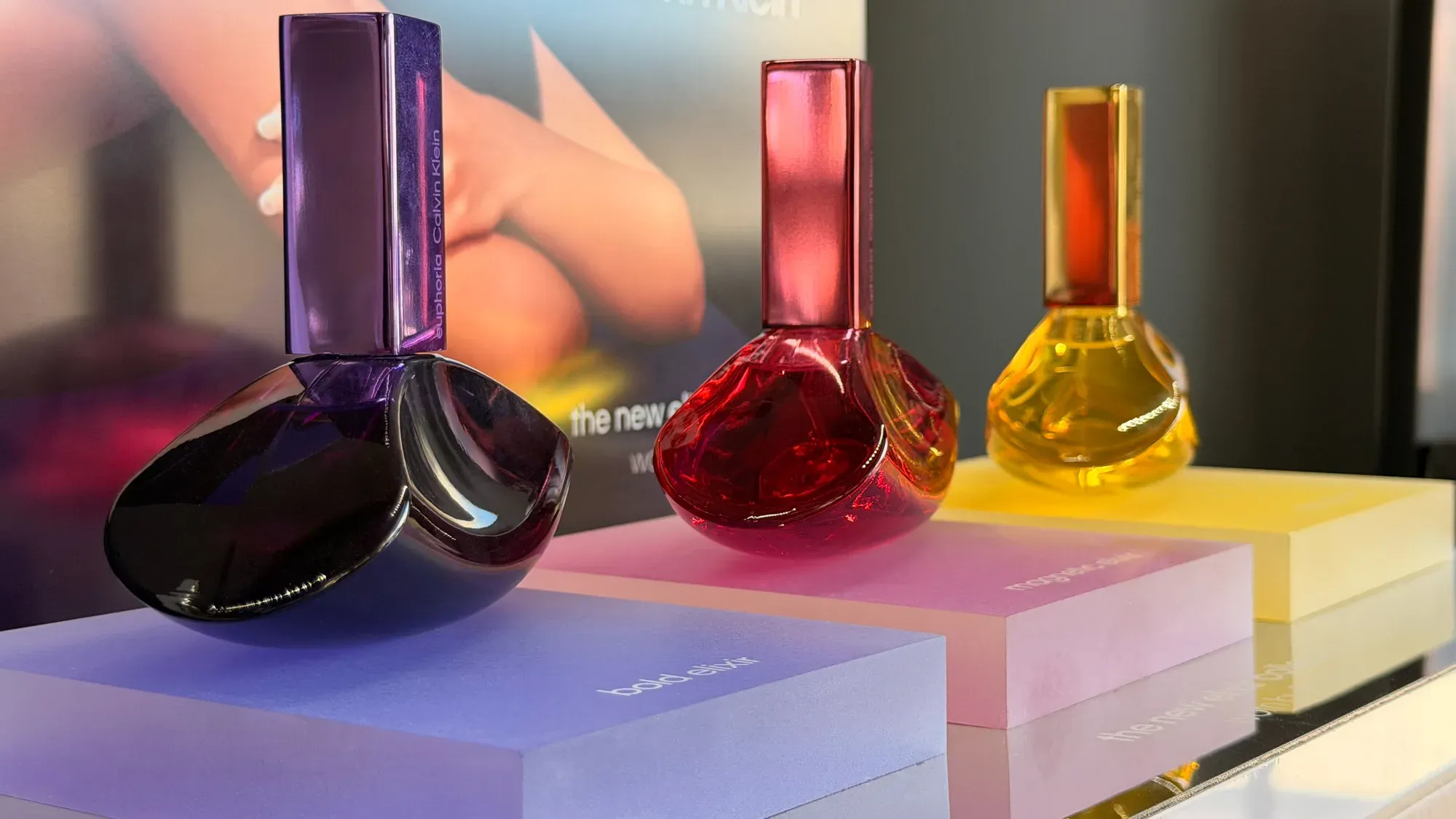
It is what we used for the podiums in Calvin Klein's euphoria collection: solid acrylic tinted lilac, pink and yellow, each screen printed with the name of its elixir, on a mirrored tray.
Its limits are cost and weight: on large floor displays the price climbs fast.
Lacquered MDF
The workhorse of the permanent display. It lasts for years, takes lacquer in any colour, and accepts routing to seat the product.
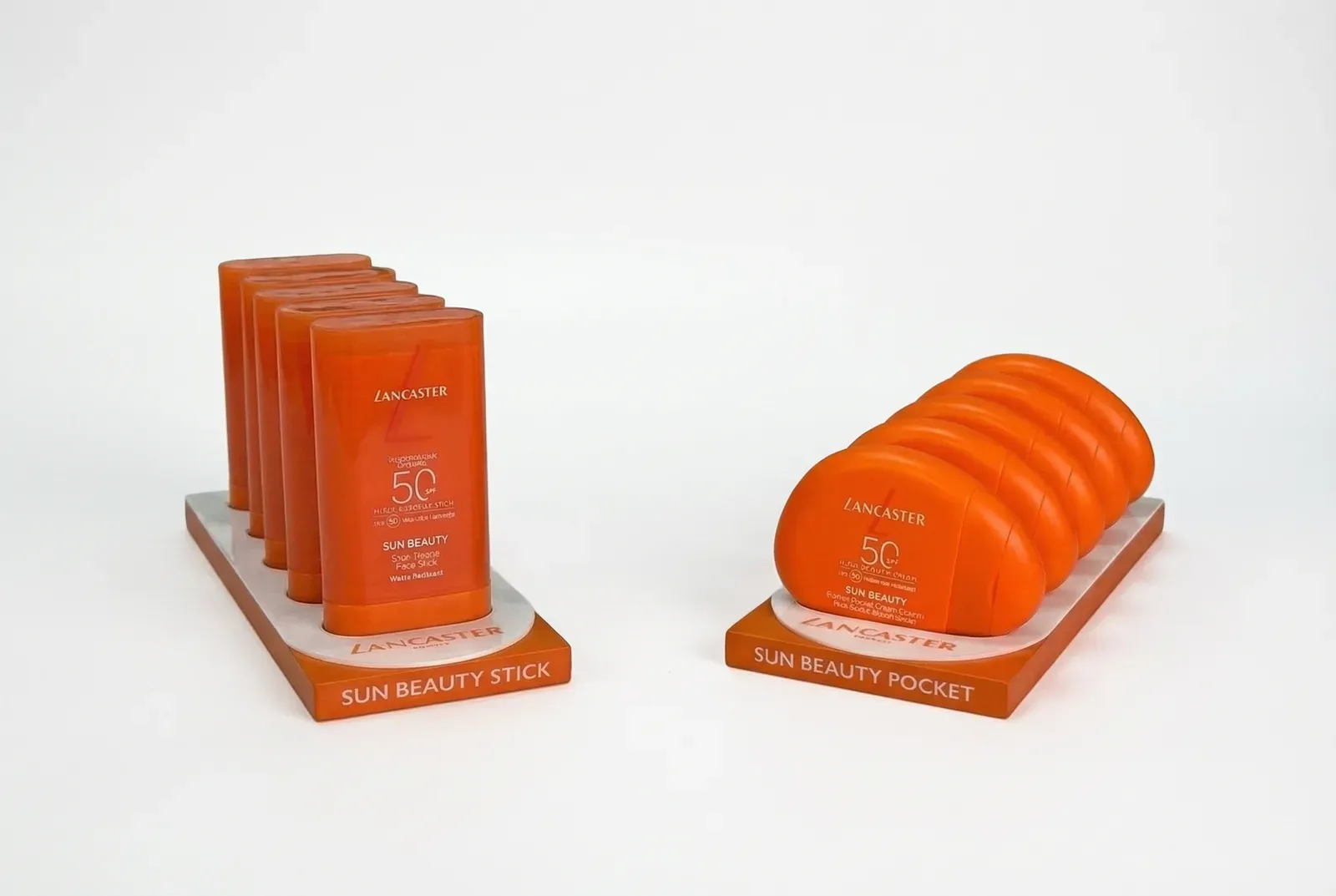
Lancaster's Sun Beauty positioners are a good example: an orange lacquered MDF base with the variant name screen printed on it, topped by a white acrylic insert that seats the product.
Premium cardboard
Cardboard has an unfair reputation in perfumery. With matte lamination, gloss varnish reserves and internal reinforcement, the result is genuinely surprising.
The BOSS Bottled Beyond column is compact cardboard, laminated in matte black with the typography in gloss varnish. From a few steps away nobody would guess it is not a cabinet.
It is the option for 4 to 12 week campaigns at medium to high volumes.
Metal
For permanent pieces with heavy traffic or heavy loads. It pairs well with magnetic vinyl when the same unit has to change brand between campaigns without scrapping the structure.
Mixed
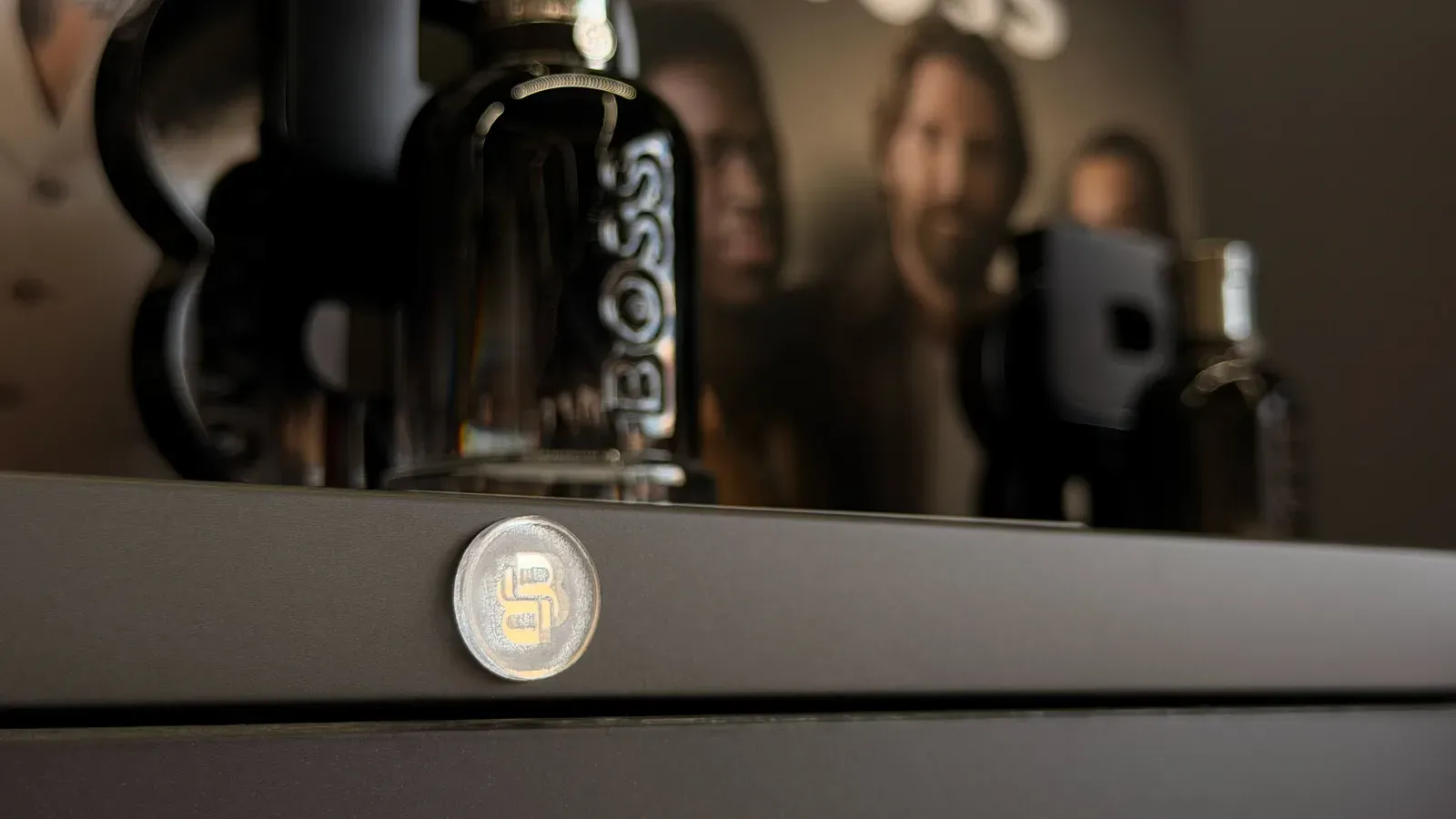
In practice, most perfumery projects end up combining. The BOSS display has a cardboard body, a top module wrapped in leather-effect vinyl, an ice-finish acrylic positioner and a mirror-finish acrylic medallion on the edge.
Each material doing what it does best.
The details that make the difference
Between a perfectly decent perfumery display and one the brand shows off, there are four or five small decisions.
The glorifier. A riser that separates the hero bottle from the rest of the range. It costs little and completely reorders the visual hierarchy of the whole piece.
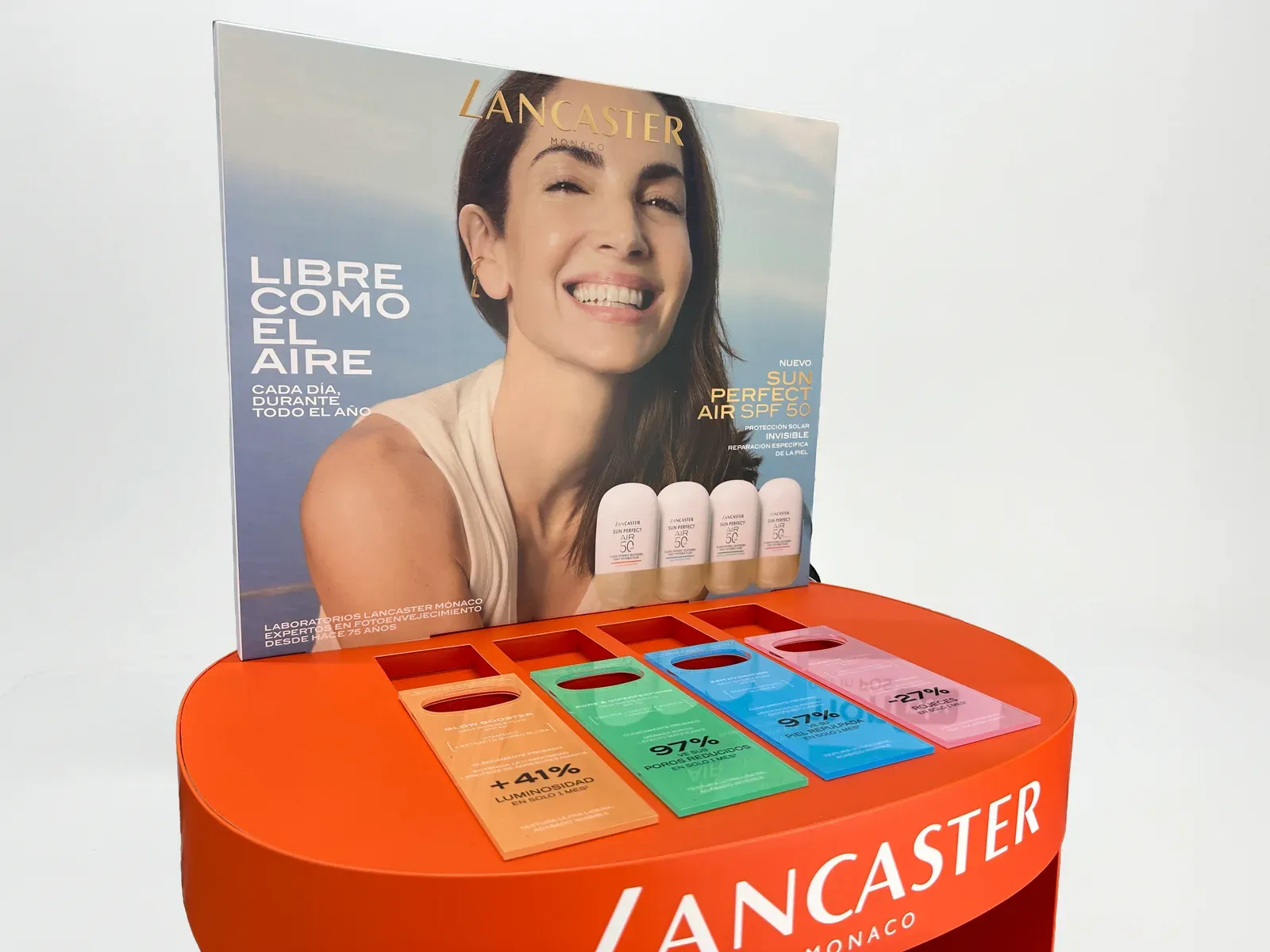
Colour coding by variant. When a range has four near-identical references, giving each one its own colour on the positioner saves the shopper from reading labels. Lancaster takes this to the limit, with the efficacy claim screen printed on every tab.
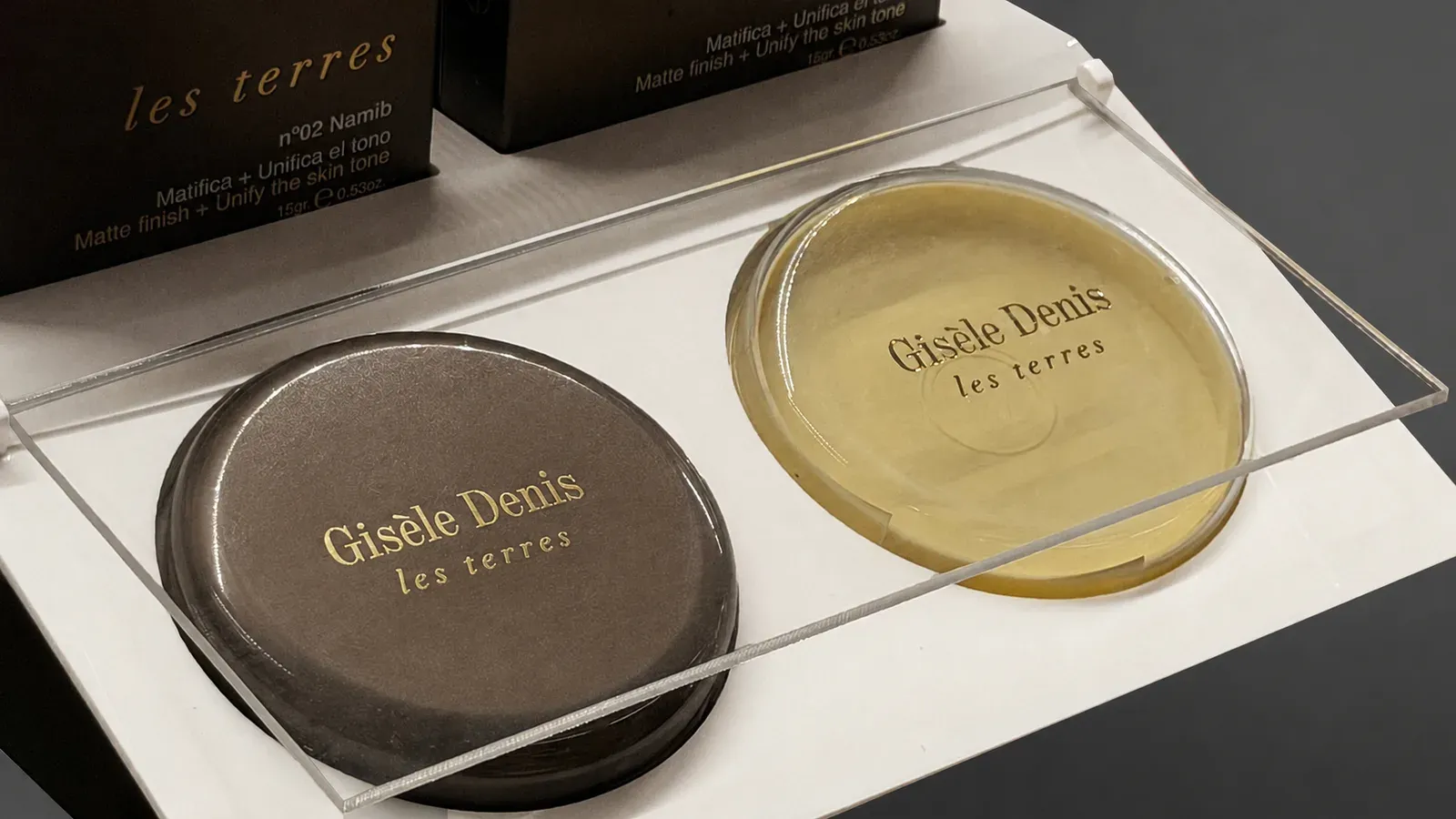
The tester area. Close to mandatory in perfumery, and almost always badly handled. The tester has to be reachable but held in place: a cutout matched to the product and an acrylic cover solve 90% of cases.
The edge finish. This is where the price difference shows. A recessed mirror-finish acrylic medallion, a lacquered edge instead of an edge band, screen printing instead of vinyl.
Lighting. An LED strip along the shelves multiplies the impact, especially in makeup corners. Always mains powered, never batteries: a three month campaign will drain anything you put in it.
Lead times and volumes: the real numbers
These are our usual lead times. The last column says when each one starts counting.
| Type of piece | Lead time | From |
|---|---|---|
| Quote | about 2 weeks | Brief received |
| Prototype | 2 weeks | Design approved |
| Cardboard (campaign) | 30-45 days | Final artwork approved |
| Permanent (MDF, metal, acrylic) | 45-60 days | Final artwork and prototype signed off |
Minimums are counted per SKU: in cardboard, 500 units for countertop and 200 for floor displays; in permanent materials, 250 for countertop and 100 for floor. Below those figures, the cost of the cutting die or the tooling is spread across so few pieces that the unit price stops making sense.
Frequently asked questions
How much does a perfumery display cost?
It depends mostly on material and volume. An acrylic counter glorifier and a permanent lacquered MDF floor tower with lighting can be a factor of thirty apart. Give us the references, the number of stores and the date and we will send you a quote in about two weeks.
Can the display be reused across several campaigns?
Yes, and it is what we recommend for permanent pieces. The structure is designed neutral and only the graphics and positioners change each campaign. With magnetic vinyl, store staff can do the swap themselves.
Do you work from our agency's design?
Usually, yes. We receive the campaign's visual world and take care of the technical development: structure, engineering, prototype and production. We also design from scratch when the brand has no concept yet.
Is cardboard good enough for a luxury brand?
With the right finishes, yes. Matte lamination, varnish reserves, textures and internal reinforcement produce results that compete with rigid materials at a fraction of the cost. The BOSS Bottled Beyond project is cardboard.
Can you install the displays in store?
Yes. We ship worldwide from Barcelona and offer in-store installation, which helps a great deal when the rollout happens simultaneously across many stores.
Let's talk about your next launch
Every brand is unique. Every display too. If you have a perfumery campaign coming up, tell us what the product is, how many stores and by when, and we will tell you what can be done with that budget and that deadline.
Tell us about your project and we will take it from there.