

Woodprint is what we call digital printing straight onto a wooden board. The artwork goes onto the board itself in a flatbed printer, with no paper, vinyl or laminate glued on top, and the printed board is then cut into the pieces of a display.
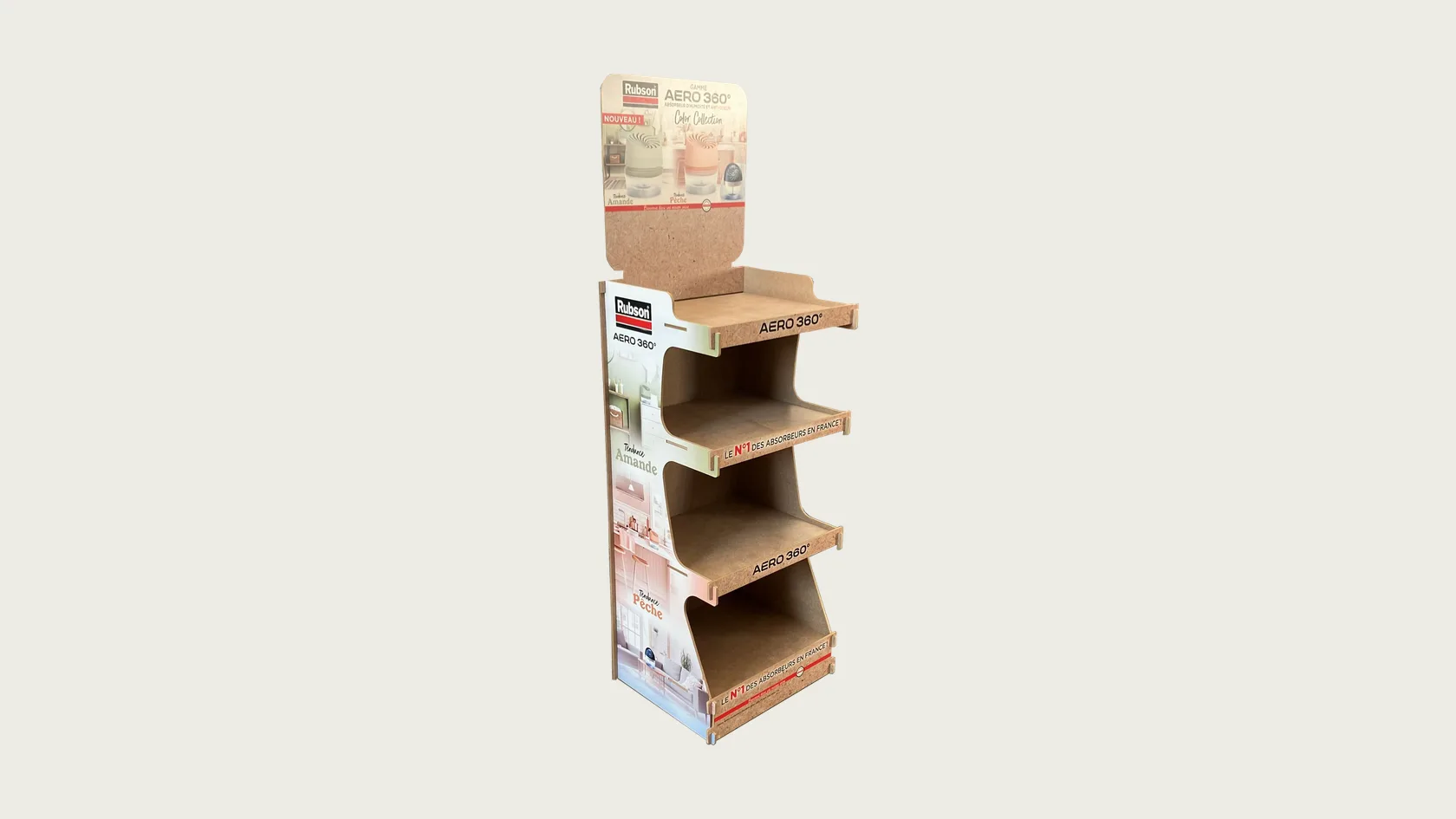
At Euromon PLV we use it on point of sale displays, mostly in MDF, and ship them worldwide from Barcelona. The display in the cover photo, for Rubson, was printed this way, and so were the other three pieces in this article.
If you searched for woodprint looking for something else, the word has two other meanings. In printmaking it is a woodcut, a print made from a carved wooden block. Online photo shops sell "wood prints", photos printed on a wooden panel to hang on the wall. This article is about the industrial technique.
What is Woodprint?
Woodprint is direct digital printing on wood, applied to POS displays. Three things define it.
- The method. A flatbed printer lays the ink on the board, so the image becomes part of the surface.
- The board. Mostly MDF, raw or with a white face, which is flat, even and has no grain to fight the print.
- The use. Floor and countertop displays, shelf fronts, headers and side panels that need a photo, a logo or the brand's colours on a wooden structure.
The alternative is to print the artwork on paper or vinyl and glue it onto the board. That works, but it adds a layer that can lift at the corners, and it turns the piece into two materials that are harder to separate at the end of its life.
How digital printing on wood works
The process has four steps.
- We choose the board. For printing, the MDF comes from the supplier with a white face already on it. When the brand wants the wood to show, we print on raw MDF instead.
- The whole board goes through the printer, flat. We print on an HP Latex R1000, a printer built for rigid boards, with water-based latex inks. The printer cures the ink with heat, so the board comes out dry.
- The printed board is cut. The cut follows the artwork, which is why the print reaches the edge of every piece and the edge itself shows the brown MDF.
- Nothing goes on top. There is no varnish, no laminate and no film over the ink. The pieces are assembled with tabs and slots, usually without screws.
Raw MDF or white-faced MDF
The board decides how the colours look. These are the finishes we use most on MDF displays.
| Finish | How it looks | When we use it |
|---|---|---|
| Woodprint on raw MDF | The brown board shows through. Colours print darker and warmer, and light tones fade into the wood | When the brand wants a natural, kraft look and the artwork is mainly dark lettering or a logo |
| Woodprint on white-faced MDF | Colours look like the brand's, and the white is the board itself. The edges stay brown | Photos, brand colours and anything with a white background |
| Lacquered MDF | One solid colour, usually the brand's Pantone, with no image | Structures in a single brand colour |
The cover photo shows the first two side by side. On the Rubson Aero 360 display, the header photo and the "AERO 360°" lettering on the shelf fronts are printed on raw MDF, and you can see the photo fade into the board at the bottom of the header. The side panel, on a white base, keeps the colours of the room photos.
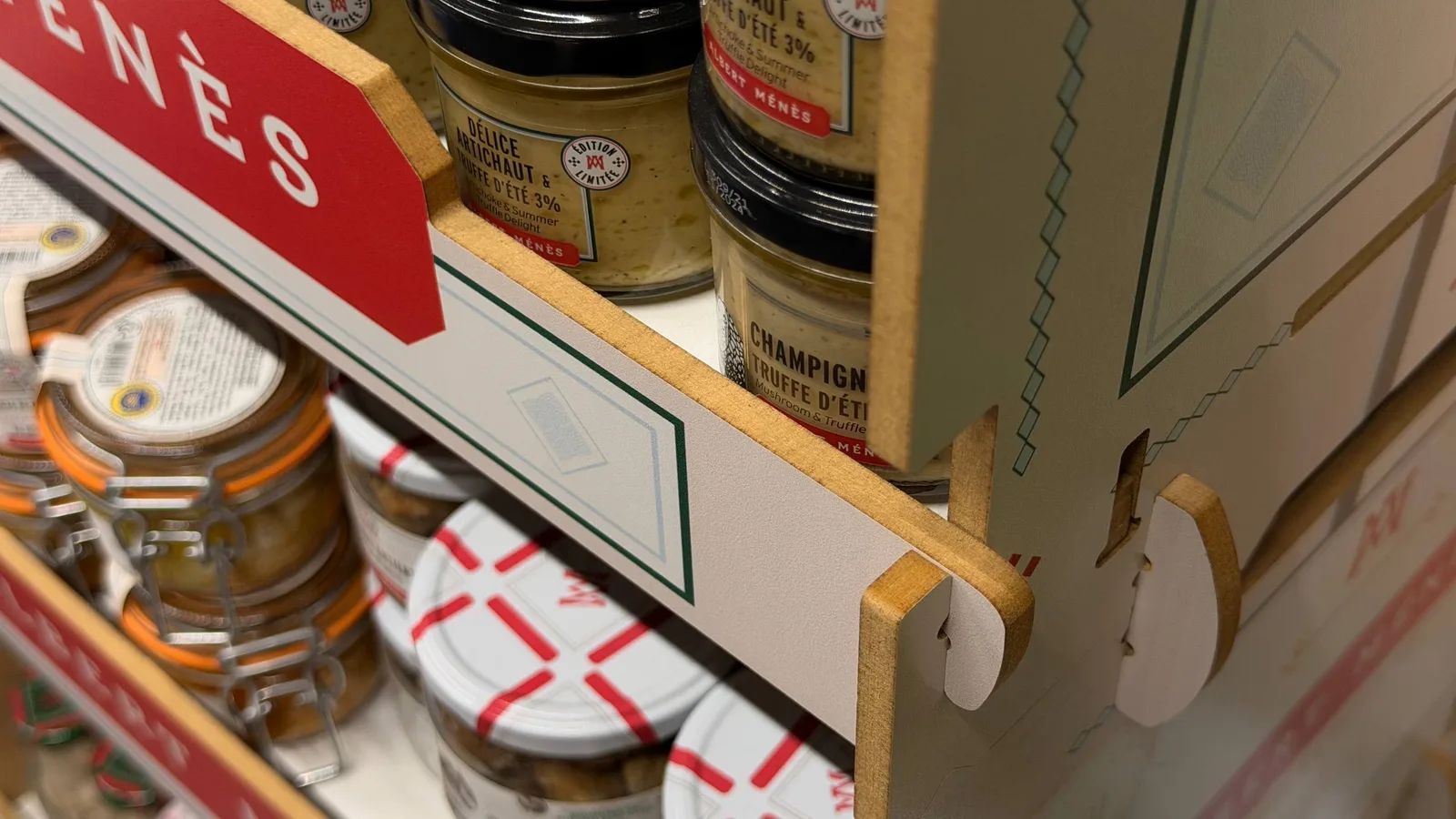
For Albert Menés, the gourmet food brand, the shelf fronts are white with a green line and a red plate with the brand name. In the store photo you can see how the print runs right up to the brown edge of each front and around the tab joints.
There is more on the board itself, its edges and its other finishes on our MDF displays page.
What Woodprint can and cannot do
Woodprint gives a sharp, full-colour image on wood, but some things depend on the board and not on the printer.
- White comes from the board. We do not print white, so a white background or a white logo needs white-faced MDF. On raw MDF, anything light disappears into the brown.
- On raw MDF, colours shift. The board tints the ink, so reds come out darker and pale colours drift towards beige. If the brand colour has to match, the board has to be white-faced.
- The edges stay brown. Every cut edge shows the MDF. On raw MDF we leave it exposed, and on printed pieces it is the way to recognise the material.
- MDF has no grain. If the brand wants real wood grain, that is solid wood or a veneer, which we cover on our wooden displays page.
- It is for indoor displays. MDF does not get along with water, so these are pieces for the inside of a store.
Where we have used Woodprint
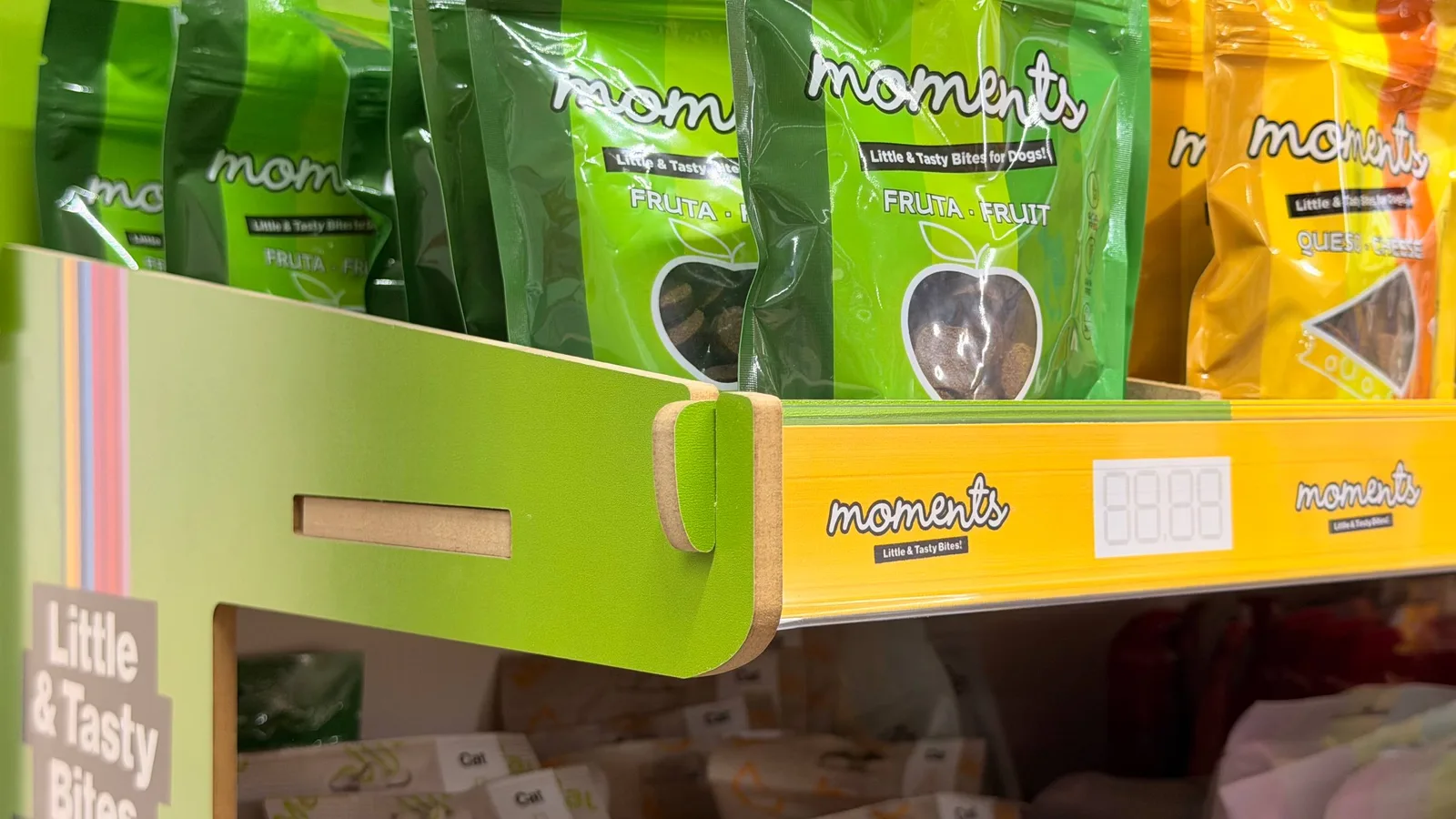
Moments makes dog snacks. Their display is printed in green and yellow from edge to edge, with the logo on every shelf front and a cut-out where the store puts its price label. The tabs that hold the shelves show the brown edge of the board.
Sika needed a countertop display for its Sikaflex range of adhesives and sealants. It has three channels for cartridges, a header with a photo of a worker and a yellow front with four icons for the product's benefits, all printed on the wooden board before it was cut.
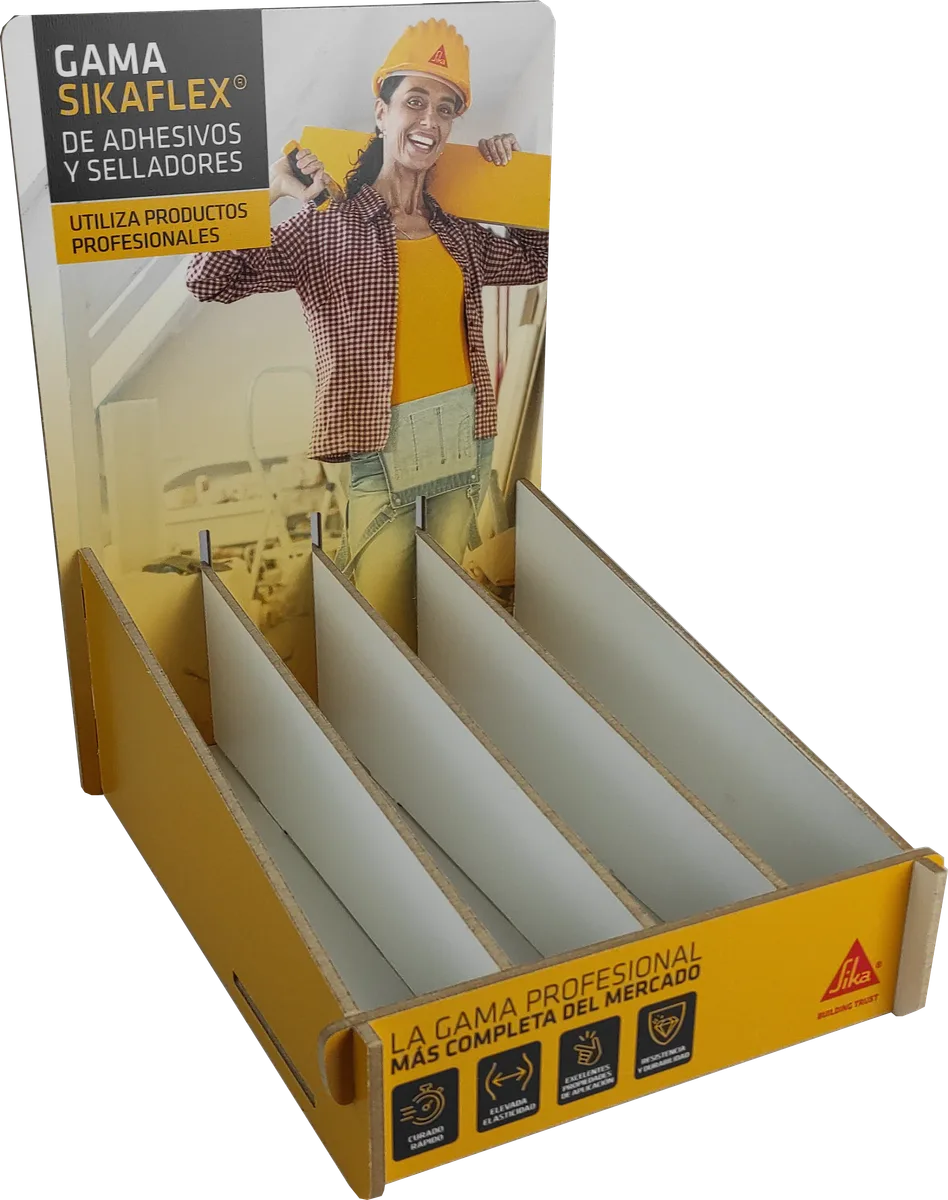
Together with Rubson and Albert Menés, these four displays cover the usual range of Woodprint: raw board with dark lettering, white-faced board with photos and brand colours, floor units and countertop units. To compare wood with other materials, read how to correctly choose POS materials.
HP Latex inks and sustainability
We were pioneers in Spain in bringing the HP Latex R1000 into POP display manufacturing. Its latex inks are water-based, and HP has them certified to UL ECOLOGO and UL GREENGUARD Gold, the second one for low chemical emissions into indoor air.
Printing straight onto the board also keeps the display simple at the end of its life. With no varnish, laminate or glued sheet on top, a printed piece is just board and ink, which makes it easy to recycle.
Our certifications and the rest of what we do on this front are on our eco page.
Frequently asked questions
What is the difference between Woodprint and a wood photo print? A wood photo print is a picture printed on a wooden panel to hang on a wall. Woodprint is the same idea applied to a POS display: the board is printed and then cut into the pieces of the display.
Can you print on raw wood? Yes. On raw MDF the brown of the board shows through, so colours come out darker and warmer. For white backgrounds or exact brand colours we use MDF with a white face.
Is printing directly on the board better than gluing a printed sheet on it? It removes a layer. There is no sheet that can lift at the corners, and the piece stays a single material, which makes it easier to recycle.
Is the print varnished afterwards? No. The latex ink stays on the board as it comes out of the printer, with no varnish or laminate on top.
Planning a wooden display?
Tell us which product it will hold, where it will go and what the artwork needs to show, and we will tell you whether raw MDF, white-faced MDF or another finish suits it.


