Hardly anyone walks into a pharmacy looking for a brand. They come in because of a sore throat, thinning hair or a bad night's sleep, and they often ask before they pick anything up. The POS displays that work in this channel help that person find what they need, and give the pharmacist something to point at while explaining it.
That shows in the design. Ranges are sorted by need, the skincare shelf is shared between a lot of brands, and the same unit has to fit a small neighbourhood pharmacy and a big one in a shopping centre.
At Euromon PLV we design and manufacture displays for pharmacy brands such as Aquilea, Arkopharma, Pilexil, Mustela, Bioderma and Santé Verte, part of Cinfa. Below are five design decisions, each with one of those projects in front of us, followed by lead times and minimum runs.
How to organise the range on a pharmacy POS display
The first job of a pharmacy display is to tell the shopper where their product is. The units that work best label every level with the need it covers and leave the product name for later.
The Santé Verte floor display does it in kraft cardboard. Every shelf front carries coloured strips with the need (joints, vitamin C, immunity, throat, nose, relaxation and sleep), and below them there are two rows of hooks for the bags of sweets. The shopper reads "soothes the throat" before the brand name, which is the order they think in when they walk in.
The Aquilea unit does the same in wood, built to last for years. It has seven shelves, each with a category label in its own colour (digestion, sleep, energy, weight, vitamins and minerals, joints and respiratory), and a branded drawer at the base to keep the refill stock. Pharmacies rarely have storage to spare, so that drawer keeps the backup stock right next to the unit.
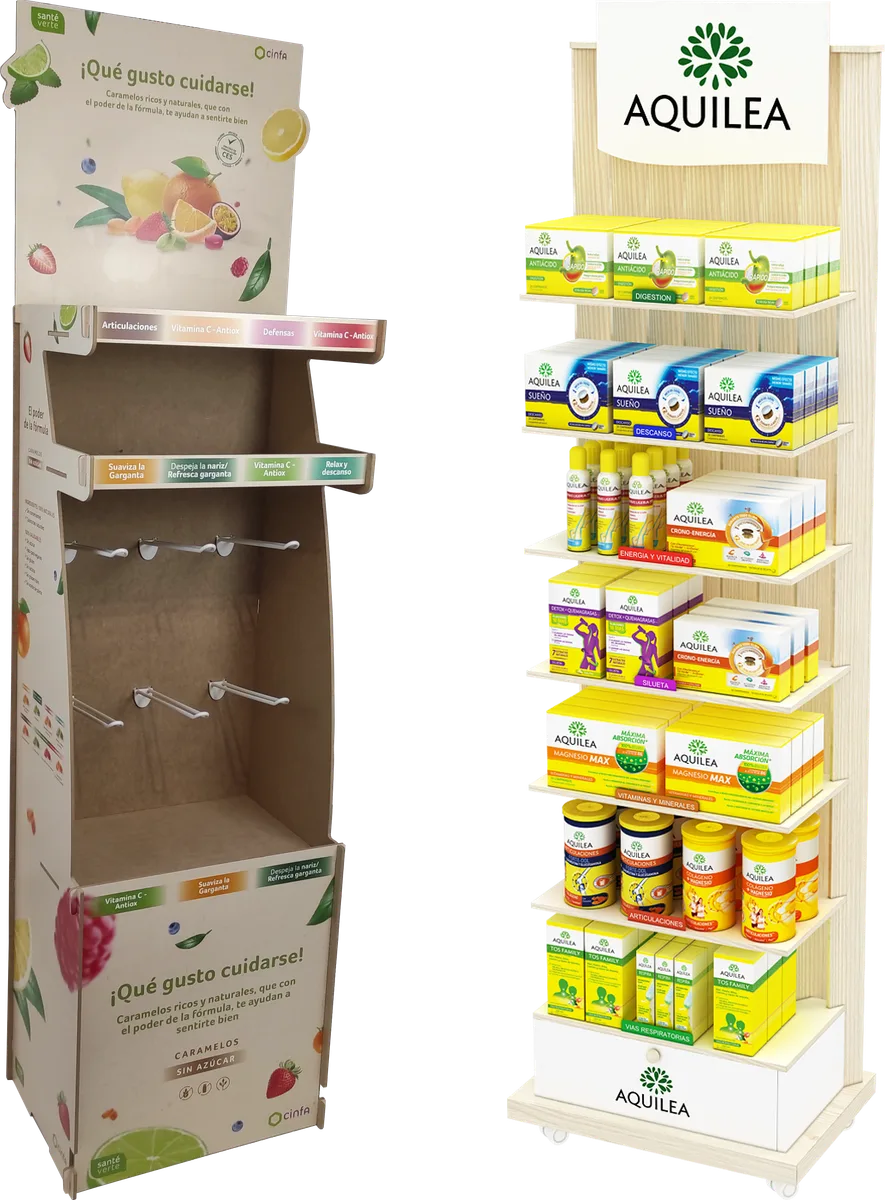
In design terms this comes down to small decisions. One colour per need, the same across every piece the brand puts in the store. The label on the front of each shelf, at eye level, and not only on the header. And before anything is drawn, how many products sit under each need, because that sets the width of each level and the number of shelves.
A permanent unit for the core range
Some ranges stay in the pharmacy all year, like herbal medicine or food supplements. For those a permanent unit pays off, and the questions change: how long it lasts, how it gets restocked and what happens when the range grows.
The Arkogélules unit for Arkopharma is made of light wood bodies stacked on a black plinth. Each body holds two angled trays with coloured strips that separate the product families, and a smaller module overhangs at the top. On the back, each body carries a graphic panel with plants, capsules or the logo, because in many pharmacies the unit is also seen from behind.
Building in modules has another advantage. The same parts can give a shorter version for pharmacies with less room, and changing a graphic panel doesn't mean touching the structure.
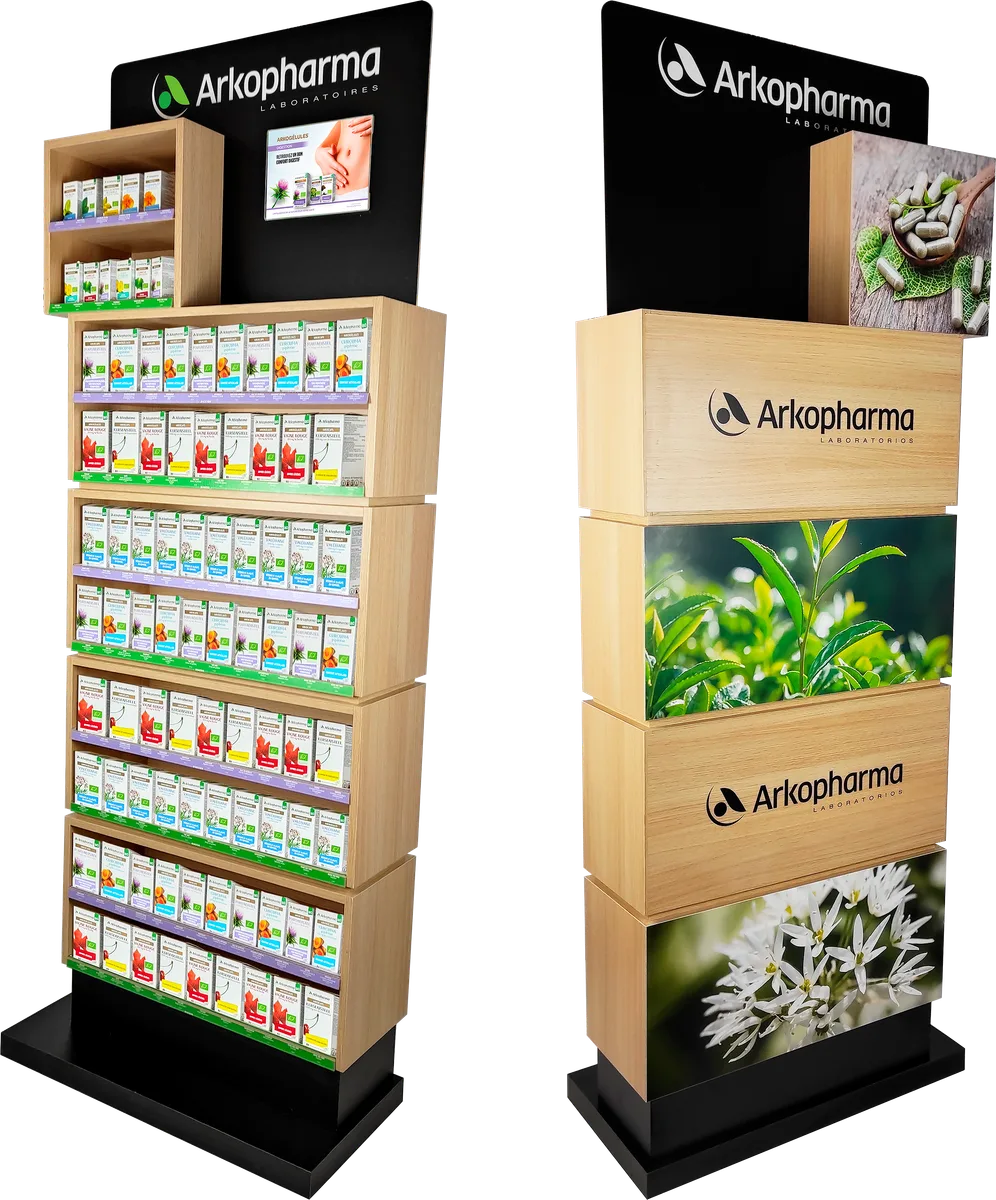
Wood stands up to years of daily use and suits natural products, which is why it is showing up more and more in pharmacies. There is more on it on our wooden displays page. If you are still weighing a permanent unit against a campaign one, our post on permanent POS displays covers what to decide before you order.
One campaign in several formats
Launches and seasonal campaigns are nearly always done in cardboard, and pharmacies add a complication. The same launch goes to stores with room for a floor display and to others that will only take something on the counter.
The Pilexil campaign for its Tripl3 anti hair loss shampoo has three pieces with the same artwork: a cube plinth, a counter card with the bottle at large scale and its three levels of action, and a narrow cardboard floor display with three labelled levels for shampoos, food supplements and lotions. A pharmacy with space can take all three, and a small one can keep the card and the plinth without losing the message.
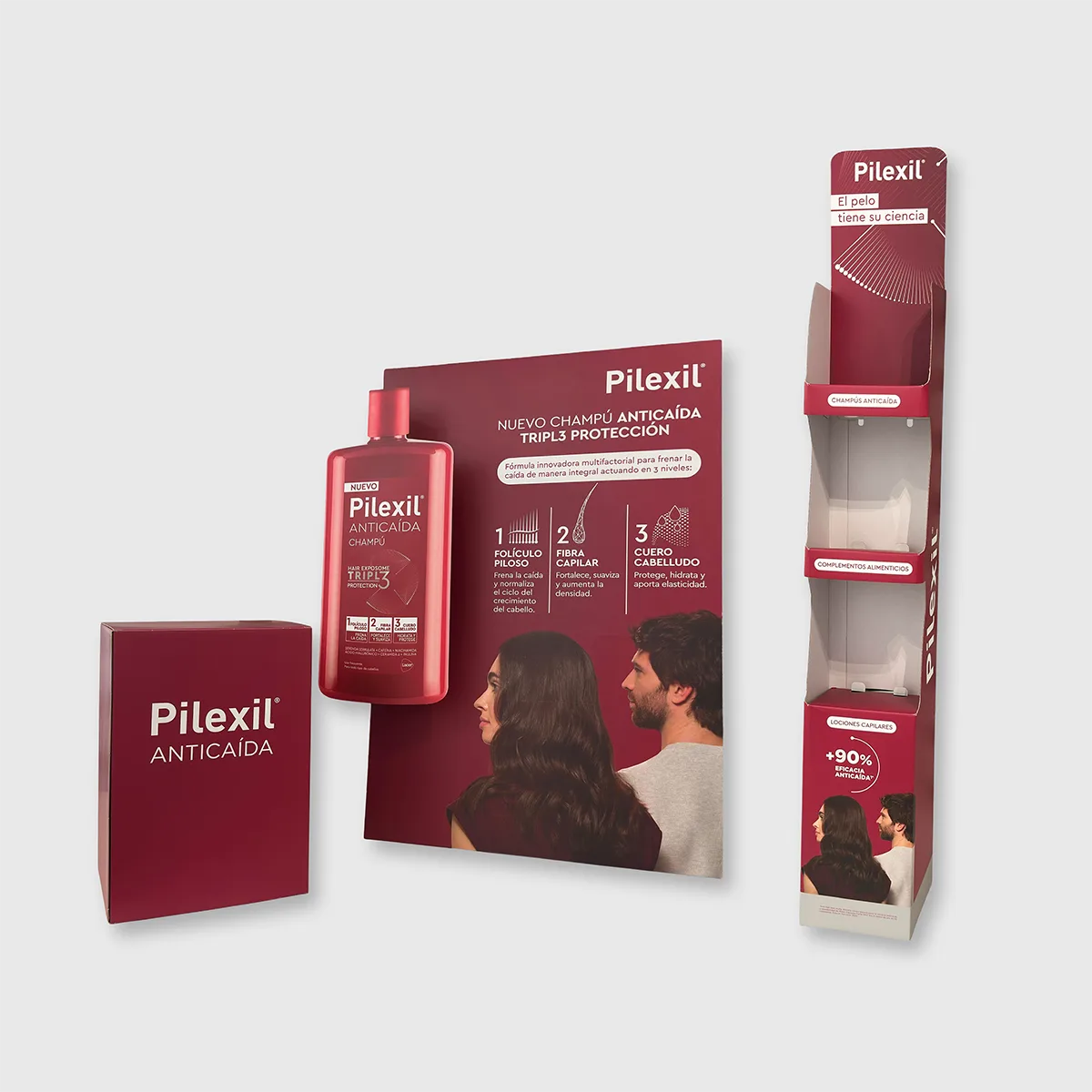
To produce a kit like this, remember that each format is a separate reference with its own minimum run: 200 units for a cardboard floor display and 500 for a countertop one. If much of the network will only use the counter card, that card is the piece with the longest run, and it helps to know that before the allocation is closed. For counter pieces, our post on the pharmacy counter display lists the sizes pharmacies usually accept, and the cardboard formats are covered one by one in cardboard displays for pharmacies.
Shapes you can recognise from the door
You can take in almost the whole of a pharmacy from the entrance, and a shape registers long before any text can be read. That is why units that turn the product or the campaign into a volume work so well.
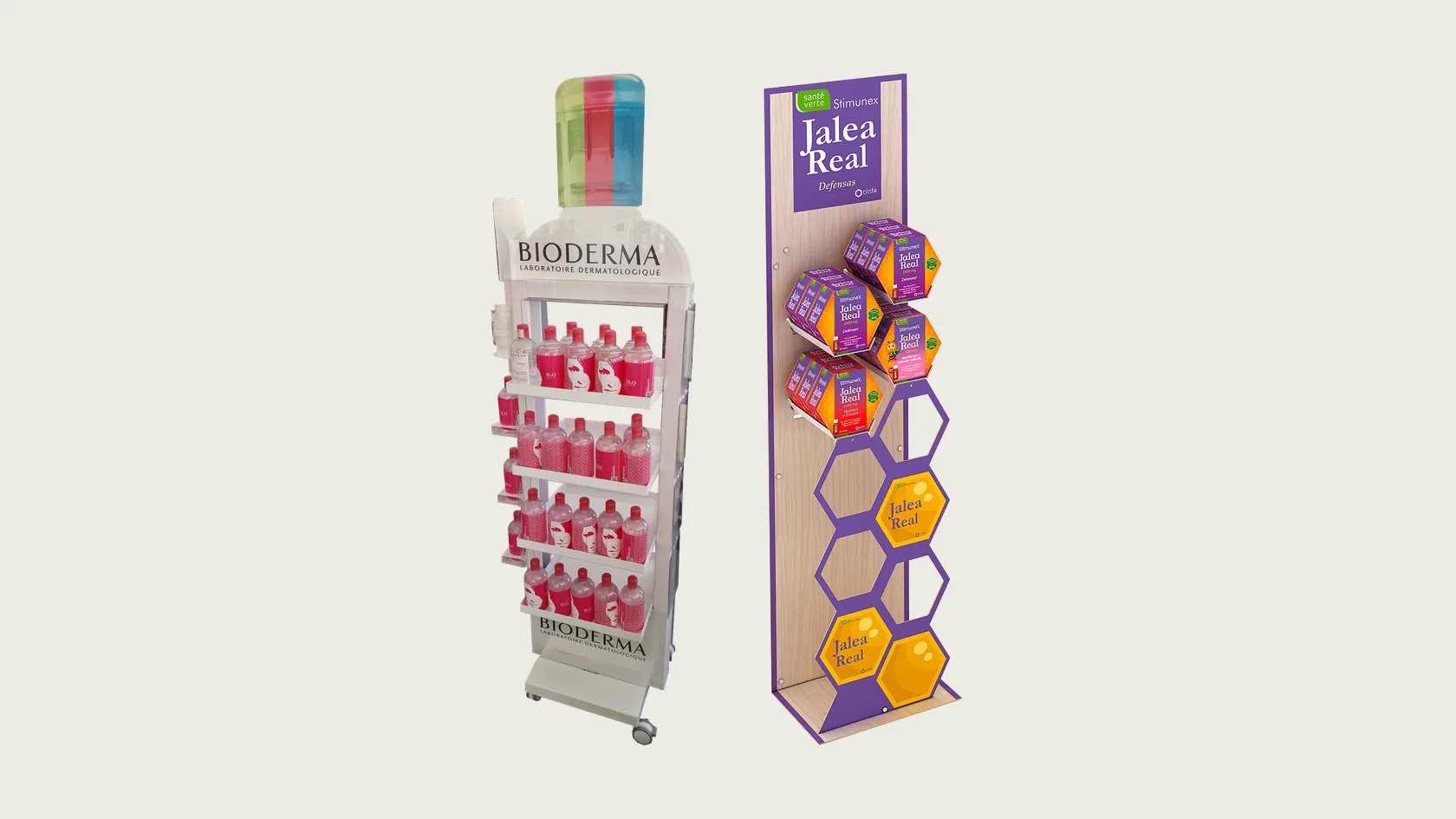
The Bioderma floor display on the cover is topped by a giant bottle of micellar water split into three bands, green, pink and blue, the cap colours the brand uses to tell its ranges apart. The Stimunex unit by Santé Verte is recognised by the honeycomb on its lower half, which echoes the hexagonal boxes of its royal jelly.
On the counter, shape does the job that size does on the floor. For Mustela's sunglasses, the countertop display is a striped beach hut that holds the boxes by size and colour, next to a surfboard with four pairs on show and the age bands printed on it, from 0-2 years to adult.
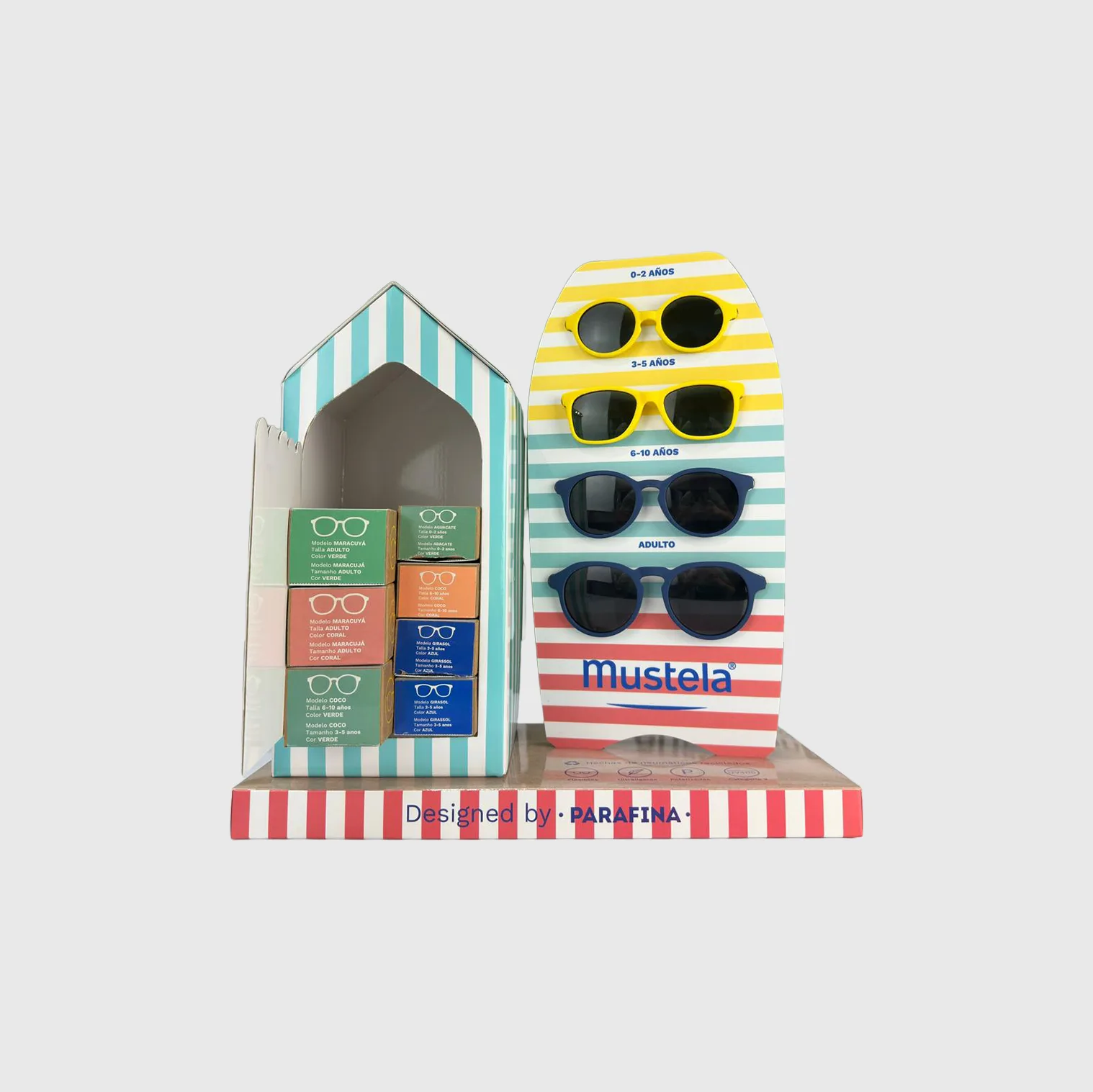
Most of these shapes are made in die-cut cardboard, which is also the cheapest way to build a dummy, the oversized replica of a product. Plastic injection gets more complex shapes, but it costs a good deal more.
The brand block on the shelf
Skincare sells mainly from the shelf, and in a pharmacy the shelf is shared between many brands. The display has to work inside the space the brand already has, without asking for more.
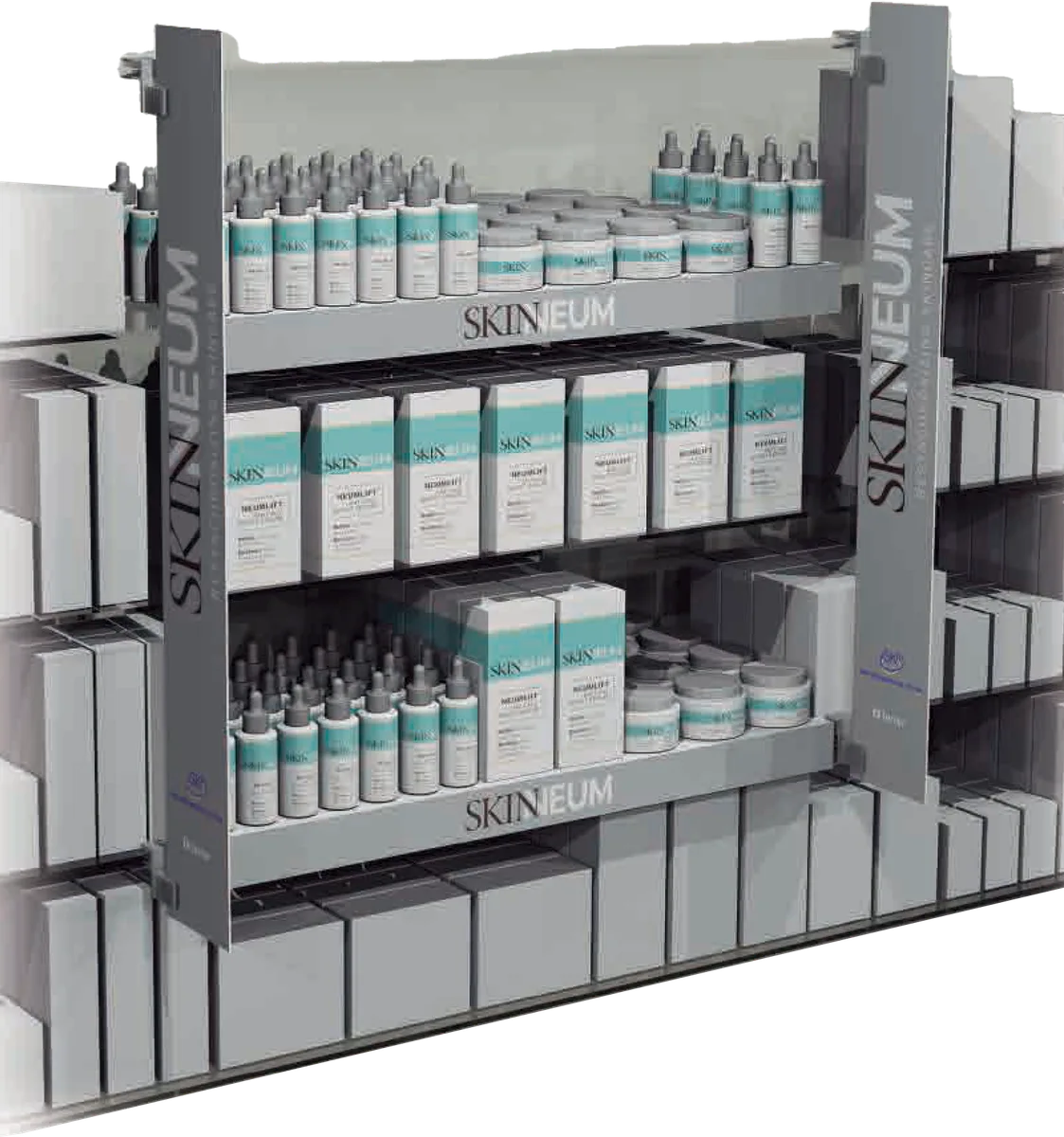
The Skinneum module fits into the pharmacy's own gondola with two anthracite side panels, the logo running vertically, and branded shelf fronts. The serums, boxes and jars are framed as one block, and the brand stands out on the shelf without taking a single facing from anyone else.
The smallest version of the idea is the shelf strip. The one we made for Sesderma is folded sheet lacquered in gold, with the logo laser cut and the brand's butterfly cut out on the top edge. It marks the block without taking any product frontage. Shelf strips, frames and headers have their own page, shelf-edge displays.
Lead times and minimum runs
Every project we do is made to measure, so there is no catalogue price. What is fixed is how lead times and minimums are counted.
| Piece | Production | Minimum per reference |
|---|---|---|
| Cardboard floor | 30-45 days | 200 units |
| Cardboard countertop | 30-45 days | 500 units |
| Permanent floor | 45-60 days | 100 units |
| Permanent countertop | 45-60 days | 250 units |
Cardboard is counted from artwork approval, and permanent pieces (wood, MDF, metal or acrylic) from artwork approval plus prototype sign-off. Before that come about two weeks for the quote and two for the prototype, which we build ourselves and test with the real product. Each phase is broken down in our guide to lead times for custom POS displays.
The minimum applies per reference. If a campaign has one display per range and each version only changes colour, each one counts as a separate run.
To quote, we need three things: how many units, a sample of the product (or its exact dimensions if that isn't possible) and the maximum pallet height.
Frequently asked questions
Which material suits pharmacy POS displays?
It depends on how long the piece will stay in the store. For a campaign of a few weeks, cardboard, which is the cheapest. For a range that stays all year, wood, MDF or metal. Acrylic is used mostly on skincare countertop units that need a more refined finish.
What is the minimum order?
In cardboard, 200 units for floor displays and 500 for countertop ones. In permanent materials, 100 for floor and 250 for countertop. Always per reference, even when two versions share a design.
Can you work from our design team's artwork?
Yes. Once the project is defined we send you the technical template of the piece so your team can lay the artwork over it. If nothing is defined yet, we start from your product and design it with you.
What if the product is an over-the-counter medicine?
Then the messages on the display follow their own rules. We go through them in our post on OTC pharmacy POS displays.
Do you ship outside Spain?
Yes. We ship worldwide from Barcelona, flat-packed for assembly on arrival or assembled and loaded, and we also handle in-store installation.
Do you have a pharmacy range that needs a display?
Tell us what the product is, how many pharmacies it will go into and when you need it, and we will tell you which format and material fit that timeline.