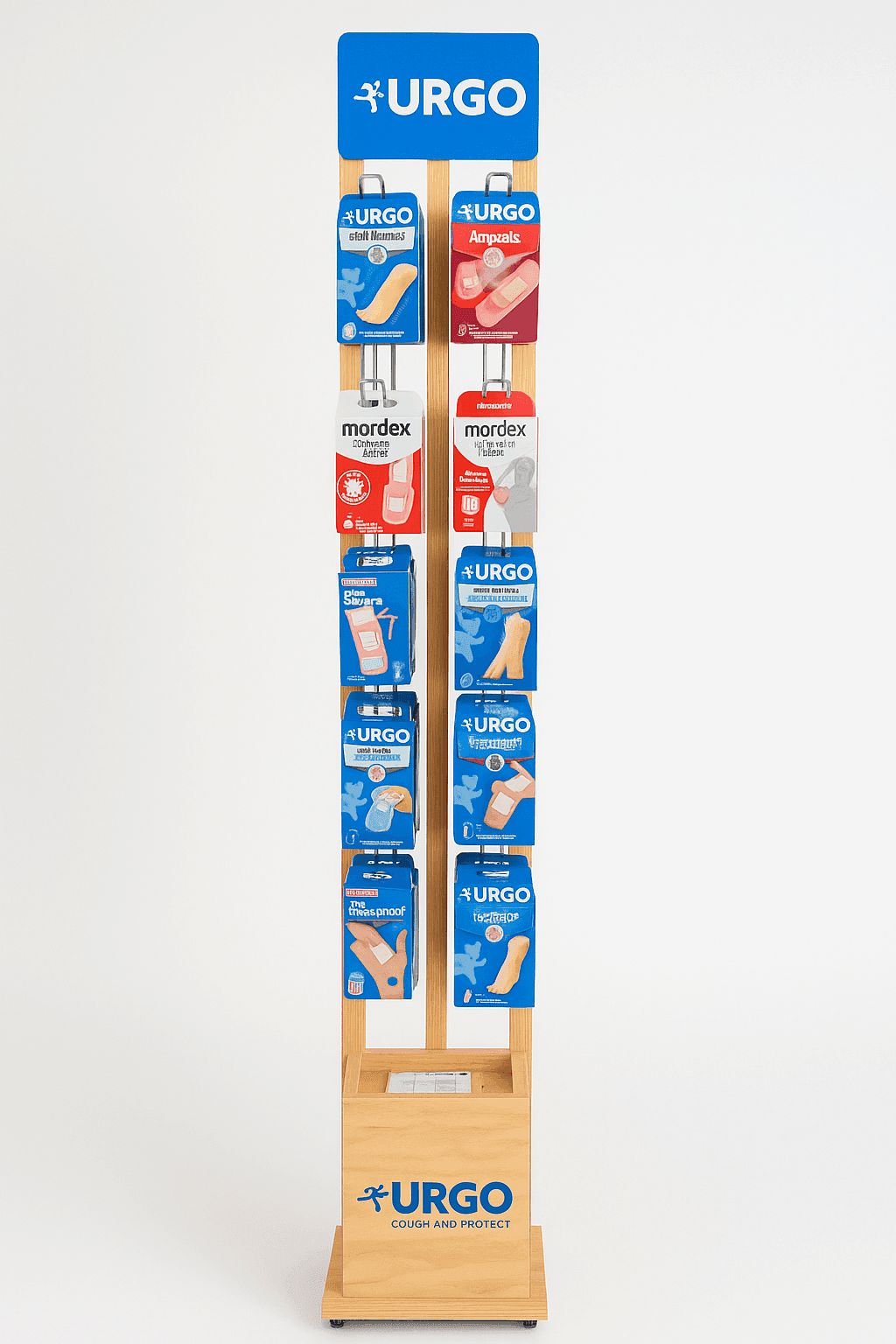
When a company goes looking for a POS display, the first question is usually "how much does it cost and how long does it take?" But behind that question there is a more important one: who handles what? If design goes to your agency, production to a manufacturer, prototyping to yet another supplier, and distribution to your logistics operator, you are coordinating four separate parties with four separate calendars. And when something goes wrong, nobody is responsible for the whole.
Integrated POS display management is the answer to that problem. At Euromon PLV, we work with brands that commission the whole project to us: from the first briefing to in-store delivery, covering design, prototyping, production and logistics. This guide explains what that model covers, how it breaks down into phases, and when it makes sense to require it from your supplier.
What "integrated management" actually means in POS
The word "integrated" carries a lot of weight. It is not enough for a manufacturer to offer services separately if there is no real coordination between them. Integrated management means that a single team, with a single point of contact for the client, controls and synchronises all project phases.
In practice, that covers:
- Briefing and initial consultancy
- Structural and graphic design
- Prototyping and validation
- Series production
- Logistics and distribution
- Storage and stock management (in phased campaign projects)
Here is what each phase actually involves in a real POS project.
Phase 1: Briefing and initial consultancy
Everything starts with a brief, but an integrated manufacturer does not simply receive it: they analyse it, question it, and improve it where needed. Before moving to design, the technical team evaluates whether the concept is manufacturable, whether the chosen material suits the end environment (indoors/outdoors, humidity, customer traffic) and whether the timeline is realistic.
In projects like the one we completed for JUNG, the German electrical mechanism manufacturer, the initial brief called for a countertop wooden display with integrated lighting. The technical review revealed that the original solution required a power cable that could not be concealed at the planned point of sale. Before a single sketch was drawn, we proposed a rechargeable battery variant that preserved the aesthetic and removed the installation problem entirely.
That kind of upfront consultancy is only possible when the same supplier who will manufacture also leads the briefing. When design is closed by your agency before going through the manufacturer, errors frequently reach the prototype stage and have to be resolved under pressure.
Phase 2: Structural and graphic design
Designing a POS display has two dimensions that must be developed in coordination: the structure (shape, materials, load-bearing, assembly) and the graphics (print, colour, typography, branding).
An integrated manufacturer handles both in-house or with validated partners. This matters because a graphic design created without considering the structure can generate production problems: artwork that crosses a die-cut line, a gradient that does not work with the intended printing process, a Pantone colour that has no equivalent in the factory's printing system.
At Euromon PLV we work with 3D design to validate the structure before moving to final artwork. The client sees the complete display, including graphics, in a render before approving the prototype. This cuts one full iteration in most projects and reduces the risk of surprises in the physical piece.
Phase 3: Prototyping and validation
The prototype is the most critical phase of the project: it is where problems are caught before series production begins. An integrated manufacturer builds the prototype in its own facilities, using the same materials and processes as production. A prototype made externally, or built by hand without reproducing industrial processes, does not give the same information.
Prototype validation involves reviewing at least:
- Structural strength: does it hold the product weight without deforming?
- In-store assembly: can retail staff assemble it without tools? How long does it take?
- Graphic accuracy: does colour and print match the brand references?
- Material behaviour: any deformation under humidity or temperature?
For cosmetics projects, such as those we have completed for Furterer, validation also includes reviewing the tolerances of the cavities where products sit: a 2 mm difference can make the product too loose or prevent it from fitting at all.
Once the prototype is validated, the series production timeline is locked. From that point, the project enters a more predictable phase. You can see typical timelines for each phase in our guide on POS display manufacturing lead times.
Phase 4: Series production
Series production is where volume and standardisation come into play. An integrated manufacturer controls the full process: cutting, die-cutting, printing, folding, gluing, assembly and packaging. Each operation has its own quality control checkpoint.
The most common materials at Euromon PLV for series production are:
- Cardboard: fastest and most versatile for short- to medium-duration campaigns. You can read more in our guide on cardboard displays.
- Wood (including Woodprint): for displays requiring greater durability or a premium positioning.
- Metal and composites: for permanent installations or high product-turnover environments.
In projects with multiple SKUs (for example, a product range with five different references on the same display), series production also involves picking management: ensuring each display unit leaves the factory with exactly the right components for that point of sale. This is a point where internal coordination makes the difference between a clean rollout and one full of in-store incidents.
Phase 5: Logistics and distribution
Manufacturing the display well is necessary but not sufficient: it has to reach the store in the right condition, at the right time, with the right documentation. An integrated manufacturer coordinates this phase too.
For single-destination projects, logistics is straightforward. But most large projects involve distribution to multiple points of sale: 50 stores, 500, or sometimes more than 1,000 across different regions or countries. In those cases, logistics management includes:
- Individual packaging per point of sale or region.
- Labelling with destination references.
- Carrier management and delivery tracking.
- Distribution reports so the client knows when and where each unit arrives.
For the Pringles rollout, with simultaneous presence across several store formats, we coordinated distribution of different display models at the same time, ensuring each type of point of sale received the right format. That level of coordination is not possible when logistics is subcontracted to a third party that has not been involved in the project from the start.
Phase 6: Storage and stock management (when applicable)
Some brands work with phased campaigns: they manufacture a larger display volume and distribute it in waves as new markets open or the season changes. In those cases, the manufacturer can also act as an intermediate storage hub.
This phase is not universal (it depends on volume, campaign cadence and the client's own logistics capacity), but it is part of the integrated service when needed. It allows the client to optimise production costs (longer runs equal lower unit cost) without having to manage storage in their own facilities.
When to require integrated management (and when not to)
Integrated management has a coordination cost that pays off in complex projects. It makes no sense for an order of 100 small cardboard countertop displays with a closed design: in that case, a manufacturer who executes production is enough.
It makes strong sense when:
- The project involves more than one material or more than one display format.
- The rollout covers more than 50 points of sale simultaneously.
- There are in-store installation constraints that need validating before production.
- The brief is still open and you need the manufacturer to help close it.
- There are phased campaigns that require synchronising production, storage and distribution over time.
In projects like the ones we have managed for BIC, with simultaneous launches across different channels and formats, the value of having a single accountable partner for the whole is hard to quantify, but any marketing team that has coordinated a complex rollout across multiple suppliers understands it immediately.
How we work at Euromon PLV
At Euromon PLV we manufacture with our own workshop in Barcelona and a supply chain that stays entirely within Catalunya. Prototype and series production run under the control of the same technical team that designed the display, minutes away from our facilities: what is validated in the prototype is exactly what gets produced.
Project management is handled by a dedicated project manager assigned from the initial briefing: the client's single point of contact across all phases. The client does not need to coordinate between design, production and logistics: the project manager does that.
If you want to understand the work process in detail, read our guide on how to work with a POS display manufacturer in Barcelona.
Have a project in mind?
If you are evaluating whether integrated management makes sense for your next POS display project, we can do an initial consultation with no commitment. Tell us what you need and we will give you an honest assessment of which phases make sense to centralise and which ones you can handle yourselves.
Frequently asked questions (FAQ)
Does integrated POS management make projects more expensive? Not necessarily. Centralising coordination with one supplier eliminates friction costs (iterations between agency and manufacturer, miscommunication, cross-party delays) which in complex projects exceed the margin of an integrated supplier.
Can I bring closed final artwork and have Euromon handle only production and logistics? Yes. The degree of integration adapts to what the client already has closed. Some projects arrive with approved final artwork and only need production, prototyping and distribution.
How many points of sale can Euromon manage in a rollout? We have managed rollouts to more than 1,000 points of sale. For projects of that scale, logistics planning starts in parallel with production to optimise delivery timings.
What if a store rejects the display because it does not fit the aisle? The structural design includes measurement validation against the retailer's planograms when the client provides them. If last-minute changes come from the point of sale, we manage the adaptation from production with the minimum impact on timeline.
Post written by the marketing and production team at Euromon PLV. For questions about integrated management on your next POS display project, contact our sales team at euromonplv.com.