When a brand or agency needs custom POS displays, selecting the right manufacturer is just as strategic as designing the display itself. A good POS display manufacturer in Barcelona doesn't just turn a brief into cardboard, wood or metal — they advise on materials, optimise costs, meet deadlines and ensure the final result actually works on the shop floor.
This guide is aimed at marketing managers, procurement directors and brand managers who are facing — often for the first time — the task of selecting a POS display manufacturing partner in the Barcelona area or across Spain.
What to look for in a POS display manufacturer in Barcelona
Not all POS display manufacturers offer the same thing. Before requesting a quote, it is worth reviewing four key areas.
1. Demonstrable experience and portfolio
A manufacturer with real experience should be able to show you actual projects — with brand, product category and point-of-sale context — in sectors similar to yours. If you sell premium cosmetics, a supplier whose main work is supermarket signage is not the right fit. Ask for references in your product category.
At Euromon PLV we have been manufacturing displays for brands such as BIC, Pringles, Furterer and JUNG for over two decades, which gives us a solid understanding of the specific demands of each sector, whether mass-market retail, cosmetics, hardware or pharmacy.
2. Technical capability and available materials
The manufacturer must have mastery of the materials your project requires. The most common in POS display production are:
- Corrugated and micro-flute cardboard: lightweight, cost-effective, recyclable. Ideal for short-duration campaigns or high-volume runs. See our article on self-assembling cardboard displays to understand their advantages.
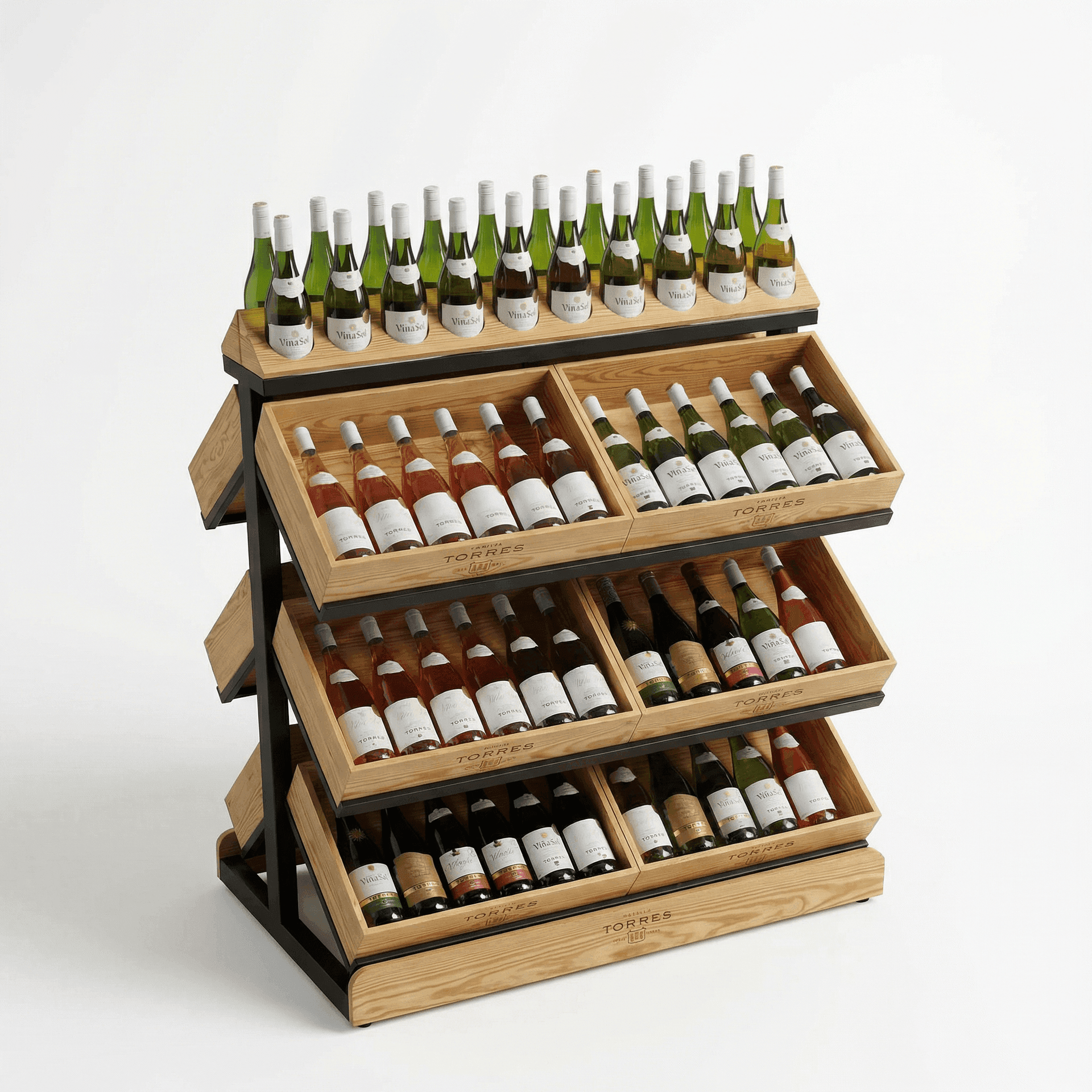
- MDF and natural wood: greater durability and a premium feel. Technologies such as Woodprint allow photographic finishes to be applied directly onto the wood surface.
- Metal: for permanent, high-load displays or intensive-use environments (hardware, appliances, tools).
- Combinations: many projects mix materials to balance cost, structural performance and aesthetics.
A manufacturer that works with all of these materials — and who advises you on which suits your campaign best — is far more valuable than one that specialises in a single substrate.
3. Quality and environmental certifications
Certifications are not just paperwork: they guarantee that the manufacturer has its internal processes under control. The most relevant ones in the POS display industry are:
- ISO 9001: quality management system. Ensures consistency between the approved prototype and the production run.
- ISO 14001: environmental management. Especially important if your brand has sustainability commitments or requires materials with certified chain-of-custody.
- EcoVadis Gold: third-party corporate sustainability rating. Highly valued by major retail groups and brands with ESG policies.
Euromon PLV holds all three certifications, which makes integration as a homologated supplier straightforward for multinationals and retailers that require sustainability audits. If this topic interests you, we explore it in depth in our article on sustainable POS displays.
4. Logistics capability and geographical coverage
A manufacturer in Barcelona with good logistics coverage can distribute across Spain and Portugal within 24–72 hours. Ask whether they also manage distribution to the final point of sale (store rollout), because this simplifies operations considerably when a project involves hundreds or thousands of locations.
The production process, step by step
Understanding how a POS display manufacturer works internally helps you plan your campaigns with enough lead time and avoid errors in the approval chain.
Phase 1: Initial brief
The starting point is always the brief. The more complete it is, the more accurate the proposal and the fewer iterations you will need in later phases. A useful brief includes:
- The product to be displayed (weight, dimensions, number of SKUs).
- Usage environment: floor display, counter unit, shelf unit, gondola, window display?
- Type of point of sale: hypermarket, specialist retailer, pharmacy, hardware store…
- Campaign duration: temporary (4–8 weeks) or permanent (1+ year)?
- Estimated unit volume.
- Critical dates: in-store delivery date, campaign start date.
- Indicative budget or target cost per unit.
With this information, the manufacturer can give you initial guidance on materials, construction and realistic lead times in your first conversation.
Phase 2: Technical proposal and 3D design
Based on the brief, the engineering and design team prepares one or more technical proposals including structural drawings and 3D renders. This phase defines the display's construction, the assembly system and the graphic layout.
This is the moment to check whether the display is easy to assemble in-store (no tools required, intuitive instructions), whether the graphics can be swapped between campaigns to reuse the structure, and whether the design has been optimised for flat-pack transport.
Phase 3: Prototyping and validation
Once the 3D proposal has been approved, a functional prototype is manufactured. This prototype is used to validate the structural performance (does it hold the product's weight?), the assembly process (can a shop assistant put it together in under five minutes?), the graphic finish and corporate colour reproduction.
Prototype sign-off is the most critical moment in the process: a change at this stage is inexpensive; the same change in full production can cost you significant time and money.
Phase 4: Production run
With the prototype approved and signed off, full production begins. At this stage the manufacturer manages material procurement, printing, die-cutting or machining, assembly and packaging. Quality control throughout production ensures that every unit matches the validated prototype.
Phase 5: Logistics and delivery
The display arrives to the client flat-packed or pre-assembled, depending on the design and the logistics agreement. If the project includes distribution to multiple points of sale, the manufacturer can manage warehousing and direct delivery to stores according to the campaign rollout schedule.
Production lead times: what to expect
Lead times vary according to the complexity of the display and the volume of the order. As a general guide, at Euromon PLV we work within these ranges:
- Cardboard prototype: 3–7 working days from drawing approval.
- Wood or metal prototype: 7–15 working days.
- Cardboard production run: 3–5 weeks from prototype sign-off, depending on volume.
- Wood or metal production run: 5–8 weeks.
These are indicative timelines. They can be shortened for urgent orders with a surcharge, or extended if design changes are requested after prototype approval. The key is to start the process well in advance of the campaign launch date: the minimum we recommend for new projects with prototyping is eight weeks.
Questions you should ask before choosing a POS display manufacturer
Before committing to a supplier, these questions help separate the genuinely capable from the merely adequate:
Can you show me displays you have made for brands in my product category? The answer should come with specific real-world examples, not generic catalogues.
What happens if the prototype does not meet my expectations? The revision process and the number of iterations included in the quote should be clear from the outset.
Do you manage in-store distribution? If your rollout involves more than 50 points of sale, a manufacturer with in-house logistics capability or established distribution partnerships will save you significant operational complexity.
Do you hold ISO or EcoVadis certifications? If your company or your client has sustainability commitments, this is not optional.
What quality control process do you apply during production? A serious manufacturer describes their process: sampling methodology, comparison against the approved prototype, and how production incidents are managed.
Reference projects at Euromon PLV
Over the years, we have manufactured POS displays for widely different product categories and contexts. A few examples:
BIC engaged us to develop a micro-flute cardboard counter display for their stationery lines. The challenge: a display that was visually appealing, easy to restock and compatible with the strict visual merchandising standards of major retail chains.
Pringles commissioned a custom wooden tray for impulse-purchase product presentation. The solution combined MDF with Woodprint printing to achieve the premium finish the brand required.
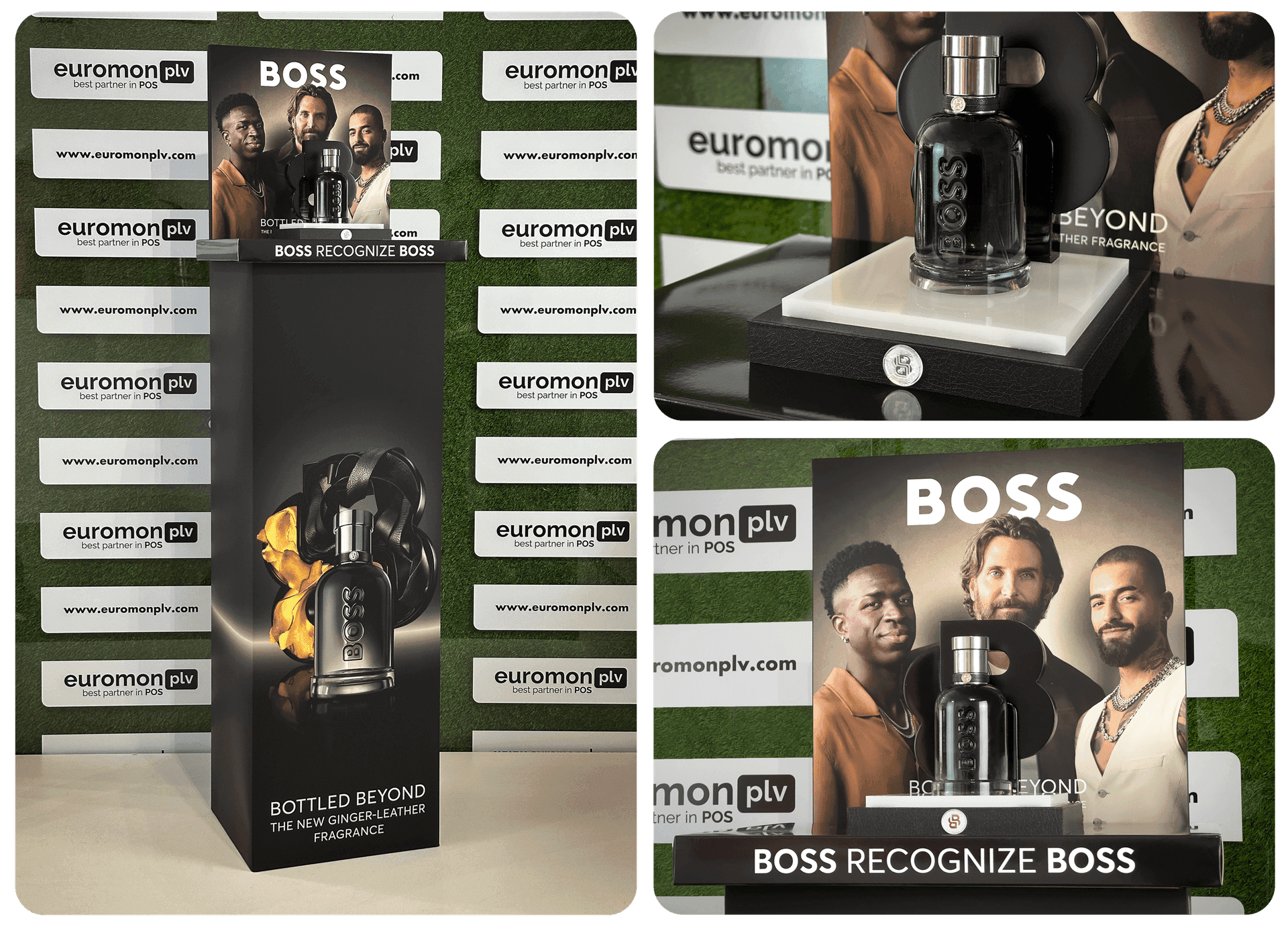
JUNG, a manufacturer of electrical fittings, needed a permanent display with real product samples mounted in place. The solution was a metal display with an adaptable panel, designed for their distributor network.
Furterer required a pharmacy-channel POS display that conveyed the natural character and sophistication of the brand. The result was a counter display in natural-finish wood with high-resolution graphics.
Each of these projects went through the full process: brief, proposal, prototyping, production and logistics. And in every case, the final result matched the approved prototype — because that is what a certified quality management system delivers.
Ready to get started?
If you are evaluating POS display manufacturers in Barcelona for your next campaign, the Euromon PLV team is happy to review your project with no commitment. We can advise on materials, timelines and budget from the very first conversation.
Frequently asked questions (FAQ)
What is the difference between a POS display manufacturer and a design agency? The manufacturer physically produces the display. The design agency creates the visual concept. Many manufacturers, including Euromon PLV, have an in-house design team that works integrated with production, which simplifies the process and reduces interpretation errors between design and manufacturing.
Do I need to have the graphic design finalised before contacting a manufacturer? No. In fact, it is advisable to get in touch earlier: the manufacturer can advise you on which structures are most efficient for your product and budget, and the design team can create finished artwork adapted to the technical production templates.
What is the minimum production volume? It depends on the material and complexity. For cardboard, minimum orders typically start at 100–200 units. For wood or metal, prototype manufacturing makes sense from small quantities, but production runs are cost-optimised from 50–100 units upward.
Can I reuse the display structure for different campaigns? Yes, as long as the display is designed with that modularity in mind from the outset. It is possible to design permanent structures with interchangeable graphics, which reduces the per-campaign cost and the environmental impact of the overall programme.
Do you ship outside Spain? Yes. Euromon PLV works with clients across Europe. International logistics are managed on a project-by-project basis depending on volume and destination.
Post written by the Euromon PLV marketing team. For technical enquiries about display manufacturing, contact our commercial team at euromonplv.com.